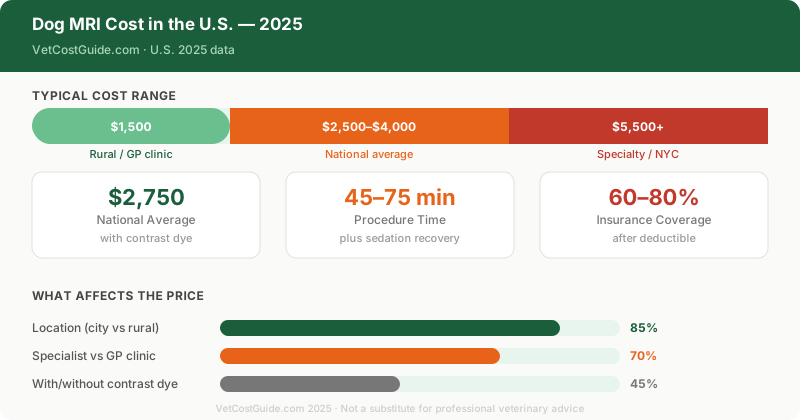
Sudden hind-leg weakness. A seizure out of nowhere. A head tilt that’s been there for three days and isn’t resolving. These are the symptoms that end with a neurologist handing you an MRI estimate. The number on that estimate — $1,500 to $5,000 — surprises most owners. It shouldn’t. Veterinary MRI is a full general anesthesia event with board-certified radiologist interpretation, carried out on equipment that costs the facility $500,000 to $2 million to own. Once you understand what’s in the price, it makes more sense — though it doesn’t necessarily make it easier to pay.
- A dog MRI costs $1,500–$5,000 at most US specialty clinics in 2025.
- Brain and spinal cord scans are the most common — and most expensive — regions imaged.
- Anesthesia adds $300–$800 and is almost always required for dogs.
- University veterinary teaching hospitals charge 30–50% less than private specialty clinics.
- Mobile MRI units are expanding access in rural areas, often at $1,200–$2,000.
2025 Price Ranges by Scan Type
Prices vary by region, facility type, and body area. Here’s what you can realistically expect across the US.
| Scan Type | Low | Average | High |
|---|---|---|---|
| Brain MRI | $1,500 | $2,800 | $4,500 |
| Spinal (single region) | $1,500 | $2,600 | $4,200 |
| Full Spine MRI | $2,000 | $3,500 | $5,000 |
| Musculoskeletal (limb) | $1,200 | $2,000 | $3,500 |
| Anesthesia (included or add-on) | $300 | $550 | $800 |
| University/Teaching Hospital | $1,000 | $1,800 | $2,800 |
| Mobile MRI Unit | $1,200 | $1,600 | $2,200 |
What’s Actually In That Invoice
A veterinary MRI invoice at a specialty center covers the scan itself, the radiologist’s interpretation, and a written report to your primary vet. The scan takes 45–90 minutes of machine time, and for most dogs that means a full general anesthetic — sometimes bundled into the MRI fee, sometimes billed separately. Always ask for an all-in quote before booking.
What you’re paying for isn’t just the magnetic field. It’s the read. Board-certified veterinary radiologists distinguish subtle signal changes that identify early disc herniation, a brain tumor, inflammatory disease, or infarction — findings that are simply invisible on X-ray or CT. That expertise is expensive and genuinely matters.
“Contrast MRI” uses a gadolinium agent injected mid-scan to highlight blood-brain barrier disruption. It’s standard for suspected tumors or inflammatory disease and adds $100–$250 to the bill. In dogs with kidney disease, the neurologist will discuss gadolinium risk ahead of time.
Pre-MRI bloodwork for anesthesia clearance is usually billed separately — typically $80–$200. Most facilities require recent chemistry and CBC panels, within 30 days, before scheduling.
The Variables That Move the Price
Facility type. Private neurology or radiology specialty clinics carry the full capital cost of MRI equipment. University veterinary teaching hospitals subsidize that overhead with educational funding and charge 30–50% less for equivalent imaging quality.
Geographic location. New York, Los Angeles, Chicago, and Seattle run 20–35% above national averages. The same scan that costs $2,200 in Kansas City may cost $3,400 in Manhattan.
Body region. A full-spine MRI covering cervical, thoracic, and lumbar regions can double the cost of a single-region scan. Brain imaging has its own protocol with longer times than a joint scan.
Dog size. Larger dogs need higher anesthesia doses and sometimes longer scan times to get adequate image quality. A Great Dane costs more to image than a Beagle, in part because of anesthesia volume.
Urgency. Emergency or after-hours MRI at a 24-hour specialty hospital carries a 25–40% premium above standard daytime rates.
- Unbundled anesthesia fees. Some clinics quote MRI prices without anesthesia. Always ask for an all-in estimate before you commit — the add-on can be $500–$800.
- CT first, MRI second. Some referral hospitals will recommend CT before MRI for certain conditions. Two separate imaging bills can quickly reach $5,000+. Ask whether one modality is sufficient for the initial diagnosis.
- Specialist consultation fees. The MRI referral often triggers a neurologist consultation charge of $150–$400 on top of the imaging fee. Confirm what’s included in your estimate.
Should You Have Pet Insurance for This?
If your dog is under seven and in good health, pet insurance covering diagnostics is worth the monthly premium specifically because MRI is the kind of unexpected four-figure bill that forces impossible decisions. Most comprehensive plans — Trupanion, Healthy Paws, Figo — cover MRI under diagnostics or illness benefits after the deductible, with 70–90% reimbursement. On a $3,000 MRI, that’s $2,100–$2,700 back after a $300 deductible.
The limitation is pre-existing conditions. Insurers won’t cover MRI for neurological symptoms if your dog has prior documented spinal or neurological issues. If you’re reading this after symptoms are already present, insurance won’t help this time around — but it protects against the next condition.
How to Reduce What You Pay
University veterinary hospitals. UC Davis, Cornell, Colorado State, and Tufts run full specialty neurology services at significantly lower rates. Residents are supervised by board-certified neurologists and radiologists; imaging quality is equivalent.
Mobile MRI units. Companies like Alliance Mobile Vet MRI operate trailer-mounted units that rotate between participating clinics on scheduled days. Shared overhead makes their pricing competitive — often $1,200–$2,000.
Request a written itemized estimate. Before signing consent forms, ask for line-item pricing. You can sometimes decline add-ons like contrast dye if the neurologist agrees it’s not critical for your specific case.
Look at payment plans. Most specialty hospitals accept CareCredit or Scratchpay at 0% interest for 6–12 months. A $3,000 MRI becomes $250–$500/month — still real money, but manageable for most budgets.
Ask whether CT is sufficient. For some conditions, a CT scan ($800–$2,000) provides enough diagnostic information to guide treatment without the cost of MRI. Your neurologist may agree CT is a reasonable first step and holds MRI for confirmation if needed.
Frequently Asked Questions
Does my dog need to be sedated for an MRI? Yes, almost always. Dogs can’t remain motionless for 45–90 minutes voluntarily, and even slight movement ruins image quality. General anesthesia is standard, administered and monitored by a veterinary anesthesiologist or trained technician.
How long does a dog MRI take from check-in to discharge? Plan for 3–5 hours total. Pre-anesthesia prep, the scan itself, and recovery from anesthesia all add time. Most dogs go home the same day and are fully alert within a few hours of the scan completing.
Is a dog MRI as good as a human MRI? Veterinary MRI uses the same physics and similar magnetic field strengths (1.0–3.0 Tesla) as human machines. Interpretation is performed by board-certified veterinary radiologists with specialized training in animal neuroanatomy.
What happens if I can’t afford an MRI? Talk openly with your vet. In some neurological cases, a CT scan, spinal tap (CSF analysis), or trial treatment may provide enough diagnostic information to move forward. Your vet can walk you through the clinical tradeoffs of each option based on your dog’s specific presentation.
Frequently Asked Questions
A dog MRI typically costs $1,500 to $5,000 in the US, with most facilities charging between $2,000 and $3,500. The final price depends on your location, the facility's equipment and expertise, the number of body regions scanned, and whether a board-certified radiologist's interpretation is included.
Most pet insurance plans cover MRI as a diagnostic procedure, typically reimbursing 70–90% after you meet your deductible, though some plans may apply annual limits or exclude certain conditions. Out-of-pocket costs usually range from $300 to $1,500 depending on your deductible and reimbursement level, but uninsured owners pay the full $1,500–$5,000 upfront.
The MRI scan itself takes 30–60 minutes, but your dog will be under general anesthesia for 1.5–3 hours total (including prep and recovery time). Most dogs wake within 2–4 hours and can go home the same day, though they may be groggy or have a mild sore throat from intubation; full recovery typically occurs within 24 hours.