In 2010, dietary dissolution was the go-to for most feline bladder stones. Today, the approach has shifted significantly — and knowing why can save you from a $1,500 surgery or, worse, a $3,000 emergency when a stone causes a blockage. The type of stone your cat has determines everything about treatment. Here’s where costs stand now.
- Urinalysis + culture: $60–$150
- X-rays to detect stones: $150–$350
- Ultrasound (better for soft stones): $200–$500
- Stone analysis (after removal): $50–$100
- Prescription dissolution diet (struvite): $50–$90/month
- Cystotomy (surgical removal): $1,200–$3,000
- Voiding urohydropropulsion (non-surgical): $200–$500
- Follow-up imaging: $150–$350
Two Stone Types, Two Very Different Approaches
Feline uroliths (bladder stones) are predominantly either:
Struvite (magnesium ammonium phosphate): Most common in cats, especially females. Often dissolve on a prescription acidifying diet in 4–12 weeks. No surgery needed in uncomplicated cases.
Calcium oxalate: The second most common type. Cannot be dissolved with diet — surgical or non-surgical removal is required. More common in older cats and males.
The stone type can’t be determined without either:
- Lab analysis of a retrieved stone (most definitive)
- Imaging characteristics (size, density, shape — suggestive but not definitive)
- Urine pH and crystalluria (supportive but not diagnostic)
This distinction is the most important thing to understand about feline bladder stone costs. Assuming struvite and trying a dissolution diet on calcium oxalate stones delays treatment by weeks and doesn’t work — potentially allowing a stone to grow while you wait.
Diagnosis Costs
| Diagnostic Step | Typical Cost | Purpose |
|---|---|---|
| Urinalysis | $40–$80 | pH, crystals, blood, infection |
| Urine culture and sensitivity | $60–$120 | Rules out concurrent UTI |
| Abdominal X-rays | $150–$350 | Detects radiodense stones (struvite, oxalate) |
| Abdominal ultrasound | $200–$500 | Better for soft/radiolucent stones |
| Stone analysis | $50–$100 | Definitive composition after retrieval |
| Blood panel | $80–$200 | Kidney function, metabolic evaluation |
Some vets use survey radiographs first because most feline uroliths are radiodense (visible on X-ray). Ultrasound is added when X-rays are negative but stones are still suspected, or when soft-tissue evaluation of the kidneys and ureters matters.
Treatment Options and Costs
Dietary Dissolution (Struvite Only)
For confirmed or highly suspected struvite stones without obstruction risk:
- Prescription dissolution diet (Hills s/d or Royal Canin Urinary SO — Dissolution formula): $50–$90/month
- Duration: typically 4–12 weeks
- Follow-up X-ray or ultrasound at 4 weeks to confirm progress: $150–$350
Total cost of successful dietary dissolution: $300–$600
This is the most cost-effective path — when it works. The catch: cats must eat only the dissolution diet (no treats, no other food), and the cat must actually eat it. Cats being cats, some refuse prescription foods entirely.
Voiding Urohydropropulsion (Non-Surgical Flushing)
Small stones (typically under 3mm) can sometimes be flushed out under sedation by filling the bladder and manually compressing it to void the stones. This technique works when:
- Stones are small enough to pass through the urethra (female cats have wider urethras than males)
- Multiple small stones are present rather than one large stone
Cost: $200–$500 including sedation. Not widely offered but increasingly used in practices comfortable with the technique.
Cystotomy (Surgical Removal)
Surgery is required for:
- Calcium oxalate stones (can’t dissolve)
- Large struvite stones (too big to dissolve quickly or pass)
- Any stone in a male cat (urethral obstruction risk makes waiting dangerous)
- Failed dissolution attempts
- Concurrent obstruction
| Cystotomy Component | Typical Cost |
|---|---|
| Pre-surgical blood panel | $80–$180 |
| Pre-anesthetic exam | $50–$80 |
| Anesthesia | $200–$400 |
| Surgery (cystotomy) | $800–$1,800 |
| Hospitalization (1–2 days) | $200–$600 |
| Stone analysis | $50–$100 |
| Post-op pain medications | $30–$60 |
| Follow-up imaging (4–6 weeks) | $150–$350 |
Total cystotomy cost: $1,200–$3,000 at a general practice. Referral to a surgical specialist can reach $3,500–$5,000.
Male cats with bladder stones have a different and more urgent situation than females. Male cats have a much narrower urethra — stones or mucus plugs can cause complete urinary obstruction, a life-threatening emergency. If your male cat is straining to urinate, posturing without producing urine, or crying while trying to urinate, go to an emergency vet immediately. Obstruction causes fatal electrolyte imbalances within 24–72 hours.
Prevention and Recurrence Costs
Cats who form struvite stones once often form them again. Long-term dietary management significantly reduces recurrence:
- Prescription urinary maintenance diet: $40–$75/month ongoing
- Increased water intake (wet food, water fountains): $0–$30/month
- Urine monitoring every 6 months: $40–$80 per urinalysis
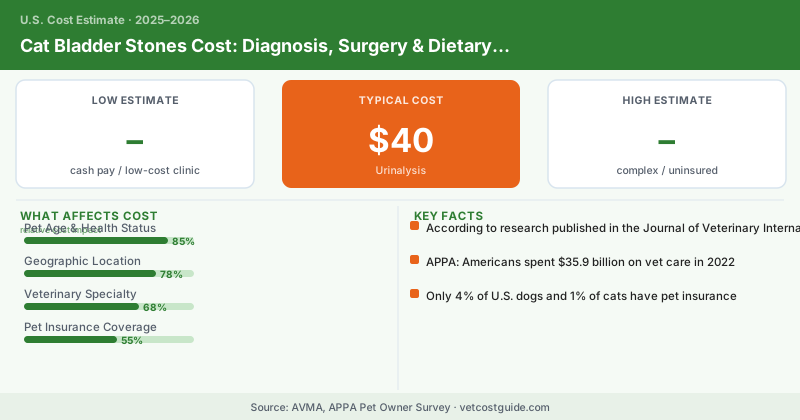
According to research published in the Journal of Veterinary Internal Medicine, dietary management reduces struvite recurrence rates from approximately 50% to under 15% over 12 months. For calcium oxalate stones, preventing recurrence involves dietary phosphorus restriction, urinary alkalinization, and sometimes potassium citrate supplementation.
Annual prevention costs (diet + monitoring): $500–$1,200/year
When Weight and Diet Play a Role
Obese cats have higher rates of urolith formation. The American Association of Feline Practitioners (AAFP) 2021 Guidelines note that increasing water intake — through wet food, water fountains, or even slightly warming water — significantly reduces urine specific gravity and mineral concentration, the key factor in stone formation.
If your cat currently eats only dry food, transitioning to wet food (or adding wet food) costs $20–$60/month more but is one of the most effective preventive steps for cats prone to urinary disease.
Total Cost Scenarios
First struvite stones, dissolved with diet, no recurrence:
- Diagnosis + diet + follow-up: $400–$700
- Total: $400–$700
Calcium oxalate stones requiring surgery:
- Diagnosis + cystotomy + recovery: $1,500–$3,500
- Long-term prevention diet: $40–$75/month
- Year one total: $2,000–$4,500
Recurrent stones with ongoing management:
- Surgery + prevention diet + semi-annual urinalysis: $600–$1,800/year after year one
Frequently Asked Questions
Diagnostic costs typically range from $410–$650 total, including urinalysis and culture ($60–$150), X-rays ($150–$350), and ultrasound ($200–$300 if needed). Ultrasound is often preferred over X-rays for detecting soft stones, though both may be used together for a complete diagnosis.
Most pet insurance plans cover bladder stone diagnosis and treatment, but coverage varies by provider and policy—some exclude pre-existing conditions or stone-related procedures entirely. You should expect to pay your deductible (typically $250–$500) plus coinsurance (10–20%) before insurance reimburses the rest, meaning out-of-pocket costs for surgery could be $300–$1,000 even with coverage.
Dietary dissolution can work for certain stone types (like struvite stones) and costs significantly less than surgery, but it typically takes 4–12 weeks and requires strict dietary compliance and frequent monitoring. If your cat has a urinary blockage, calcium oxalate stones, or fails to respond to diet within 6–8 weeks, surgery becomes necessary, costing $1,500–$3,000, or $3,000+ in emergency situations.