42% of all cat fractures in the U.S. result from being hit by a vehicle — making this one of the most common traumatic emergencies in feline medicine. The other leading causes are falls from height (high-rise syndrome), dog attacks, and accidental trapping in doors. If your cat comes home limping, not bearing weight on a leg, or in obvious pain after any trauma, you’re looking at a probable fracture — and the cost question is immediate.
Here’s what fracture repair actually costs, which factors push the price up, and when the treatment options differ significantly from what you’d expect.
Cat Fracture Repair Cost Overview
| Fracture Type / Treatment | Low | Typical | High |
|---|---|---|---|
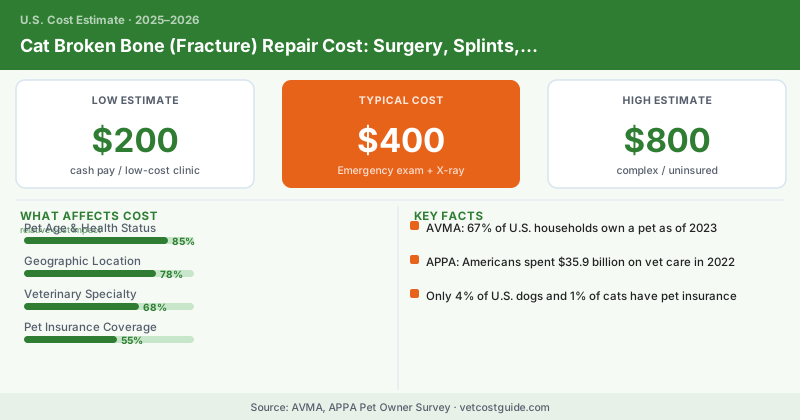
| Emergency exam + X-rays (diagnosis) | $200 | $400 | $800 |
| Simple limb fracture — splinting only | $300 | $600 | $1,000 |
| Simple fracture — surgical repair (plates/pins) | $1,500 | $2,500 | $4,000 |
| Complex or comminuted fracture | $2,500 | $3,500 | $6,000 |
| Pelvic fracture (conservative management) | $400 | $800 | $1,500 |
| Pelvic fracture — surgical repair | $2,000 | $3,500 | $6,000 |
| Spinal fracture (stabilization/surgery) | $3,000 | $5,000 | $10,000+ |
| Post-op rechecks + X-rays (2–3 visits) | $300 | $600 | $1,200 |
The First 24 Hours: Emergency and Diagnosis
A fractured cat needs emergency care — not a “wait until tomorrow” situation. Pain management begins immediately, and X-rays confirm the fracture type, location, and severity. Most emergency practices require:
- Emergency exam: $100–$250 at an emergency animal hospital
- X-rays (radiographs): 2–4 views of the affected area at $150–$400
- Pain management (injectable opioids, NSAIDs): $50–$150
- Wound care if the fracture is open (bone through skin): $100–$300 for initial cleaning and bandaging
The AVMA recommends that suspected fractures always be X-rayed before manipulation — what looks like a simple displaced fracture may be comminuted (shattered into multiple pieces) or involve a growth plate in young cats, which changes the repair approach entirely.
- Simple (transverse or oblique): clean break across the bone — best candidates for surgical repair with plates/pins
- Comminuted: bone in multiple fragments — more complex fixation required, higher cost
- Open (compound) fracture: bone has broken through skin — infection risk is high, requires emergency debridement
- Growth plate fracture (Salter-Harris): in kittens under 12 months — requires specialized repair to avoid long-term deformity
- Pathologic fracture: broken bone with no major trauma — possible bone tumor, requires additional diagnostics
Splinting vs. Surgery: The Core Decision
Not every cat fracture requires surgery. Whether your cat goes into the OR depends on the fracture location, the fracture type, and your cat’s overall health.
Splinting/conservative management works for:
- Stable, non-displaced fractures of the lower limb (tibia, radius, ulna — below the “knee” or “elbow”)
- Pelvic fractures where the cat is still able to urinate and defecate (minor pelvic fractures often heal with cage rest alone)
- Cats too systemically ill for anesthesia
Splinting involves weekly bandage changes for 6–8 weeks and carries real risks: bandage sores, pressure wounds, and incorrect healing that may require surgery anyway. The “cheap” option isn’t always the right option.
Surgical repair is typically required for:
- Fractures above the knee or elbow (femur, humerus) — these don’t splint well at all
- Any fracture where bone is displaced or unstable
- Open fractures (infection risk makes delayed surgery dangerous)
- Comminuted fractures where bone fragments need to be held in alignment
- Young cats where growth plate involvement is present
Surgical fixation methods include:
- Intramedullary (IM) pins: a pin placed down the center of the bone — typically used for simple femur or humerus fractures. Less expensive.
- Bone plates and screws: more rigid fixation for complex or high-stress fractures — more expensive but better long-term outcome in many cases.
- External skeletal fixation (ESF): pins through the bone connected by an external frame — used for open fractures and complex cases.
Cost by Fracture Location
Location changes everything about what treatment is possible and what it costs:
Lower limb (radius, ulna, tibia, fibula): Below the knee/elbow. These may splint successfully, making them the most economical to treat. Splinting: $300–$1,000 over the full bandage change course. Surgical repair if needed: $1,500–$3,000.
Femur (thigh bone): The most common fracture site in hit-by-car injuries. Femur fractures almost always require surgery — you can’t effectively splint a femur. Intramedullary pinning: $1,200–$2,500. Plate fixation: $2,000–$4,000.
Humerus (upper front leg): Similar to femur — splinting rarely achieves adequate stability. Expect surgical repair at $1,500–$3,500.
Pelvis: Range is wide. Minor pelvic fractures with normal urinary/GI function may heal with 4–6 weeks of strict cage rest ($200–$500 in rechecks). Severe pelvic fractures requiring surgical reconstruction: $2,000–$5,000.
Spine: The most serious category. Spinal fractures may cause nerve damage or paralysis. If the spinal cord isn’t severed, surgical stabilization can preserve or restore function. Spinal stabilization surgery: $3,000–$8,000+, often at a specialty referral center.
Open fractures — where bone is visible through a skin wound — are a surgical emergency, not a “wait until morning” situation. The contamination clock starts the moment bone is exposed. Infection in a fractured bone (osteomyelitis) is difficult to treat, may require limb amputation, and can be life-threatening. If your cat has an open fracture, get to an emergency vet within hours, not the next day.
Amputation: When It’s the Right Answer
For some fractures — particularly severely comminuted fractures in the lower limb, or cases where blood supply to the limb is compromised — amputation is the most appropriate and most economical option. A three-legged cat adapts remarkably well. Cats compensate for limb loss better than most owners expect, returning to near-normal activity within weeks.
Amputation costs $1,000–$2,500, significantly less than complex multi-surgery fracture repair. When a vet recommends amputation for an unrepairable fracture, it’s not giving up — it’s often the fastest, least painful path to a functional, comfortable life.
Recovery Costs After Fracture Repair
Surgery isn’t the end of the bill. Factor in:
- Post-operative rechecks: 2–3 visits over 8–12 weeks at $100–$200 each, including repeat radiographs to confirm bone healing
- Strict cage rest (8–12 weeks): a cat-sized recovery cage ($50–$120) is essential — cats don’t naturally rest, and overactivity is the primary cause of implant failure
- Pain medication: typically $30–$80 for a 2–3 week post-op course
- E-collar: $15–$30 to prevent licking of the incision
- Bandage changes (if splinting): $50–$120 per change, weekly for 6–8 weeks — this adds $300–$700 to the total cost of splinting
Does Pet Insurance Cover Cat Fractures?
Yes — fractures from trauma are covered under all comprehensive accident and illness pet insurance plans. Since fractures result from sudden accidents, they’re not typically excluded as pre-existing conditions unless your cat had a prior fracture at that location. The main caveat is waiting periods — most accident coverage kicks in 24–48 hours after policy activation. If your cat was just hit by a car and you don’t have insurance, this is when CareCredit for vet bills and vet payment plans become essential tools.
For indoor-outdoor cats, accident-only coverage is also available at $10–$20/month — a reasonable hedge given that vehicle strikes are the leading cause of fractures in cats.
The Bottom Line
Cat fracture repair costs $300–$1,000 for conservatively managed lower-limb fractures and $1,500–$5,000 for surgical repair of the femur, humerus, or pelvis. Open fractures, spinal fractures, and comminuted cases push costs to $5,000–$10,000+. Emergency diagnosis (X-rays and pain management) runs $200–$600 before any repair begins. The key decision point is always location: lower-limb fractures have splinting as an option; upper-limb fractures almost always require surgery. When repair cost is truly prohibitive, amputation at $1,000–$2,500 is a legitimate, humane alternative with excellent quality-of-life outcomes for most cats.
Frequently Asked Questions
Surgical repair for cat fractures typically costs $1,500–$5,000, depending on the bone location, fracture complexity, and your veterinary clinic's location. Urban clinics and emergency veterinary hospitals generally charge at the higher end of this range, while rural practices may be closer to $1,500–$2,500.
Most pet insurance plans cover fracture repair as an accident claim, though you'll typically pay 10–20% coinsurance after meeting your deductible ($250–$500). However, pre-existing conditions and certain hereditary bone disorders are commonly excluded, so review your specific policy before filing a claim.
Splinting costs $300–$800 and works for simple, non-displaced fractures in stable bones, with healing taking 4–6 weeks. Surgical repair ($1,500–$5,000) is necessary for complex, displaced, or weight-bearing bone fractures and typically heals faster (6–8 weeks) with better long-term outcomes, though it requires anesthesia and post-operative pain management.