Most people assume a feline leukemia virus diagnosis is a death sentence. It’s not. The Cornell Feline Health Center estimates that roughly 70% of cats exposed to FeLV will either eliminate the virus or develop latent infection — and even cats with persistent FeLV can live years with appropriate care. The question isn’t just how long — it’s how you’ll manage the costs that come with it.
What FeLV Treatment and Management Costs
There’s no cure for FeLV. What you’re managing is the cat’s immune system health and the secondary infections and complications that FeLV allows. Costs depend almost entirely on which complications develop.
| Service/Treatment | Typical Cost | Frequency |
|---|---|---|
| FeLV/FIV Combo Test | $30–$60 | At diagnosis and annually |
| Wellness Exam (FeLV-positive cat) | $55–$120 | Every 6 months recommended |
| Complete Blood Count (CBC) | $80–$180 | Every 6–12 months |
| Chemistry Panel (organ function) | $100–$200 | Every 6–12 months |
| Antibiotic Course (respiratory/dental infection) | $40–$120 | As needed |
| Immune-stimulant medications (interferon) | $30–$80/month | If prescribed |
| Appetite stimulants (mirtazapine) | $15–$40/month | As needed |
| Anemia treatment (Epogen/darbepoetin) | $100–$400/month | If anemia develops |
| Lymphoma chemotherapy | $1,500–$5,000 total | If lymphoma develops |
| Palliative/hospice care | $200–$1,000 | End of life |
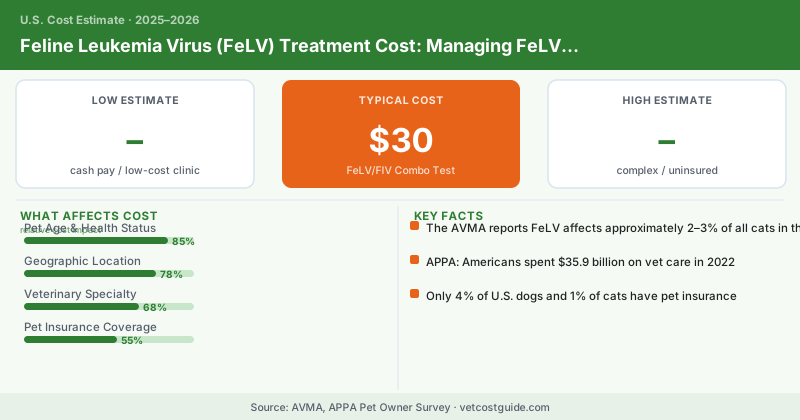
The AVMA reports FeLV affects approximately 2–3% of all cats in the United States — higher in outdoor cats and multi-cat households. It’s the most common cause of cancer in cats and a leading cause of death in young cats.
Understanding What FeLV Does
FeLV is a retrovirus that suppresses the immune system and can cause:
- Anemia — the most common complication, ranging from mild to life-threatening
- Lymphoma — FeLV-positive cats develop lymphoma at rates significantly higher than FeLV-negative cats
- Secondary infections — respiratory infections, dental disease, skin infections that healthy cats fight off easily
- Immune-mediated disease — the immune dysfunction can turn the immune system against the cat’s own tissues
The virus is passed through saliva, nasal secretions, urine, feces, and milk — cat fights, shared food bowls, and mutual grooming are the main transmission routes.
When a cat is exposed to FeLV, three outcomes are possible:
- Abortive infection (~30% of exposed cats): The cat’s immune system clears the virus entirely. These cats develop immunity. No ongoing treatment needed.
- Regressive infection (~30–40%): The virus goes latent in bone marrow. The cat tests negative on standard snap tests but carries dormant virus. May or may not activate. Requires monitoring.
- Progressive infection (~30–40%): The virus replicates persistently. This is what most people mean when they say a cat “has FeLV.” These cats need ongoing monitoring and management of secondary conditions.
A single positive snap test result should always be confirmed with an IFA (immunofluorescence assay) or PCR test to determine which category your cat falls into.
Annual Management Costs for an FeLV-Positive Cat
For a cat with progressive FeLV that’s currently healthy, the core annual costs look like this:
- 2 wellness exams per year: $110–$240
- 2 CBC + chemistry panels: $360–$760
- Vaccination for other preventable diseases (do vaccinate — immune support matters): $80–$150
- Any intercurrent illnesses (1–2 treated infections per year): $100–$400 average
Baseline healthy FeLV-positive cat: $650–$1,550/year
When complications develop, costs climb steeply:
- Anemia requiring treatment: Add $1,200–$5,000/year
- Lymphoma (most common FeLV complication): $1,500–$5,000+ for treatment
- Frequent hospitalizations: $500–$2,500 per episode
Some owners choose quality-of-life focused management without aggressive treatment when serious complications arise — keeping the cat comfortable, controlling pain and secondary infections, without chemotherapy or blood transfusions. This is a valid choice and significantly reduces costs.
The FeLV Vaccine — And Why It Matters for Other Cats in Your Home
There’s an approved FeLV vaccine. It’s not 100% effective, but it substantially reduces the risk of infection. The AVMA and AAFP (American Association of Feline Practitioners) classify it as a “non-core” vaccine recommended for cats with outdoor access or exposure to FeLV-positive cats.
If you adopt an FeLV-positive cat and have other cats at home, those cats should be tested and vaccinated. Keep FeLV-positive cats as indoor-only — not only to reduce transmission to other cats, but because outdoor exposure to secondary infections is dangerous for their compromised immune systems.
Vaccine cost: $20–$40 per dose, two doses initially then annual boosters.
Should You Adopt an FeLV-Positive Cat?
Many rescue organizations specifically place FeLV-positive cats in single-cat homes or with other FeLV-positive cats. These cats aren’t unadoptable — they’re cats with a chronic condition requiring informed management.
The honest conversation: FeLV-positive cats have shorter median lifespans than FeLV-negative cats. But “shorter median” doesn’t mean “short.” Many FeLV-positive cats live 5–8+ years after diagnosis with appropriate care. The costs are manageable if you know what you’re getting into and budget accordingly.
Do not skip the bi-annual wellness exams for an FeLV-positive cat, even when they seem healthy. Early detection of anemia (via CBC) and early treatment of infections prevents the rapid deterioration that can happen when FeLV-positive cats are monitored only when visibly sick. The $150–$250 for an exam and bloodwork twice a year is far less costly than an emergency hospitalization for a crisis that could have been caught earlier.
Pet Insurance and FeLV
Standard pet insurance won’t cover FeLV if it was diagnosed before enrollment — or sometimes even if a prior exam noted any symptoms consistent with immune compromise. If you’re adopting a young cat and plan to get insurance, test for FeLV before enrolling, and if the cat tests positive, understand that FeLV-related conditions are likely to be excluded.
Some newer insurers (Trupanion’s unlimited coverage model, Embrace’s flexible riders) are more nuanced about pre-existing conditions, particularly for conditions that were managed well before the policy term. Read the fine print carefully before assuming FeLV complications will be covered.
Frequently Asked Questions
Initial FeLV testing typically costs $50–$150 per test, with most vets recommending both an ELISA and Western blot test to confirm diagnosis, bringing total diagnostic costs to $100–$300. Follow-up blood work to monitor your cat's immune system may run $75–$200 per visit, usually needed 2–4 times yearly depending on your cat's condition.
Most pet insurance policies exclude coverage for FeLV since it's considered a pre-existing condition if diagnosed before enrollment, though some insurers may cover secondary infections or conditions arising from FeLV if the policy was active before diagnosis. You'll typically pay out-of-pocket for routine FeLV management, including blood work, medications, and supportive care, which averages $500–$3,000 annually depending on secondary health issues.
Most veterinarians recommend blood work and check-ups every 3–6 months for cats with FeLV to monitor white blood cell counts and watch for secondary infections, though cats with complications may need visits every 4–8 weeks. Regular monitoring costs $150–$400 per visit including exam fees and bloodwork, making ongoing care a significant long-term expense even for stable FeLV cases.