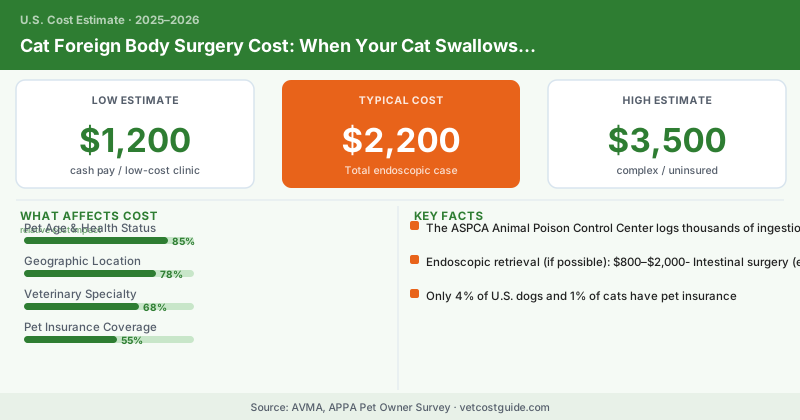
That hair tie you left on the bathroom counter? Gone. Your cat ate it — and you didn’t notice until the vomiting started. Foreign body ingestion in cats is more common than most owners realize, and string/linear foreign bodies (the kind cats love to chew) are the most dangerous category. The ASPCA Animal Poison Control Center logs thousands of ingestion incidents annually, and surgical cases average $1,500–$3,500 before you factor in hospitalization.
- Endoscopic retrieval (if possible): $800–$2,000
- Intestinal surgery (enterotomy or resection): $1,500–$4,500
- Hospitalization post-surgery (2–4 days): adds $600–$2,000
- The ASPCA notes that linear foreign bodies (string, thread, rubber bands, hair ties) cause the most severe intestinal damage and highest surgical complication rates in cats
- Cats are the #1 species for linear foreign body ingestion — their tongue structure (retroflexed papillae) makes it physically difficult to spit out string once it’s past the tip of the tongue
- Delay in treatment increases the risk of intestinal perforation and septic peritonitis, which can double the total treatment cost
Cat Foreign Body Surgery Cost Breakdown
| Service | Low | Average | High |
|---|---|---|---|
| ER exam + X-rays (2–3 views) | $200 | $400 | $700 |
| Abdominal ultrasound | $200 | $350 | $600 |
| Endoscopic retrieval (stomach) | $800 | $1,400 | $2,000 |
| Exploratory laparotomy (surgery) | $800 | $1,500 | $2,500 |
| Enterotomy (intestinal incision + removal) | $300 | $600 | $1,000 |
| Intestinal resection + anastomosis | $600 | $1,200 | $2,000 |
| Hospitalization per day (post-op) | $200 | $400 | $700 |
| Post-op fluids + antibiotics + pain meds | $200 | $400 | $700 |
| Follow-up exams | $100 | $200 | $350 |
| Total endoscopic case (uncomplicated) | $1,200 | $2,200 | $3,500 |
| Total surgical case (moderate) | $2,000 | $3,500 | $5,500 |
| Total with complications (peritonitis) | $4,000 | $6,500 | $10,000 |
The String Problem: Why Linear Foreign Bodies Are Dangerous
Here’s what makes string, thread, hair ties, tinsel, and rubber bands uniquely dangerous: cats can’t easily spit them out. The backward-facing papillae on a cat’s tongue pull foreign objects toward the throat. Once swallowed past the tongue, the cat loses voluntary control.
When string reaches the stomach and one end anchors under the tongue or at the pylorus (stomach exit), peristalsis — the intestine’s natural contractions — tries to push the string through. But with one end anchored, the intestine pleats along the string like fabric on a drawstring. Each contraction tightens the pleat. Within 12–24 hours, the string saws through the intestinal wall. Intestinal perforation releases bacteria into the abdomen — septic peritonitis — which is life-threatening and dramatically more expensive to treat.
Endoscopy vs. Surgery: When Each Is Used
Endoscopic retrieval works when the foreign body is in the stomach and hasn’t passed the pylorus. A flexible endoscope is passed down the esophagus; grasping forceps retrieve the object without any incisions. This is ideal — faster recovery, no abdominal wound, lower complication risk. Cost: $800–$2,000.
Surgery is required when:
- The foreign body has entered the small intestine
- Any string is anchored at the pylorus or tongue base
- There’s evidence of intestinal damage or perforation
- Multiple obstructions are present
Intestinal surgery involves an enterotomy (incision to remove the object) or resection and anastomosis (removing a segment of damaged intestine and rejoining the healthy ends). The more segments involved, the longer the surgery and the higher the complication risk.
The Timeline That Matters
How quickly you act directly determines cost and outcome.
- Under 2 hours since ingestion: some caustic or small objects may be managed with induced vomiting or endoscopy
- 2–12 hours: endoscopy may still be possible if the object is in the stomach
- 12–24 hours with linear foreign body: surgery is almost certain; intestinal damage likely
- 24–48+ hours with symptoms: high risk of perforation; peritonitis workup adds $1,000–$2,500 to the bill; ICU care required
The ASPCA emphasizes that suspected linear foreign body ingestion — if you see string hanging from the mouth, or string at the rear end of the cat — requires immediate veterinary evaluation. Do not pull on any visible string.
Never pull string hanging from a cat’s mouth or rectum. String that’s already threaded through the intestines can lacerate the intestinal wall if pulled. Leave it in place and go directly to your vet or emergency clinic. This is not a “watch at home” situation.
What Cats Swallow Most Often
Based on emergency veterinary records:
- Hair ties and rubber bands — the #1 culprit in many ER reports
- Thread, string, and yarn — especially in sewing households
- Tinsel — peaks in December
- Toy components — feathers, small plastic pieces
- Foam earplugs — surprisingly common
- Ribbon — holiday gift wrapping
- Fabric strips and sock fragments
The best prevention is keeping these items completely inaccessible. Hair ties in a closed drawer, not the bathroom counter. Ribbon disposed of after unwrapping, not left on the floor.
Post-Surgical Recovery Costs
Most cats go home 2–4 days after intestinal surgery. Post-discharge costs include:
- Prescription gastrointestinal diet for 2–4 weeks: $40–$80
- Oral antibiotics: $50–$100
- Pain management: $30–$70
- E-collar (some cats need it to prevent licking abdominal incision): $15–$30
- Follow-up at 10–14 days: $60–$120
If complications develop (incision dehiscence, ileus, or peritonitis), additional hospitalization can add $1,000–$3,000 to the final bill.
Pet Insurance and Foreign Body Surgery
Foreign body surgery is covered as an accident under all comprehensive pet insurance plans — there are no waiting periods for accidents (vs. 14-day waiting periods for illness). If your cat swallowed something today and you have a policy that started more than a few days ago, you’re likely covered. Trupanion, Fetch, and Nationwide all cover GI foreign body surgery under accident benefits.
The Bottom Line
Cat foreign body surgery costs $1,200–$5,500 for most cases, with complicated peritonitis cases reaching $10,000. The single most important variable is how quickly you act — especially with string or linear foreign bodies. Keep hair ties and thread locked away, act immediately if you suspect ingestion, and don’t pull on any visible string. Those three rules can save your cat’s life and your wallet several thousand dollars.
Frequently Asked Questions
Cat foreign body surgery typically costs $800–$4,500, with most surgical cases averaging $1,500–$3,500 before hospitalization fees. The final bill depends on factors like imaging (X-rays or ultrasound at $200–$500), anesthesia, length of hospital stay, and whether complications arise during surgery.
Most pet insurance plans cover foreign body surgery as an accident or illness claim, though you'll typically pay 10–30% out-of-pocket after your deductible ($250–$1,000). However, some policies exclude pre-existing conditions or have annual coverage limits, so review your specific plan before surgery.
Your cat should see a veterinarian within 2–4 hours of ingestion; if imaging confirms a foreign body, surgery is usually recommended within 24 hours to prevent intestinal perforation or death. Delaying surgery increases the risk of serious complications like sepsis, so emergency vet clinics are the appropriate choice for suspected ingestions.