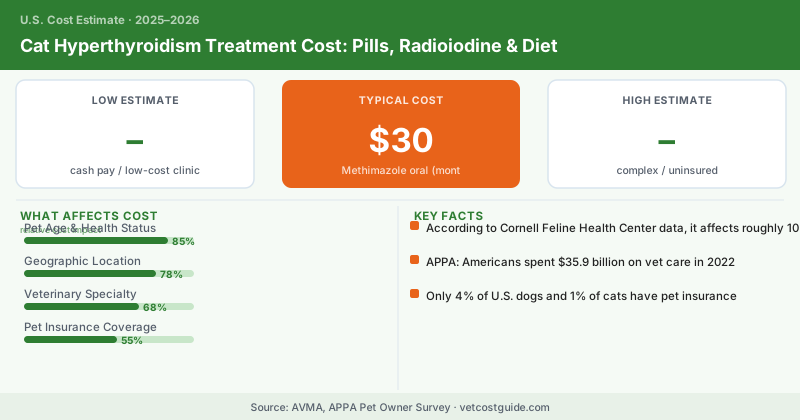
Methimazole costs about $30–$60 per month and keeps hyperthyroidism under control. Radioiodine costs $1,500–$2,500 once and cures it. That difference — control versus cure — is the central question every owner faces after their cat gets this diagnosis. The right answer isn’t the same for every cat or every budget, but the math is clearer than most people realize.
Feline hyperthyroidism is the most common endocrine disease in older cats. According to Cornell Feline Health Center data, it affects roughly 10% of cats over age 10. The thyroid gland overproduces T4, flooding the body with too much thyroid hormone. Left untreated, it’s hard on the heart, kidneys, and overall body condition. The good news is that it’s one of the most treatable conditions in feline medicine — with four distinct options at very different price points.
- A T4 blood test ($60–$150) confirms hyperthyroidism, but you’ll also need kidney function labs before starting treatment — hyperthyroidism can mask underlying chronic kidney disease (CKD).
- Methimazole (oral or transdermal) controls the condition for $30–$80/month but requires lifelong administration and monitoring bloodwork every 3–6 months.
- Radioiodine (I-131) at $1,500–$2,500 is curative in over 95% of cats — often cheaper than five years of medication plus monitoring.
- The prescription y/d diet is the simplest option but requires strict compliance: your cat must eat only that food, with zero exceptions.
What’s Happening in Your Cat’s Thyroid
The thyroid gland sits in your cat’s neck and regulates metabolism. In hyperthyroidism, one or both thyroid lobes develop benign nodular growths called adenomas that produce thyroid hormone autonomously — without the normal feedback signals that would tell a healthy thyroid to slow down. The result is a metabolic furnace running at full blast.
Symptoms are unmistakable once you know to look for them: weight loss despite an excellent or even ravenous appetite, restlessness, a rough or unkempt coat, increased thirst and urination, and sometimes vomiting. Some cats become vocal and difficult to sleep with. Cardiac changes — elevated heart rate, heart murmur — are common findings on physical exam.
Diagnosis Costs
Your vet will run a thyroid panel, but the complete diagnostic picture involves more than just T4.
- T4 (thyroxine) test: $60–$150. Elevated T4 in the context of clinical signs confirms the diagnosis in most cats. A small percentage have “occult” hyperthyroidism with normal T4 on initial testing — a free T4 test ($80–$180) or repeat testing in 4–6 weeks catches most of those.
- Chemistry panel + CBC: $100–$200. Assessing kidney function before treatment is critical — not optional. More on this below.
- Blood pressure measurement: $30–$50. Hypertension is common with hyperthyroidism and may need separate treatment.
Hyperthyroidism artificially elevates kidney blood flow, which makes kidney function look better than it really is. In some cats, treating the thyroid disease unmasks underlying chronic kidney disease (CKD) that was hidden beneath the elevated perfusion. This is why you must recheck kidney values 4–6 weeks after starting any treatment. If CKD appears, your vet may deliberately allow mild hyperthyroidism to persist — because perfect thyroid control would accelerate kidney failure. It’s a balance, not a cure-at-all-costs situation.
Treatment Options and Costs
| Treatment | Cost | Ongoing Cost | Cure? |
|---|---|---|---|
| Methimazole oral (monthly) | $30–$60 | Bloodwork $150–$250/panel | No |
| Methimazole transdermal (monthly) | $40–$100 | Bloodwork $150–$250/panel | No |
| y/d Prescription Diet (monthly) | $60–$120 | Compliance-dependent | No |
| Radioiodine I-131 (one-time) | $1,500–$2,500 | None if successful | Yes (95%+) |
| Surgical thyroidectomy | $1,000–$2,000 per side | Monitoring only | Usually yes |
Option 1: Methimazole (Oral or Transdermal)
Methimazole blocks thyroid hormone synthesis. It’s available as oral tablets or as a transdermal gel applied to the inner ear flap — the gel is easier for cats who resist pilling. Oral methimazole costs $30–$60/month; the transdermal formulation runs $40–$100/month because it’s compounded.
The catch is monitoring. Bloodwork to check T4 levels and kidney/liver function is needed every 3–6 months at $150–$250 per panel. About 15–20% of cats experience side effects — vomiting, facial itching, blood cell changes — that require switching formulations or dose adjustments. Methimazole also requires your commitment. Miss doses regularly and T4 climbs back up.
Five-year rough total (oral methimazole + twice-annual monitoring): $1,800–$4,800.
Option 2: y/d Prescription Diet
Hill’s y/d is an iodine-restricted diet that limits the raw material thyroid hormones are made from. It works — T4 normalizes in most cats within 4–8 weeks. It’s also the only non-medication, non-procedural option. Monthly cost is $60–$120 depending on can versus dry and where you purchase it.
The constraint is strictness. Your cat must eat only y/d — no other food, no treats, no hunting access (indoor-only cats only). In single-cat households with a cooperative cat, it’s genuinely viable. In multi-cat homes, it’s nearly impossible to enforce.
Option 3: Radioiodine (I-131) Therapy
A single injection of radioactive iodine is absorbed by the overactive thyroid tissue and destroys it, while leaving normal tissue largely intact. Cure rate exceeds 95% in most published series. No ongoing medication, no daily pilling, no monitoring bloodwork beyond standard senior wellness.
The process: your cat stays at the referral facility for 1–7 days (regulations vary by state) until radiation levels drop to safe thresholds for home contact. You’ll follow low-level radiation precautions for a week or two after discharge — mostly around litter handling.
One-time cost: $1,500–$2,500 depending on facility and region. University veterinary teaching hospitals often charge toward the lower end. Private referral centers in high-cost cities can reach $2,500 or more.
Five-year comparison: At $30/month for methimazole plus twice-annual bloodwork at $200/panel, you’re at $3,600–$4,800 over five years. Radioiodine at $2,000 costs less — and your cat has no daily medication, no side effect monitoring, and no missed doses. For cats expected to live 3+ more years, the economics favor radioiodine for most owners who can manage the upfront cost.
Option 4: Surgical Thyroidectomy
Removing the affected thyroid lobe or lobes used to be standard practice before radioiodine became widely available. It costs $1,000–$2,000 per side and, when successful, is curative. The risk is inadvertent removal or damage of the parathyroid glands, which sit adjacent to the thyroid and regulate calcium — hypoparathyroidism is a serious complication requiring intensive management.
Most veterinary internists today recommend radioiodine over surgery when a referral center is accessible. Surgery still has a role when radioiodine facilities aren’t geographically available or when other factors make anesthesia preferable to radioiodine protocol.
Never stop methimazole abruptly without veterinary guidance. If you miss doses for several days or decide to discontinue without consulting your vet, T4 levels can rebound rapidly. The thyroid adenoma is still there — the medication only suppresses its function, it doesn’t shrink or eliminate it. Sudden withdrawal can trigger rapid heart rate, hypertension, and cardiac complications in cats with underlying heart disease. Always taper or transition under veterinary supervision.
Pet Insurance Considerations
Hyperthyroidism diagnosed before enrollment is typically excluded as a pre-existing condition. But cats enrolled before any thyroid symptoms or elevated T4 on bloodwork are documented have a real path to coverage — including radioiodine. Given that the procedure costs $1,500–$2,500, comprehensive accident-and-illness coverage with an 80% reimbursement structure could offset $1,200–$2,000 of that.
The AVMA’s senior cat care guidelines recommend T4 testing as part of annual wellness exams for cats over 7 years old — which means most cats will have their first T4 test well before symptoms develop. An elevated result before enrollment creates a pre-existing condition record. This is a genuine argument for enrolling cats in insurance early, before senior screening begins.
Frequently Asked Questions
How much does cat hyperthyroidism treatment cost? Methimazole runs $30–$80/month plus $150–$250 every 3–6 months for monitoring bloodwork. Radioiodine is a one-time cost of $1,500–$2,500 with no ongoing medication costs. The y/d prescription diet costs $60–$120/month. Surgical thyroidectomy is $1,000–$2,000 and is rarely the first choice today.
Is radioiodine worth it for cats? For most cats, yes. The cure rate is over 95%, there’s no daily medication, and the long-term cost is often lower than years of methimazole plus monitoring bloodwork. The main obstacle is the upfront payment and a brief hospitalization period. For cats with 3+ years of expected lifespan, the math almost always favors radioiodine.
How do I know if my cat has hyperthyroidism? Watch for weight loss paired with a good or excessive appetite — that combination in a cat over 8 years old should prompt a vet visit. Other signs include increased thirst, restlessness, vomiting, and a rough coat. A simple T4 blood test confirms the diagnosis. The Cornell Feline Health Center notes that hyperthyroidism affects roughly 10% of cats over 10 years old, making it one of the most common diagnoses in senior feline medicine.
Frequently Asked Questions
It depends on the treatment you choose. Daily methimazole medication runs $30–$80 per month ongoing — affordable but lifelong. Radioiodine therapy costs $1,500–$3,000 as a one-time cure with a 95%+ success rate. Surgical thyroidectomy runs $2,000–$5,000. Diagnosis (bloodwork, T4 test) adds $150–$400 before treatment begins.
For most cats in otherwise good health, yes. The Cornell Feline Health Center calls radioiodine the gold standard — it's curative, has minimal side effects, and avoids daily pilling. The upfront cost ($1,500–$3,000) is often offset within 2–3 years compared to ongoing medication costs. It also eliminates the risk of owner non-compliance with daily dosing.
No — untreated hyperthyroidism is fatal. The condition forces the heart to work harder, leading to hypertrophic cardiomyopathy, hypertension, and eventual heart failure. According to the American Association of Feline Practitioners, hyperthyroidism is the most common endocrine disorder in older cats and requires prompt treatment to prevent irreversible organ damage.