Your vet just said your cat needs an MRI. The quote came in at $2,200. You’re wondering if that’s normal, whether it’s really necessary, and whether there are cheaper alternatives. All reasonable questions — let’s answer them directly.
Cat MRI costs typically run $1,500–$3,500 depending on the facility, region, location scanned, and whether contrast dye is used. That’s the real range most owners encounter. Here’s what determines where you fall in it.
What a Cat MRI Costs
| Scan Type | Low | Typical | High |
|---|---|---|---|
| Brain MRI (without contrast) | $1,500 | $2,000 | $2,800 |
| Brain MRI (with contrast) | $1,800 | $2,400 | $3,200 |
| Spinal MRI (one region) | $1,500 | $2,000 | $2,800 |
| Full spinal MRI (multiple regions) | $2,200 | $2,800 | $3,500 |
| Anesthesia (always required) | $300 | $500 | $800 |
| Neurologist consultation (often bundled) | $150 | $250 | $400 |
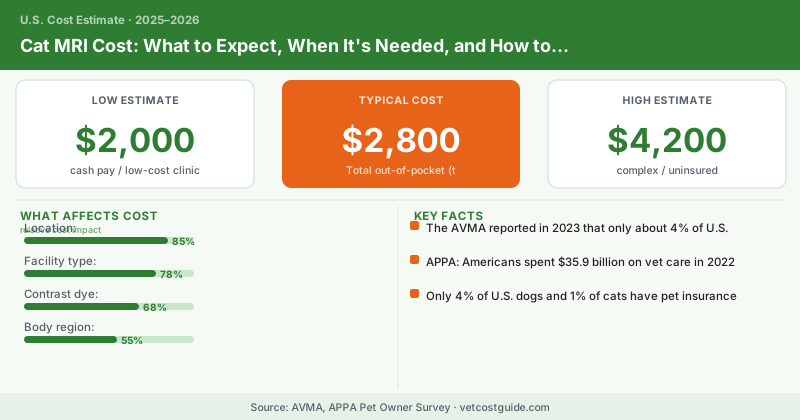
| Total out-of-pocket (typical) | $2,000 | $2,800 | $4,200 |
Anesthesia is always required for feline MRI — cats can’t hold still for 30–90 minutes in a loud machine. That adds $300–$800 to the scan cost, though many facilities bundle it into the quote. Always ask whether anesthesia is included.
Why Your Cat Might Need an MRI
MRI is the gold standard for imaging soft tissue — particularly the brain and spinal cord. Your vet or veterinary neurologist recommends it when:
- Seizures that don’t respond to standard workup (blood panel, x-rays)
- Sudden behavior changes suggesting brain involvement
- Hind limb weakness or paralysis — ruling out intervertebral disc disease, tumors, or spinal cord compression
- Head tilt, circling, or vestibular signs beyond what inner ear disease explains
- Known or suspected brain tumor requiring surgical planning
- Facial nerve paralysis or other cranial nerve abnormalities
CT scans see bone and basic structure well. MRI sees soft tissue detail — brain parenchyma, spinal cord, nerve roots, disc material — with far more clarity. For neurological workups in cats, MRI is usually the right tool. CT costs less ($800–$1,500) and is sometimes an appropriate first step, but neurologists often need MRI to plan treatment or confirm diagnosis.
CT scan ($800–$1,500): Best for bone assessment, chest screening, abdominal masses, nasal tumors. Faster (5–15 minutes under anesthesia).
MRI ($1,500–$3,500): Best for brain, spinal cord, soft tissue tumors, nerve root disease. Longer scan (30–90 minutes under anesthesia).
Your neurologist will recommend the right one. Don’t assume CT is “close enough” for a neurological workup — for brain and spinal cord conditions, MRI provides significantly better diagnostic information and may save you money by avoiding misdiagnosis.
What Affects the Cost
Location: Academic veterinary hospitals (teaching hospitals at vet schools) typically charge 20–35% less than private specialty centers. If you’re within driving distance of a vet school — UC Davis, Cornell, NC State, Colorado State — ask about an appointment there.
Facility type: Mobile MRI units that travel to regional practices sometimes charge less than dedicated specialty hospitals, though scheduling can be less flexible.
Contrast dye: Gadolinium contrast enhances visualization of tumors, inflammation, and vascular abnormalities. Not every scan needs it. Your neurologist will specify — adding contrast adds $300–$500.
Body region: A single-region spinal scan costs less than full spine imaging or brain + spine combined.
Geographic region: Costs in major metro areas (NYC, LA, Chicago) run $300–$600 higher than mid-sized cities. Rural specialty centers are often slightly cheaper.
The ACVIM Factor
A board-certified veterinary neurologist (DACVIM Neurology) interprets your cat’s MRI and provides the diagnosis. Neurologist consultation fees ($150–$400) are often included in facility quotes, but confirm before you assume.
The American College of Veterinary Internal Medicine (ACVIM) reports that approximately 1.5 million dogs and cats undergo advanced neurological diagnostics annually in the US. That volume supports a growing network of specialty hospitals with MRI capability in most metro areas.
Is an MRI Always the Right Call?
Sometimes yes, sometimes it’s one reasonable option among several. Questions worth asking your neurologist:
- Would a CT scan provide sufficient information for the suspected diagnosis?
- Would the MRI findings change the treatment plan? (If treatment is the same regardless of what the MRI shows, you might reasonably skip it.)
- What’s the next step after the MRI? (If it’s a brain tumor with poor prognosis regardless of type, some owners choose comfort care without full imaging.)
These aren’t arguments against getting an MRI. They’re conversations worth having so you make an informed choice rather than a reflexive one.
Anesthesia risk in cats with neurological symptoms is real. Cats with elevated intracranial pressure, seizures, or significant illness carry higher anesthetic risk than healthy cats undergoing routine procedures. Your neurologist and anesthesiologist should discuss this with you before the procedure. Ask specifically about your cat’s individual risk given their condition.
Paying for a Cat MRI
CareCredit: Accepted at most veterinary specialty centers. 6-month deferred interest promotional financing is available for balances over $200. If you pay the full balance within the promotional period, you pay no interest.
ScratchPay: Another veterinary financing option; often approves applicants CareCredit doesn’t. Monthly payment plans typically run 12–24 months.
Pet insurance: If your cat is already insured, an MRI for a covered condition is typically reimbursable at 70–90% after your deductible. Check your policy for exclusions — some plans exclude neurological conditions or pre-existing issues. The AVMA reported in 2023 that only about 4% of U.S. cats are insured, which means most owners are paying out of pocket.
Academic veterinary hospitals: Vet school hospitals often charge 20–35% less than private specialty centers. Quality is equivalent — you’re treated by supervised residents under board-certified specialists.
Ask about a payment plan. Many specialty hospitals offer internal payment plans, especially for long-standing clients. It doesn’t hurt to ask.
Frequently Asked Questions
How long does a cat MRI take? The scan itself takes 30–90 minutes depending on what’s being imaged. Add time for anesthesia induction, monitoring, and recovery — plan for a 4–6 hour appointment at the facility.
When will I get results? Most facilities have the neurologist’s written report within 24–48 hours. Urgent cases are often reported same-day.
My cat had an MRI and needs surgery — what does that cost? Brain surgery in cats runs $5,000–$10,000+. Spinal surgery (decompression) runs $3,000–$7,000. Not every MRI leads to surgery — some findings are managed medically. Your neurologist will present options after reviewing the images.
Can I get a second opinion on the MRI? Yes. MRI images are stored digitally and can be shared with another board-certified neurologist for review, often at lower cost than a full repeat evaluation.
Frequently Asked Questions
Cat MRI costs typically range from $1,500 to $3,500 at most veterinary specialty centers, though the final bill depends on factors like your location, the facility type, which body part is scanned, and whether contrast dye is needed. Regional variations can be significant, with urban specialty hospitals often charging toward the higher end of this range.
Most pet insurance plans do cover MRI scans if they are deemed medically necessary, but you'll typically pay 10–30% out-of-pocket after your deductible is met, depending on your specific plan and coverage level. Some policies exclude MRIs or have annual limits, so review your plan details or call your insurer before scheduling to confirm your actual out-of-pocket responsibility.
The MRI scan itself usually takes 30–60 minutes, though your cat will need sedation or anesthesia, adding 1–2 hours to the total appointment time for pre-exam prep and recovery. Your veterinarian typically receives the radiologist's report within 24–48 hours and will contact you with findings and next steps for treatment.