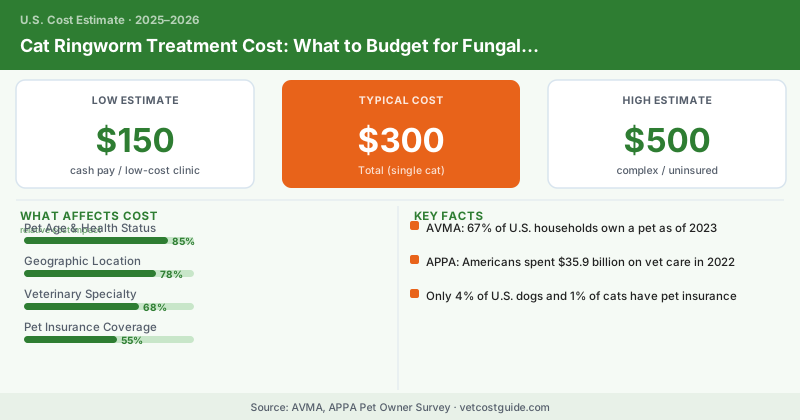
Most pet owners assume ringworm is a worm. It’s not — it’s a highly contagious fungal infection, and it spreads to humans more easily than almost any other pet condition. That zoonotic risk is exactly why treatment isn’t optional, and why it has to be thorough. The average cat ringworm treatment costs $150–$500 in veterinary care, plus another $100–$300 in environmental cleaning supplies. Here’s what you’re actually dealing with.
- Vet diagnosis (exam + fungal culture or Wood’s lamp): $80–$200
- Topical antifungal treatment (lime sulfur dips or miconazole): $40–$120 for a full course
- Oral antifungal medication (itraconazole or terbinafine, 6–8 weeks): $60–$200
- Environmental decontamination supplies: $30–$100
- Multi-cat household treatment: multiply per-cat costs; expect $400–$800+ total
- Total for single cat, uncomplicated case: $150–$500
Cost Breakdown by Treatment Component
| Service/Product | Low | Average | High |
|---|---|---|---|
| Vet exam + diagnosis | $50 | $80 | $130 |
| Fungal culture (DTM plate) | $40 | $60 | $80 |
| Wood's lamp exam (in-office) | $0 | $0 | $30 |
| Lime sulfur dip (vet-applied, per session) | $30 | $50 | $80 |
| Miconazole shampoo (owner-applied at home) | $15 | $25 | $40 |
| Itraconazole (6–8 weeks, per cat) | $60 | $120 | $200 |
| Terbinafine (6–8 weeks, per cat) | $40 | $90 | $160 |
| Environmental antifungal spray/cleaner | $20 | $40 | $70 |
| Recurrence recheck + culture | $80 | $120 | $180 |
| Total (single cat) | $150 | $300 | $500 |
What Ringworm Treatment Actually Involves
Ringworm (dermatophytosis) in cats is caused primarily by Microsporum canis. The CDC estimates it causes between 1 and 3 million human infections per year in the U.S., with cats being a major transmission source — particularly in households with children, elderly individuals, or immunocompromised people.
Treatment has three simultaneous fronts: the cat, the environment, and monitoring.
Treating the cat requires both topical and systemic (oral) antifungals working together. Topical treatment alone — twice-weekly lime sulfur dips, miconazole or ketoconazole shampoo — reduces spore counts on the coat but doesn’t eliminate the fungus from deeper hair follicles. Oral itraconazole (5 mg/kg daily or on a pulse dosing schedule) penetrates hair follicles systemically. Most vets prescribe a pulse protocol: one week on, one week off, for 6–8 weeks total. Terbinafine is an alternative if itraconazole isn’t tolerated.
Long-haired cats often benefit from shaving affected areas — it reduces the total spore burden on the coat and makes topical treatment more effective. Factor in a grooming visit or in-clinic shaving fee ($30–$75) if your vet recommends it.
Treating the environment is equally critical and often underestimated. Ringworm spores survive on surfaces, carpets, and upholstery for up to 18 months. Without decontamination, the cat re-infects from the environment after treatment, and the cycle repeats. Twice-weekly vacuuming and washing of all soft surfaces, followed by antifungal disinfectant (diluted bleach at 1:10 ratio works for hard surfaces; Lysol IC or Accel products for pet-safe applications) needs to continue throughout the treatment period.
Monitoring requires repeat fungal cultures — usually at the end of the treatment course and again 2–4 weeks later. Treatment doesn’t end when lesions look healed; it ends when cultures are negative. Premature discontinuation is the most common reason for reinfection.
Kittens, Shelters, and Multi-Cat Homes
Kittens under 4 months and immunocompromised cats are the most susceptible. ASPCA shelter data confirms that ringworm is one of the most common conditions causing extended shelter holds for kittens — with treatment protocols often running 8–12 weeks before a kitten is considered cleared for adoption.
In multi-cat households, all cats need to be tested and treated simultaneously, even if they don’t show lesions — they can be asymptomatic carriers shedding spores onto every surface. This doubles or triples the medication budget quickly. Four cats at $120 each in oral antifungals equals $480 in medication alone, before adding dips and vet visits.
If you recently adopted a kitten from a shelter and notice hair loss, scaling, or crusty lesions within 2–4 weeks, suspect ringworm immediately. The incubation period is 1–3 weeks from exposure.
Ringworm is a zoonotic infection — it spreads from cats to humans regularly and easily. Children, elderly people, and anyone on immunosuppressant medications are at highest risk for contracting it. If you suspect ringworm in your cat, wear gloves when handling the cat, wash hands thoroughly after contact, and don’t allow the cat in sleeping areas or on soft furniture until cleared by your vet. See your own doctor if you develop a circular, scaly rash on your skin.
Wood’s Lamp and Fungal Culture: The Two Diagnostic Tools
A Wood’s lamp is an ultraviolet light your vet shines over the cat’s coat in a darkened room. M. canis fluoresces apple-green under UV light — a fast, in-office screening tool. The problem: only about 50% of M. canis strains fluoresce, so a negative Wood’s lamp doesn’t rule out ringworm.
A dermatophyte test medium (DTM) culture is the gold standard. Hairs are plucked from the lesion margin and placed on a red agar plate. A color change from yellow-orange to bright red within 7–14 days indicates dermatophyte growth. Cost is typically $40–$80 and takes 1–2 weeks to yield results. More advanced PCR testing is available at reference labs for faster results ($80–$150).
Frequently Asked Questions
How long does ringworm treatment take in cats? Most cases require 8–12 weeks of consistent treatment. Cultures typically clear by week 8–10. Long-haired cats and households with high environmental contamination may take longer. Don’t stop treatment early based on visual improvement alone.
Can ringworm clear on its own in cats? Technically, adult cats with healthy immune systems can clear ringworm without treatment over 3–4 months. But they shed spores the entire time, infecting humans and other pets. Treatment is strongly recommended for any cat with confirmed or suspected ringworm.
Is ringworm treatment covered by pet insurance? Most comprehensive pet insurance policies cover ringworm as a medical condition. However, if a cat was diagnosed with ringworm before the policy’s waiting period ended, it may be considered pre-existing. Check your policy’s definition of dermatological conditions.
Frequently Asked Questions
Veterinary ringworm treatment typically costs $150–$500, depending on whether your vet prescribes topical antifungals (creams or sprays), oral medications, or a combination of both. Additional diagnostic tests like fungal cultures may add $50–$100 to the initial visit fee of $100–$200.
Most pet insurance plans cover ringworm treatment as part of illness coverage, though you'll typically pay out-of-pocket first and then submit for reimbursement (usually 70–90% after your deductible). Some policies exclude fungal infections or have waiting periods, so review your specific plan documents before treatment begins.
Ringworm treatment typically takes 2–4 weeks with consistent topical medication application and 4–12 weeks with oral antifungals, though some cats remain contagious for 3 weeks after treatment starts. Recovery is fastest when you combine veterinary medication with thorough environmental decontamination (cleaning surfaces with antifungal sprays costing $100–$300) and isolate the infected cat from other pets and family members.