Your cat needs surgery and nobody at the clinic has given you a number yet. That’s the worst part of this whole process — the not-knowing. So let’s fix that right now with real ranges pulled from what cats actually cost to operate on across the U.S. in 2025 and 2026.
Feline surgery costs split into three tiers: routine (spay/neuter, minor mass removal), moderate (bladder stone removal, dental extractions with surgery, foreign body removal), and complex (orthopedic repair, tumor resection with margins, emergency abdominal exploratory). The American Veterinary Medical Association’s 2024 pet owner survey found that unexpected veterinary costs are the top financial stressor cited by cat owners, and surgery is usually the reason why.
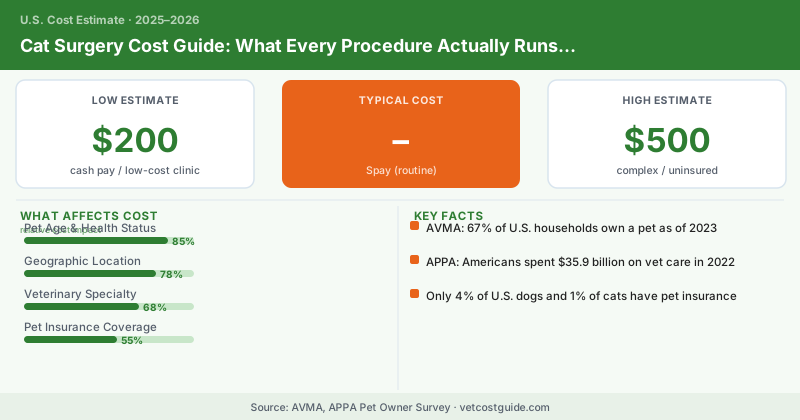
- Spay (female cat): $200–$500
- Neuter (male cat): $100–$300
- Mass/lump removal: $300–$900
- Bladder stone surgery (cystotomy): $1,500–$3,000
- Foreign body removal (intestinal): $2,000–$4,500
- Orthopedic repair (fracture): $2,500–$6,000
Full Cost Breakdown by Procedure
| Procedure | Low End | High End | Typical Total |
|---|---|---|---|
| Spay (routine) | $200 | $500 | $300 |
| Neuter (routine) | $100 | $300 | $180 |
| Mass removal (small, benign) | $300 | $700 | $450 |
| Mass removal (large or malignant margins) | $700 | $1,800 | $1,100 |
| Bladder stone surgery (cystotomy) | $1,500 | $3,000 | $2,100 |
| Intestinal foreign body removal | $2,000 | $4,500 | $3,000 |
| Fracture repair (orthopedic) | $2,500 | $6,000 | $3,800 |
| Amputation | $1,200 | $2,800 | $1,900 |
| Exploratory abdominal surgery | $1,800 | $4,000 | $2,600 |
| Dental extraction surgery (multiple teeth) | $600 | $1,800 | $1,000 |
Why the Range Is So Wide
Three things drive the spread between the low end and the high end of any surgical quote: anesthesia complexity, whether a specialist is involved, and geography.
Anesthesia and monitoring account for a bigger slice of the bill than most owners expect — often 25–35% of the total. A 20-minute spay under general anesthesia costs less to monitor than a 90-minute orthopedic repair requiring IV fluids, blood pressure monitoring, and post-op pain management. Longer procedures mean more anesthetic drugs, more staff time, and more monitoring equipment in use.
General practice vs. specialist matters enormously. A board-certified veterinary surgeon (Diplomate ACVS) charges significantly more per hour than a general practitioner, but for complex fracture repairs or oncologic surgery, that expertise reduces complication risk. Many general practice vets refer orthopedic and complicated soft-tissue cases to specialists precisely because outcomes improve with specialized training.
Geographic cost of living shifts every number on this page by 30–60%. A bladder stone surgery quoted at $1,500 in a smaller Midwestern city might run $2,800 in Los Angeles or Boston for the identical procedure with identical equipment.
- Always ask for a written estimate range, not a single number — most quotes include a low-to-high range covering complications
- Ask what’s included: pre-surgical bloodwork, IV catheter, pain medication, and the recheck visit are sometimes itemized separately
- Get a second opinion for any surgery quoted above $2,000 if you have time — a consult fee ($50–$150) is cheap insurance against overtreatment
- Ask whether your case qualifies for CareCredit or a payment plan before the day of surgery, not after
What’s Included (and What Isn’t) in a Surgical Quote
A complete surgical estimate should include: pre-anesthetic bloodwork ($80–$150), the surgery itself, anesthesia and monitoring, pain medication (injectable and take-home), an e-collar, and a follow-up recheck exam. What’s frequently NOT included unless you ask: additional imaging if something unexpected is found mid-surgery, extended hospitalization for complications, or a second round of pain medication if recovery is slower than expected.
Ask your vet directly: “Is this the total cost, or does this exclude anything I should plan for?” Clinics that build detailed estimates aren’t hiding anything — they’re being upfront about medical uncertainty that exists in every surgery.
Reducing Cost Without Cutting Corners
Pre-surgical bloodwork isn’t optional padding — it’s how your vet catches an underlying condition (like early kidney disease) that would change the anesthesia protocol. Skipping it to save $100 on a surgery that costs $2,000 is a bad trade.
What you can reasonably shop around for: the exam and consult fee, and whether the practice offers multi-pet or loyalty discounts. Getting quotes from two or three practices for elective procedures like spay/neuter is completely reasonable and can save $50–$150.
For anything beyond routine, ask whether your vet is board-certified or refers to a specialist — and factor that into your decision, not just the price tag.
Frequently Asked Questions
Routine cat surgeries like spay/neuter run $200–$500, while more involved procedures like mass removals or bladder stone surgery run $800–$2,500. Complex orthopedic or emergency abdominal surgery can reach $3,000–$6,000 depending on your region and whether a specialist is involved.
Most pet insurance plans cover surgery when the underlying condition isn't a pre-existing one, reimbursing 70–90% of costs after your deductible. Enrolling before a problem develops is essential since insurers exclude conditions that show symptoms before the policy's effective date.