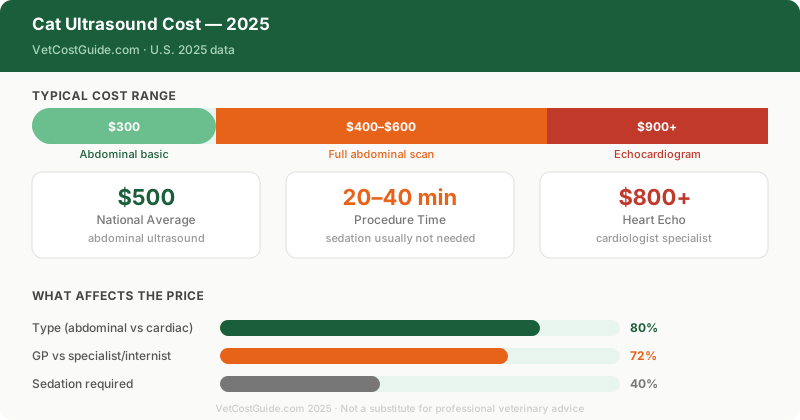
When your vet recommends an ultrasound, the first question is usually: how much is this going to cost? The honest answer is that it depends on what type of scan you need and where it’s being done. For context: the machine performing your cat’s scan costs somewhere between $30,000 and $80,000. The person interpreting the images in real time has anywhere from months to years of specialized training. Add clinic overhead, sedation when needed, and a written report, and the $250–$500 range for an abdominal scan starts making sense. Cardiac echocardiograms step up in complexity and typically run $400–$800 before you add the cardiologist’s consultation fee.
- Abdominal ultrasounds average $300–$450 at most US veterinary clinics in 2025.
- Cardiac echocardiograms average $500–$700 and nearly always require a specialist.
- Specialty or university hospitals add a $150–$350 consultation fee on top of the scan itself.
- Pet insurance with diagnostics coverage typically covers 70–90% of ultrasound costs after the deductible.
What Does a Cat Ultrasound Cost?
The type of scan and who performs it matter more than almost anything else in determining your final bill.
| Scan Type | Low | Average | High |
|---|---|---|---|
| Abdominal Ultrasound (GP) | $200 | $325 | $500 |
| Abdominal Ultrasound (Specialist) | $350 | $475 | $700 |
| Cardiac Echo (Cardiologist) | $400 | $575 | $800 |
| Echocardiogram + Consult | $550 | $750 | $1,100 |
| Focused/Limited Scan (FAST) | $150 | $225 | $350 |
Large metro areas — New York, Los Angeles, San Francisco — skew toward the high end of these ranges. Rural clinics and Midwest practices often come in 20–30% lower.
What You’re Actually Paying For
Equipment and setup. That $30,000–$80,000 machine has to be paid for, and ultrasound fees are part of how clinics recoup the capital investment. You’re also paying for ultrasound gel, the clipping of fur over the scan area, and the time to set up and clean down between patients.
The sonographer’s time. A thorough abdominal scan takes 20–40 minutes for someone who knows what they’re looking for. At a specialty clinic, a board-certified internal medicine specialist (DACVIM) interprets images in real time and writes a formal report. At a general practice, your regular vet does the scan with their level of training — which is entirely adequate for most common findings.
Image archiving and written report. Most clinics store digital images and generate documentation. If you’re ever referred to a specialist, having those original images on file can save you the cost of a repeat scan.
Sedation, when used. Many cats sit through abdominal ultrasounds without sedation. Anxious cats, painful cats, or those needing precise positioning often do better with light sedation — which adds $50–$150 to the total.
Cardiac echocardiograms include all of this plus Doppler flow measurements, wall-thickness calculations, and detailed cardiology reporting — which is why they take 45–60 minutes and cost noticeably more.
What Drives the Price Variation
Type of scan. A focused FAST scan checking for abdominal fluid is quick and inexpensive — 5–10 minutes, relatively simple interpretation. A complete organ-by-organ abdominal survey is substantially more work. A full cardiac echo with Doppler is the most time- and skill-intensive of all three.
Who does it. A general practitioner with ultrasound training charges less than a board-certified radiologist or internal medicine specialist. The specialist brings deeper expertise — important for complex cases — but costs noticeably more. For most routine abdominal scans, a trained GP is entirely appropriate.
Where you live. Ultrasound fees in New York City or Seattle can be double those in rural Tennessee. Clinic real estate, staff wages, and local market competition all influence the price.
Whether your cat needs sedation. Some cats won’t cooperate without it. If sedation is used, anesthetic monitoring time and drug costs get added to the bill.
What happens during the scan. If the ultrasound reveals a suspicious mass or fluid pocket, your vet may recommend a fine-needle aspirate (FNA) right there during the appointment — typically an additional $75–$200 for the procedure plus cytology laboratory fees.
- “Interpretation fee” billed separately. Some specialty hospitals charge a reading fee of $75–$150 on top of the imaging fee. Always ask whether the written report is included in the quoted price.
- Emergency or after-hours surcharges. An ultrasound performed at an emergency clinic overnight can carry a 20–50% surcharge, pushing a $350 scan past $500.
- Repeat scans without explanation. If a GP clinic says they couldn’t get adequate images and refers you to a specialist — costing you twice — ask whether a direct referral from the start would have saved money overall.
Pet Insurance and Ultrasound Coverage
If your cat has a chronic condition requiring imaging as a management tool — inflammatory bowel disease, hypertrophic cardiomyopathy (HCM), kidney disease — this is where pet insurance genuinely earns its keep. A cat with HCM needs cardiac monitoring every 6–12 months. That’s $400–$800 per visit, year after year. Insurance reimbursing 70–90% of those costs after the deductible is meaningful money over time.
Most comprehensive pet insurance plans (Trupanion, Healthy Paws, Embrace) classify ultrasounds as diagnostic procedures covered under illness benefits. After your annual deductible ($200–$500 depending on the policy), you’re typically getting back most of what you spend.
For young, healthy cats without chronic conditions, the math is less compelling. Wellness add-on riders that cover routine diagnostics often don’t pencil out. But accident-and-illness coverage is worth having before your cat needs it — because once a condition appears on a record, it becomes a pre-existing exclusion.
Ways to Keep Costs Down
Start with your regular vet. If your primary care vet has ultrasound capability and the case isn’t highly complex, starting there saves $100–$250 versus going directly to a specialty center. Your vet will tell you honestly if a referral makes clinical sense.
Ask about same-day bundling. Ultrasound performed alongside bloodwork, urinalysis, or X-rays on the same visit sometimes comes with a modest discount at practices that bundle diagnostics. It’s worth asking about explicitly.
Get quotes from multiple specialty clinics if you’re being referred. Board-certified specialists represent a fairly consistent standard of care. Pricing between clinics is not. Calling two or three specialty centers to compare consultation plus imaging fees is entirely reasonable.
Look at a teaching hospital. Vet school hospitals at institutions like Cornell, Colorado State, or UC Davis offer specialist-level care at fees often 15–30% lower than private specialty clinics. The trade-off is potentially longer wait times, but for non-emergencies the savings are real.
Use CareCredit or a payment plan. Many clinics accept CareCredit with 0% interest promotional periods up to 24 months. A $600 ultrasound workup spread over several months is much more manageable than coming up with the full amount the same day.
Frequently Asked Questions
Does my cat need to fast before an ultrasound? For abdominal scans, most vets want food withheld for 6–8 hours beforehand. A full stomach obscures views of the liver, pancreas, and intestines with gas and fluid. Water is usually fine to leave out. Cardiac echos generally don’t require fasting.
Can my regular vet do an ultrasound or do I need a specialist? Many general practice vets have ultrasound equipment and adequate training for routine abdominal scans. For cardiac echocardiograms, assessment of complex masses, or anything requiring Doppler analysis, a board-certified specialist gives you more reliable results. Your vet is usually honest about when a referral is the right call.
How long does a cat ultrasound take? A focused FAST scan: 5–10 minutes. A complete abdominal survey: 20–40 minutes. A full cardiac echo with Doppler: 45–60 minutes. Add 15–30 minutes for sedation induction and recovery if your cat needs it.
Will my cat need to be shaved? Usually a small patch over the scan area gets clipped to improve gel contact and image quality. It grows back in 4–6 weeks. Purely cosmetic and temporary.
Frequently Asked Questions
A cat abdominal ultrasound typically costs between $250 and $500, depending on your veterinary clinic's location and whether sedation is required. Urban clinics and specialty animal hospitals tend to charge toward the higher end of this range, while rural practices may be closer to $250–$350.
Most pet insurance plans cover ultrasounds as part of diagnostic care, typically reimbursing 70–90% of the cost after you meet your deductible (usually $250–$500). However, pre-existing conditions are almost always excluded, so check your policy details before scheduling to understand your out-of-pocket responsibility.
A typical cat abdominal ultrasound takes 15–30 minutes, though the appointment may last longer including check-in and paperwork. Most vets recommend fasting your cat for 6–8 hours before the scan to get the clearest images, and your vet will provide specific pre-appointment instructions when you schedule.