Your cat walked into the kitchen this morning and fell over. Now she’s lying on her side, her eyes are moving back and forth in rapid, rhythmic flicks, and her head is cranked sideways at an angle you’ve never seen before. Your first thought: stroke. Brain tumor. Something catastrophic.
Here’s what’s far more likely: idiopathic vestibular disease. It looks terrifying. It usually isn’t. And for most cats, the treatment costs under $400 and they’re back to normal within two to three weeks.
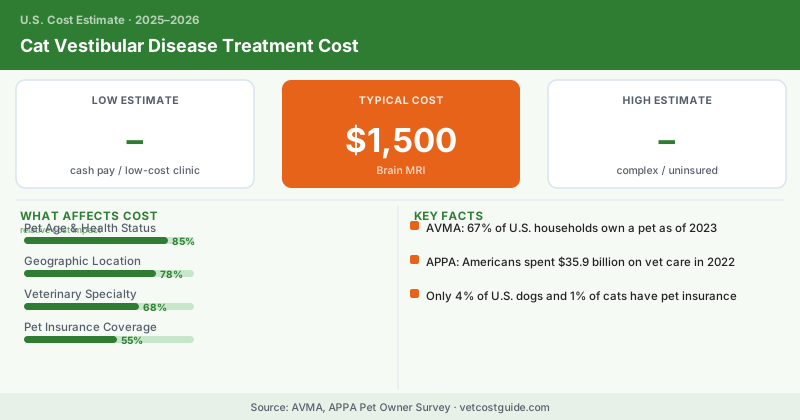
The expensive scenario — ruling out a brain tumor or central nervous system disease with MRI — runs $1,500 to $2,500. Whether your cat needs that depends almost entirely on how she looks over the next 48 to 72 hours.
- Emergency exam + initial neurological assessment: $150–$300
- Anti-nausea medication (maropitant or meclizine): $25–$60
- Blood panel (to rule out metabolic causes): $80–$200
- Ear examination + culture if infection suspected: $100–$250
- MRI of the brain and inner ear: $1,500–$2,500
- Cerebrospinal fluid (CSF) analysis: $300–$600 (added to MRI cost)
- Hospitalization (if cat can’t stand or is vomiting): $200–$500 per night
What Is Vestibular Disease?
The vestibular system is the brain-and-inner-ear network that tells your cat which way is up. It controls balance, posture, and coordinated eye movement. When something disrupts it — infection, inflammation, injury, or for unknown reasons — the whole system goes haywire at once.
In cats, the most common form is idiopathic vestibular disease, meaning the cause is never identified. The Cornell Feline Health Center notes it’s one of the most alarming-looking conditions vets see, but also one of the most self-resolving. The vestibular nerve appears to recover on its own in the vast majority of cases without any specific treatment.
The three hallmark signs:
- Head tilt — sometimes severe, 45 degrees or more
- Nystagmus — rapid back-and-forth or rotary eye movements
- Ataxia — stumbling, falling, inability to walk in a straight line
Vomiting is also common, particularly in the first few hours, because the sudden vestibular disruption is essentially severe motion sickness.
The 48-to-72-Hour Rule
Most veterinary neurologists use a 48-to-72-hour observation window as a first decision point. Here’s why:
Idiopathic vestibular disease typically shows improvement within the first two to three days. The nystagmus usually resolves first — often within 24 to 48 hours. The head tilt and ataxia improve more gradually, but directional progress matters. A cat who is slightly less wobbly on day two is almost certainly dealing with idiopathic vestibular disease.
A cat whose signs are the same or worsening after 72 hours, or who develops new neurological signs, needs a more aggressive workup.
This window isn’t about being cheap with diagnostics — it’s about choosing the right diagnostic at the right time. The AVMA emphasizes that diagnostic sequencing in veterinary neurology should be guided by clinical probability, because unnecessary advanced imaging carries its own cost and anesthetic risk.
Cost Breakdown: The Two Paths
| Diagnostic Path | Cost Estimate | When Recommended |
|---|---|---|
| Exam + blood panel + anti-nausea meds | $150–$400 | Classic presentation; cat stable and improving |
| Add ear cytology/culture (infection suspected) | $100–$250 additional | Discharge from ear; otitis history |
| MRI brain + inner ear | $1,500–$2,500 | No improvement at 72 hrs; additional neuro signs |
| CSF analysis (added to MRI) | $300–$600 additional | If MRI inconclusive or CNS disease suspected |
| Hospitalization (1–2 nights) | $200–$500 per night | Cat cannot stand or is vomiting continuously |
What Causes Vestibular Disease in Cats?
Idiopathic accounts for the majority of cases — there’s no identified cause, and the condition resolves on its own. But other causes do exist and need to be considered based on your cat’s history and exam findings:
- Otitis interna (inner ear infection): The most common non-idiopathic cause. Often preceded by outer or middle ear infection that spreads inward. Treatment requires systemic antibiotics for four to eight weeks; cost adds $80–$200 for the antibiotic course plus follow-up exams.
- Polyps or masses in the middle ear: More common in young cats. May require CT or MRI to identify; surgical removal runs $800–$2,000.
- Hypothyroidism (rare in cats, unlike dogs): Blood panel screens for this.
- Thiamine (Vitamin B1) deficiency: Can cause vestibular and other neurological signs; seen in cats fed certain raw fish diets or highly processed food. Thiamine supplementation reverses it quickly and inexpensively.
- Intracranial tumors (meningioma, lymphoma): More common in older cats. Require MRI to diagnose; treatment options range from palliative care to surgery or radiation.
When You Actually Need the MRI
MRI is not the first step. It becomes the right move when:
- No improvement by day 4–5 of the episode
- Nystagmus changes direction over time (suggests central rather than peripheral vestibular disease)
- Additional neurological deficits appear: facial nerve paralysis, difficulty swallowing, altered consciousness, changes in mentation
- Recurrent episodes with no resolution between them
- Cat is under 2 years old: younger cats are less likely to have idiopathic disease; polyps or developmental issues become more likely
Brain MRI at a veterinary neurology center or specialty hospital runs $1,500–$2,500, typically including the anesthesia. If CSF analysis is added to sample spinal fluid for testing, add another $300–$600. This brings the maximum diagnostic workup to around $2,500–$3,000 before any treatment.
| Advanced Diagnostic | Cost Range | What It Diagnoses |
|---|---|---|
| Brain MRI | $1,500–$2,500 | Tumors, infarcts, inflammation, inner ear disease |
| CT scan (head) | $800–$1,500 | Bony structures; middle ear disease; faster than MRI |
| CSF tap + analysis | $300–$600 | Meningitis, encephalitis, lymphoma |
| Toxoplasma titers (blood) | $60–$150 | Infectious encephalitis in outdoor cats |
Supporting Your Cat at Home
If your vet has confirmed idiopathic vestibular disease and your cat is stable, recovery happens at home over two to four weeks. The AVMA and Cornell Feline Health Center both note that supportive care — not treatment — is what the recovery period looks like.
Practical steps that help:
- Confine her to one safe room so she can’t fall down stairs or get stuck somewhere.
- Keep food and water low and close — she may not be able to reach an elevated bowl.
- Anti-nausea medication (prescribed by your vet) manages the motion sickness component and makes eating easier.
- Don’t force movement — let her rest and reorient at her own pace.
Most cats have a noticeable head tilt for several weeks even after they’ve stabilized. A small percentage carry a mild permanent tilt for life with no effect on quality of life. It looks worse than it is.
Do not assume every cat who falls over and tilts her head has idiopathic vestibular disease. An initial vet exam is non-negotiable — the same presentation can be a stroke, a brain tumor, toxic exposure, or severe inner ear infection, all of which require different responses. If your cat is seizing, unable to breathe normally, or completely unresponsive, go to an emergency clinic immediately. Vestibular disease should be a diagnosis your vet reaches after ruling out more serious causes, not one you self-diagnose at home.
The Bottom Line
For most cats — especially middle-aged and senior cats who present with sudden onset head tilt, nystagmus, and ataxia — the realistic cost of vestibular disease is a $150–$300 emergency exam, some anti-nausea medication, and two to three weeks of home care. Total out of pocket: under $400 in the majority of cases.
The $2,500 MRI scenario is real, but it’s not where most cats end up. It’s where you go when something about the picture doesn’t fit the classic pattern, or when your cat isn’t getting better on schedule.
Watch closely for those first 72 hours. Improvement is the key signal. If she’s trending better, the expensive diagnostics can usually wait — or be avoided entirely.
Frequently Asked Questions
No, though the symptoms look nearly identical — sudden head tilt, loss of balance, rolling, rapid eye movement (nystagmus). A stroke involves interrupted blood flow to the brain. Idiopathic vestibular disease involves sudden disruption of the inner ear or vestibular nerve with no identifiable cause. The prognosis is completely different: most cats with idiopathic vestibular disease recover fully within two to four weeks without specific treatment. A stroke may cause permanent neurological damage. Your vet will use the presentation, onset, and neurological exam to distinguish between them.
Not necessarily. Most vets take a wait-and-see approach for 48–72 hours, especially in older cats who present with classic vestibular signs and no other neurological deficits. If symptoms are improving by day three, idiopathic vestibular disease becomes much more likely. MRI becomes important if your cat isn't improving, has additional neurological signs (facial droop, difficulty swallowing, altered mentation), or if the head tilt and nystagmus persist beyond four weeks without any resolution.
It can, but recurrence is uncommon — probably 10–15% of cats that have had one episode will experience another. When it does recur, it's usually milder and resolves faster because the cat's nervous system has already adapted once. If a cat has repeated episodes, your vet may recommend MRI to rule out an underlying structural cause such as a polyp, middle ear mass, or — rarely — a meningioma.