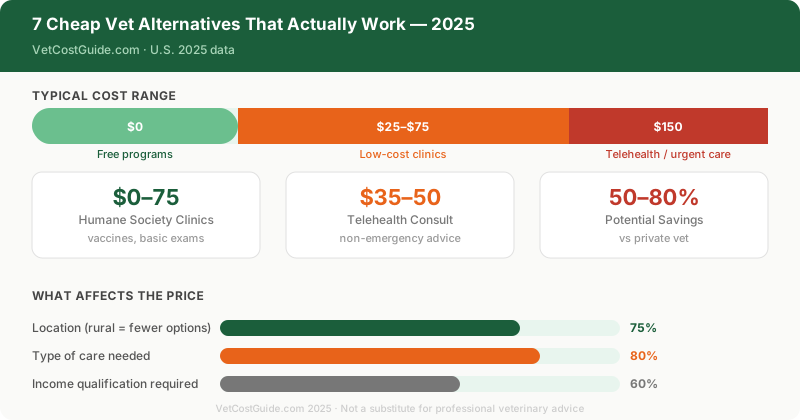
Nearly 1 in 3 pet owners delayed or skipped veterinary care in the past year because of cost — that’s from a 2024 American Pet Products Association survey. Here’s the thing: paying $400 for a routine vet visit isn’t actually inevitable. Nonprofits, teaching hospitals, telehealth platforms, and community organizations are actively filling the gap between what private practice charges and what people can actually afford. These options aren’t workarounds — they’re legitimate, licensed, and in some cases arguably better than what you’d get at a standard private clinic.
- Low-cost clinics at humane societies and nonprofits typically charge 40–70% less than private vets for routine care
- Veterinary school teaching hospitals offer specialist-level care at a fraction of private clinic prices
- Telehealth platforms like AirVet and Vetster handle many non-emergency issues for $30–$75 per consult
- Vaccine clinics at PetSmart and Petco charge $15–$35 per vaccine versus $25–$65 at private practices
Cost Comparison: Private Vet vs. Alternatives
| Service | Private Vet | Alternative | You Save |
|---|---|---|---|
| Annual wellness exam | $55–$100 | ASPCA clinic: $25–$45 | Up to $75 |
| Rabies vaccine | $25–$45 | PetSmart clinic: $15–$20 | Up to $30 |
| Spay (dog, <40 lbs) | $300–$600 | HSUS affiliate: $75–$175 | Up to $425 |
| Dental cleaning | $400–$800 | Vet school: $150–$300 | Up to $500 |
| Sick visit + basic Rx | $150–$300 | Telehealth + pharmacy: $40–$90 | Up to $210 |
| Heartworm test | $35–$75 | Low-cost clinic: $15–$25 | Up to $50 |
Seven Ways to Cut Your Vet Bills Without Cutting Corners
1. Nonprofit and Humane Society Clinics
The ASPCA, Petco Love-funded partners, and independently operated local humane societies run veterinary clinics built around one goal: making care affordable. These aren’t charity operations with questionable standards — they employ licensed veterinarians and trained techs, use the same vaccines and medications as private practices, and in many cases serve hundreds of patients a week. The ASPCA’s Community Veterinary Center in New York City charges $30 for a basic exam and $20 for core vaccines. Similar nonprofits operate in most major metro areas and many rural counties. Search “low-cost vet clinic [your city]” or use the ASPCA’s clinic finder at aspca.org/pet-care/community-outreach.
2. Veterinary School Teaching Hospitals
There are 33 AVMA-accredited veterinary schools in the United States, and almost all of them operate teaching hospitals open to the public. Board-certified faculty supervise every case. The students and residents do more of the hands-on work, which takes longer — but the clinical outcomes are equivalent to private practice, and the savings are 30–50% on specialist-level services. Cornell, UC Davis, Tufts, and Colorado State are well-known, but Iowa State, Mississippi State, and Lincoln Memorial all run excellent teaching clinics. For non-emergency care, the longer wait times are worth it.
3. Mobile and Pop-Up Vaccine Clinics
Banfield (operating inside PetSmart) and VIP Petcare (inside Petco) hold vaccine clinics with no exam fee. Core vaccines run $15–$35 each. These aren’t substitutes for a full wellness exam, but if your otherwise-healthy pet just needs annual boosters, this approach saves $50–$100 per year per animal. Some Tractor Supply locations host similar mobile clinic events — worth checking in rural areas.
4. Telehealth and Virtual Vet Services
AirVet, Vetster, Dutch, and PetCoach connect you with licensed veterinarians via video or text for $30–$75. The real value: figuring out whether a symptom actually needs a $250 emergency visit or whether it can wait until Monday for a regular appointment. According to a 2023 AVMA report, telehealth adoption grew by over 40% post-pandemic and has stayed elevated — largely because owners find it cost-effective for triage and follow-up care. Dutch is particularly strong for ongoing prescriptions like anxiety medications and allergy treatments, where you don’t need a new exam every refill cycle.
5. PAWS, SNAP, and Income-Based Programs
PAWS (Progressive Animal Welfare Society) and SNAP (Spay-Neuter Assistance Program) offer free or heavily subsidized services to households at or below 200% of the federal poverty line. If you’re receiving SNAP benefits, Medicaid, or WIC, you’ll almost certainly qualify. We’re talking free spay/neuter, vaccines, and basic care — not just discounts. Check pawsweb.org and snapus.org for current eligibility criteria and participating locations.
6. Vet School Specialty Departments
General care is one thing, but vet schools’ specialist departments are where the savings really compound. A cardiology consult at a private referral hospital can run $400–$700 for the appointment alone. At a teaching hospital’s cardiology department, that same consultation typically lands between $150–$250. Oncology, orthopedics, dermatology, and internal medicine follow similar patterns. If your pet has been referred to a specialist, it’s worth calling the nearest vet school first.
7. Local Rescue and Shelter Partnerships
This option is underused. Many breed-specific rescues and municipal shelters maintain ongoing relationships with local vets who offer community rates — not just to adopters, but sometimes to any area resident. Call your local SPCA or a relevant breed rescue and ask directly whether they have a vet referral network. Some organizations extend their discounts broadly and simply don’t publicize it because they’d be overwhelmed with calls.
How to Track Down These Resources Where You Live
Finding these options takes about 20 minutes and can save you hundreds per year. Go to aspca.org/pet-care/community-outreach/low-cost-vet-care and enter your ZIP code. Then check petcolove.org/lifesaving-outcomes to find clinics funded through Petco Love grants. Google “[your city/county] low-cost vet clinic” and look specifically for nonprofits and humane society affiliates — not sponsored ads.
If you’re near a university, find the nearest AVMA-accredited school at avma.org and call their teaching hospital scheduling line directly. And don’t overlook local Facebook groups for pet owners — these communities often surface pop-up events and sliding-scale clinics that haven’t made it into any database.
- Don’t skip the annual wellness exam entirely — many low-cost clinics offer full exams; skipping early detection is far more expensive long-term
- Avoid unaccredited “clinics” that advertise on Craigslist or Facebook without verifiable credentials — always confirm the supervising veterinarian is licensed in your state
- Don’t assume telehealth replaces in-person care for serious symptoms like difficulty breathing, uncontrolled bleeding, or suspected poisoning — those need an ER vet immediately
What Pet Owners Actually Saved
Sarah, Chicago: Two cats. She switched annual vaccines to VIP Petcare pop-up clinics at Petco ($28 per cat for FVRCP + rabies) and moved wellness exams to a local PAWS clinic ($35 each). Annual vet spending: down from $520 to $186. That’s $334 per year without compromising anything.
Marcus, rural Tennessee: His Labrador needed ACL surgery. Private vet quote: $4,200. The University of Tennessee College of Veterinary Medicine teaching hospital did the same TPLO procedure for $2,400, supervised by a board-certified surgeon. He saved $1,800.
Linda, Phoenix: Her senior cat needs recurring hyperthyroid medication. She now uses Dutch telehealth ($30/month subscription) for prescription management and fills through Chewy’s pharmacy. Savings versus previous private vet visits: roughly $60 per month.
Frequently Asked Questions
Is care at a vet school clinic as good as a private vet? For specialist care, teaching hospitals are often better — not worse. You’re seen by residents under board-certified faculty supervision, and those faculty members are frequently among the top researchers in their fields. For routine care, quality is equivalent to a standard private practice. The trade-off is time, not clinical quality.
How do I know if a low-cost clinic is legitimate? Stick to clinics associated with recognized nonprofits — ASPCA, humane societies, Petco Love grantees — or state-licensed facilities. You can verify any veterinarian’s license through your state’s veterinary licensing board website, which is publicly searchable.
Can I use telehealth for a sick pet? Yes, for triage and follow-ups. Not as a replacement for in-person care when symptoms are serious. Not eating for 48+ hours, repeated vomiting, labored breathing, suspected poisoning — those require an in-person exam. Use telehealth to figure out how urgently you need to be seen, then go be seen.
Do low-cost clinics accept pet insurance? Many do, though policies vary. Some nonprofit clinics collect payment at time of service and let you file the claim yourself afterward. Call ahead and ask — it’s a quick conversation that can save you a reimbursement headache later.
Frequently Asked Questions
Low-cost clinics typically charge $50–$150 for a basic wellness exam, while private veterinary practices average $200–$400 for the same visit. Nonprofit clinics and community animal hospitals often operate on sliding fee scales, so uninsured pet owners may pay even less depending on household income.
Most pet insurance plans cover telehealth consultations at the same rate as in-person visits, though coverage varies by provider and plan type. Out-of-pocket costs for telehealth typically range from $25–$75 per visit, with many plans requiring you to meet your deductible first before coverage applies.
Telehealth vets can diagnose and treat minor issues like skin irritations, ear infections, behavioral concerns, and medication refills—typically resolving these in 15–30 minutes without an in-person visit. However, they cannot perform physical exams for serious conditions, run bloodwork, perform surgery, or see animals that need emergency care, which still requires a traditional veterinary clinic.