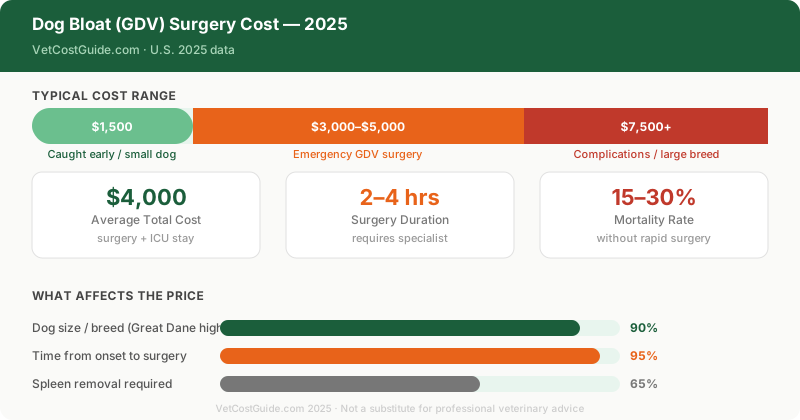
11 p.m. Your Great Dane is pacing, trying to vomit, and his belly looks like a basketball. You’ve just found yourself in the middle of gastric dilatation-volvulus — GDV — and the clock is already running. The total bill for emergency GDV treatment lands between $2,000 and $7,500, and that number arrives at the worst possible moment. But this is one of the few veterinary emergencies where knowing the cost in advance — and having a plan — genuinely determines whether your dog comes home.
- Total GDV treatment cost ranges from $2,000 for uncomplicated cases to $7,500 for dogs requiring intensive stabilization and complications management.
- Emergency surgery itself costs $1,500–$4,500; ICU hospitalization for 2–3 days adds $800–$1,500 on top of that.
- Adding a prophylactic gastropexy (stomach-tacking surgery) costs $300–$500 extra during the GDV procedure and prevents recurrence in the other 80% of at-risk dogs.
- Without surgery within 6 hours of symptom onset, mortality exceeds 50%; even with surgery, overall survival rates run 75–85% depending on how quickly treatment begins.
What GDV Treatment Actually Costs
| Type | Low | Average | High |
|---|---|---|---|
| ER exam + initial stabilization | $300 | $450 | $600 |
| IV fluids + decompression | $200 | $325 | $450 |
| GDV surgery (gastropexy incl.) | $1,500 | $3,000 | $4,500 |
| Anesthesia + monitoring | $300 | $500 | $800 |
| ICU hospitalization (2–3 days) | $800 | $1,150 | $1,500 |
| Post-op medications + discharge | $100 | $175 | $250 |
| Gastropexy add-on (if not already included) | $300 | $400 | $500 |
| Total estimated cost | $2,000 | $4,500 | $7,500 |
Breaking Down What You’re Paying For
GDV treatment moves through several phases, each with its own costs.
Emergency stabilization comes first — an IV catheter, aggressive fluid resuscitation for shock, and decompression of the stomach. Decompression is done via a stomach tube or a needle trocar inserted through the body wall to release trapped gas. Pre-surgical bloodwork (CBC and chemistry panel) is standard here; the team needs to know how the kidneys and liver are doing before putting a dog under anesthesia.
The surgery itself involves repositioning the twisted stomach, decompressing it fully, and suturing it permanently to the body wall — the gastropexy step that prevents it from twisting again. If portions of the stomach wall or spleen have lost blood supply and begun to necrose, those tissues have to be removed. That adds time, surgical complexity, and cost.
ICU monitoring post-surgery typically covers 48–72 hours. Cardiac arrhythmias are common in the first day or two after GDV — the heart’s electrical system gets disrupted by the shock and vascular compromise. Continuous monitoring, pain management, IV antibiotics, and nutritional support are standard during this window.
Discharge medications usually include an antibiotic, a proton pump inhibitor, and pain medication for the first week at home.
What Pushes the Bill Higher
Time to treatment. Dogs that reach the ER early — before significant shock or tissue death — need less stabilization, shorter surgeries, and fewer ICU days. Each hour of delay increases both the biological complexity and the financial cost of treatment.
Geographic location. Emergency specialty hospitals in New York, Los Angeles, Chicago, or Seattle charge 40–60% more than similar facilities in mid-sized or rural markets. A procedure costing $3,200 in rural Ohio might run $5,500 in Boston.
Spleen involvement. In roughly 10–15% of GDV cases, the spleen also twists or becomes necrotic and must be removed (splenectomy). That adds $500–$1,000 to surgical costs.
Stomach wall necrosis. When gastric tissue has been without blood supply long enough to die, partial gastrectomy is required. This dramatically extends anesthesia time and surgical complexity, adding $800–$2,000 to the total.
Dog size. Large and giant breeds require more anesthesia, larger IV volumes, and longer surgical times. A 120-pound Great Dane costs meaningfully more to treat than a 60-pound Labrador — the pharmacology alone scales with weight.
Do not wait to see if symptoms resolve on their own. GDV symptoms — distended abdomen, unproductive retching, restlessness, pale gums — will not resolve without intervention. Every hour of waiting increases the chance of necrosis, arrhythmia, and death. Drive to an emergency hospital immediately. Also, don’t forgo the gastropexy to reduce costs. Without stomach tacking, recurrence risk for GDV is approximately 70–80%. A second GDV surgery costs the same as the first — the $300–$500 gastropexy add-on during the initial surgery is almost always the right decision. Finally, don’t assume your regular vet can handle this. GDV surgery requires general anesthesia, surgical experience, and 24-hour post-operative monitoring.
The Insurance Math for GDV-Prone Breeds
For Great Danes, German Shepherds, Standard Poodles, Weimaraners, and Dobermans, pet insurance isn’t a vague financial hedge — it’s a near-certainty calculation. Great Danes have a lifetime GDV incidence estimated at 42%. A typical accident-and-illness policy costs $45–$90 per month for a large-breed dog, with $200–$500 deductibles and 70–90% reimbursement. Against a $4,500 GDV bill with a $250 deductible and 80% reimbursement, you’d recover $3,400 — more than the annual premium. Policies need to be in place before any symptoms appear; GDV can’t be covered retroactively.
Prophylactic gastropexy — stomach tacking done electively when the dog is young, often at the time of spay or neuter — costs $300–$500 added to a routine procedure, or $800–$1,500 as a standalone laparoscopic surgery. For deep-chested, high-risk breeds, most veterinary surgeons strongly recommend it.
Strategies That Actually Reduce Your Bill
Enroll in pet insurance before 12 months of age. The younger the dog at enrollment, the lower the premium and the fewer potential exclusions. Waiting until symptoms develop means the most likely emergencies won’t be covered.
Ask about prophylactic gastropexy during spay or neuter. Adding it when the dog is already under anesthesia is the most cost-effective window — $300–$500 added to an existing procedure rather than $1,000–$1,500 for a separate surgery later.
Know your nearest 24-hour emergency hospital before you need it. Time spent searching at 1 a.m. is time your dog doesn’t have. Save the address and phone number now.
Ask about payment plans at intake. Most emergency hospitals offer CareCredit, Scratchpay, or internal payment plans. Asking about financing when you arrive — not after the procedure — gives you time to set it up without delaying care.
Compare regional emergency facilities when possible. In markets with multiple 24-hour ERs, prices can vary $800–$1,500 for identical procedures. If the dog is stable enough for a 15-minute additional drive, a quick call to compare isn’t unreasonable.
Frequently Asked Questions
What are the first signs of bloat in dogs? The classic signs are a visibly distended or hard abdomen, repeated unproductive retching (trying to vomit without producing anything), restlessness or inability to get comfortable, drooling, and pale or white gums in advanced cases. Any dog exhibiting unproductive retching with an enlarged belly should be treated as a GDV emergency immediately.
Can a dog survive GDV without surgery? No. GDV is fatal without surgical correction. Gastric decompression can temporarily relieve gas pressure, but the twisted stomach cannot untwist on its own and will continue cutting off blood supply to surrounding tissue. Survival without surgery is not documented in the veterinary literature.
How long does GDV surgery take? The surgery itself typically takes 1.5 to 2.5 hours depending on complexity. Pre-surgical stabilization adds 30–60 minutes. Post-operative ICU monitoring continues for 48–72 hours in most cases.
Which dog breeds are most at risk for GDV? Deep-chested, large and giant breeds carry the highest risk: Great Danes (up to 42% lifetime risk), Standard Poodles, German Shepherds, Weimaraners, Doberman Pinschers, Irish Setters, Gordon Setters, and Basset Hounds. Risk factors include once-daily large-meal feeding, rapid eating, exercise immediately after meals, and first-degree relatives who’ve had GDV.
Frequently Asked Questions
Emergency GDV surgery typically costs between $1,500 and $7,500, with an average of around $4,000 to $5,000 at most US veterinary emergency hospitals. Additional costs for imaging (ultrasound or X-rays), pre-operative blood work, anesthesia, and post-operative care can push the total toward the higher end of this range.
Most pet insurance plans cover GDV surgery as an emergency condition, but you typically pay the full bill upfront and submit a claim for reimbursement of 70–90% after the fact. However, some policies exclude or limit coverage for emergencies, have high deductibles ($500–$1,000), or cap annual payouts, so reviewing your specific policy before an emergency occurs is critical.
GDV is life-threatening and requires surgery within 4–6 hours of symptom onset to maximize survival chances; after 12 hours, the risk of death increases significantly due to tissue damage and organ failure. Symptoms include a hard, distended abdomen, unproductive vomiting, excessive drooling, and restlessness, so any dog showing these signs should be rushed to an emergency veterinary clinic immediately.