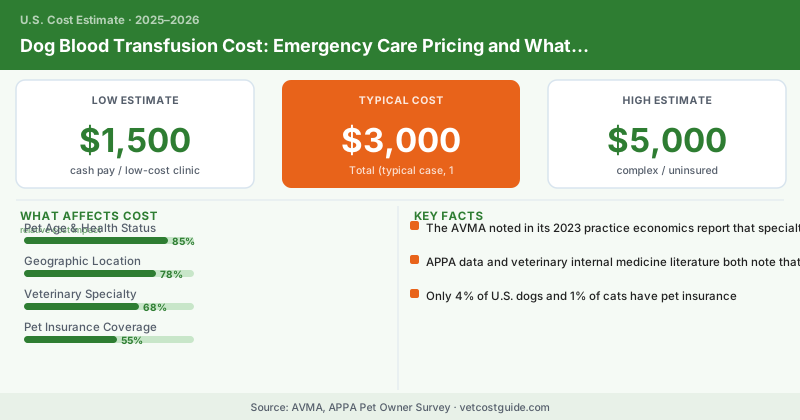
In 2010, a unit of canine packed red blood cells cost around $200. Today, that same unit runs $400–$700 at most emergency hospitals — a reflection of how complex veterinary blood banking has become. If your dog needs a transfusion, you’re looking at $500–$2,500 just for the blood, plus the cost of the emergency visit, diagnostics, and hospitalization on top of that. Total bills in the range of $2,000–$5,000 are common. Here’s what you need to understand.
- Packed red blood cells (pRBC), per unit: $400–$700
- Whole blood, per unit: $300–$500
- Fresh frozen plasma (FFP), per unit: $200–$400
- Platelet concentrate, per unit: $500–$900
- Most dogs need 1–3 units; large dogs with severe anemia may need more
- Total transfusion cost (blood only): $400–$2,500
- With ER visit, diagnostics, and hospitalization: $1,500–$5,000+
Full Emergency Cost Breakdown
| Service | Low | Average | High |
|---|---|---|---|
| Emergency exam + triage | $100 | $200 | $350 |
| CBC + blood chemistry | $150 | $225 | $350 |
| Crossmatch / blood typing | $75 | $125 | $200 |
| Packed red blood cells (per unit) | $400 | $550 | $700 |
| Whole blood (per unit) | $300 | $400 | $500 |
| Fresh frozen plasma (per unit) | $200 | $300 | $400 |
| IV fluid support | $100 | $200 | $350 |
| Hospitalization (per night, ICU) | $400 | $700 | $1,200 |
| Monitoring (continuous, per day) | $150 | $250 | $400 |
| Total (typical case, 1–2 units + 2 nights) | $1,500 | $3,000 | $5,000 |
Why Blood Is This Expensive
Veterinary blood banking is genuinely complex. Unlike human blood banks supported by volunteer donations and government health infrastructure, veterinary blood has to be commercially sourced or maintained by blood donor programs at specialty hospitals.
Commercial veterinary blood banks — companies like Animal Blood Resources International (ABRI) and Hemoglobin Oxygen Therapeutics — maintain donor animal programs, perform extensive infectious disease screening on every unit, and ship refrigerated products overnight to hospitals across the country. The costs of running those programs are built into the per-unit price.
Specialty hospitals with in-house donor programs can sometimes offer lower per-unit prices, but they’re the exception. Most emergency clinics buy blood from commercial suppliers and pass through the cost with a markup.
The AVMA noted in its 2023 practice economics report that specialty emergency care — including critical care and transfusion medicine — is one of the fastest-growing segments of veterinary expenditure, with costs rising an average of 7% per year since 2019.
When Dogs Need Blood Transfusions
The two most common reasons are acute hemorrhage and immune-mediated hemolytic anemia (IMHA).
Acute hemorrhage — from trauma, surgery, or internal bleeding (ruptured splenic mass, for example) — can drop a dog’s packed cell volume (PCV) below the 20–25% threshold where the body can’t adequately oxygenate tissues. A single large splenic bleed can require 2–4 units of blood support before and during surgery.
IMHA (immune-mediated hemolytic anemia) is a condition where the immune system attacks and destroys red blood cells. APPA data and veterinary internal medicine literature both note that IMHA carries a 30–40% mortality rate even with treatment — making it one of the more serious medical emergencies in dogs. Cocker Spaniels, Standard Poodles, and Old English Sheepdogs are disproportionately affected. Transfusions provide a “bridge” while immunosuppressive drugs (prednisone, often combined with other agents) bring the immune attack under control.
Other reasons include severe bleeding from toxin exposure (rodenticide poisoning causes coagulopathy, requiring fresh frozen plasma or whole blood), surgical blood loss, and hereditary anemias in certain breeds.
Blood Types and Crossmatching in Dogs
Dogs have multiple blood group systems — the most important being DEA 1.1 (Dog Erythrocyte Antigen 1.1). Roughly 40% of dogs are DEA 1.1 positive. A first-time transfusion without crossmatching is generally considered safe, because dogs rarely have pre-formed antibodies against DEA 1.1. But a second transfusion without blood typing risks a serious transfusion reaction.
Blood typing costs $75–$150 and takes 10–15 minutes with in-house test kits. Crossmatching — testing the recipient’s plasma against the donor’s red cells — is more comprehensive and costs $125–$200. In life-threatening emergencies, transfusion often begins before typing is complete, but it should follow as soon as possible.
Transfusion reactions can occur during or after the procedure — signs include vomiting, facial swelling, hives, rapid breathing, and collapse. These are most common in dogs with prior transfusion exposure who weren’t blood typed first, or in dogs receiving incompatible units. Most reactions are mild and manageable; severe anaphylaxis is rare but requires immediate treatment. During a transfusion, your dog should be monitored continuously by veterinary staff, with the transfusion rate adjusted and stopped immediately at the first sign of reaction.
Fresh Frozen Plasma and Platelets: What They’re Used For
Fresh frozen plasma (FFP) contains clotting factors — it’s used for rodenticide toxicity, DIC (disseminated intravascular coagulation), and liver failure where the dog can’t make its own clotting proteins. Unlike red cells, plasma transfusions don’t raise the PCV but stop the bleeding cascade. A dog with brodifacoum (rat poison) toxicity may need 1–2 units of FFP per day for several days, adding $400–$800/day to the hospital bill.
Platelet concentrate is the most expensive blood product and the most perishable — it must be used within 5 days of collection. It’s used for immune-mediated thrombocytopenia (ITP), where the immune system destroys platelets. At $500–$900 per unit, platelet transfusions significantly escalate costs. Not all emergency hospitals stock platelets; some must obtain them through same-day courier.
The Insurance Math
A $3,000 blood transfusion and ICU hospitalization case is exactly the kind of bill that separates owners with pet insurance from those without. A comprehensive accident-and-illness policy with 80% reimbursement and a $500 deductible would cover approximately $2,000 of that bill. Annual premiums for a medium-sized dog run $400–$900 — meaning a single transfusion event typically more than justifies several years of premium payments.
For breeds with elevated IMHA risk (Cocker Spaniels, Poodles) or those prone to splenic tumors (Golden Retrievers, German Shepherds), emergency coverage isn’t a hedge — it’s a near-certainty calculation.
Frequently Asked Questions
How long does a dog blood transfusion take? Individual units are administered over 4–6 hours to minimize the risk of volume overload. A dog receiving two units is typically transfused over 8–12 hours, with monitoring throughout. Some critically anemic dogs receive a “rescue” unit faster in true emergencies.
Can dogs donate blood? Yes. Dogs weighing over 50 pounds, under 8 years old, vaccinated, and healthy are often eligible to donate. Some emergency hospitals run donor programs offering free wellness care in exchange for periodic donations. Contact your local emergency hospital or search for ABRI-affiliated donor programs.
Will my dog need another transfusion after this one? Depends entirely on the underlying cause. A dog that had surgery for acute hemorrhage and is healing well typically doesn’t need additional transfusions. A dog with IMHA may need 2–4 transfusions over 1–3 weeks while immunosuppressive therapy takes effect. Your vet will monitor PCV every 12–24 hours to guide the decision.
Frequently Asked Questions
A single unit of canine packed red blood cells costs $400–$700 at most emergency hospitals, though the transfusion procedure itself may run $500–$2,500 depending on the facility. When combined with emergency visit fees, diagnostics, and hospitalization, total costs typically range from $2,000–$5,000.
Most pet insurance plans cover blood transfusions as part of emergency or accident/illness coverage, though you may face a deductible ($250–$1,000) and coinsurance of 10–20%. Some plans exclude blood transfusions entirely, so review your specific policy before an emergency occurs.
The transfusion itself typically takes 1–4 hours depending on the amount of blood needed and your dog's condition, though the full emergency visit usually lasts 4–8 hours. Most dogs show improvement within 24–48 hours and are discharged within 1–3 days of hospitalization, though full recovery may take 1–2 weeks.