Three scenarios. Three completely different bills.
A Chihuahua jumps off the couch wrong — radius fracture, incomplete break, splint for six weeks, total cost around $800. A Labrador gets clipped by a car — shattered femur, plate-and-screw fixation from a board-certified surgeon, $4,500 before rehabilitation. A Boxer lands badly after a fence jump — open fracture, contaminated, too complex to reconstruct — amputation is the best option at $2,000, and he’s running on three legs eight weeks later.
The fracture type, its location, and whether bone has broken through the skin determine what treatment is appropriate. Your budget, unfortunately, doesn’t get a vote.
- Initial X-rays to diagnose a fracture cost $150–$350; additional views or CT imaging for complex fractures add $400–$800.
- Splints and casts for simple, stable fractures cost $500–$1,200 total, but require 4–6 bandage changes at $75–$150 each during the 6–8 week healing period.
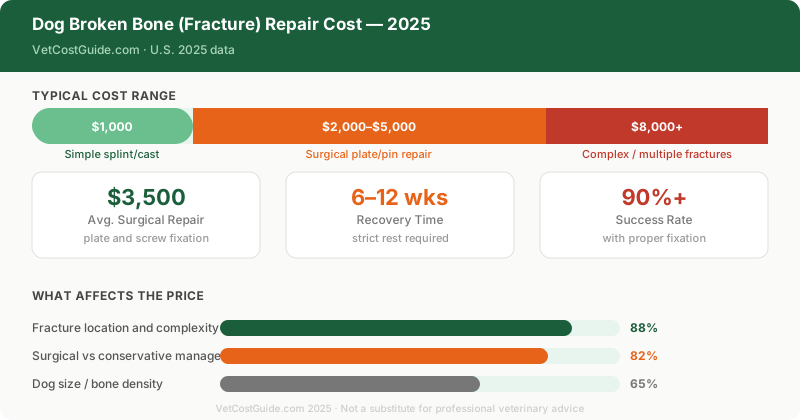
- Surgical plate-and-screw fixation for complex fractures costs $2,000–$5,000 at a surgical specialist and delivers the most reliable long-term outcome for articular and unstable fractures.
- Amputation costs $1,500–$3,000 and is often the fastest, least complicated treatment path for severely comminuted fractures in small dogs — dogs adapt remarkably well to three legs.
What Fracture Repair Costs in 2025
| Type | Low | Average | High |
|---|---|---|---|
| Initial X-rays (2–4 views) | $150 | $250 | $350 |
| CT scan (complex fractures) | $400 | $600 | $800 |
| Splint or cast (simple fracture) | $500 | $850 | $1,200 |
| Bandage change (per visit) | $75 | $112 | $150 |
| Surgical plate and screw fixation | $2,000 | $3,500 | $5,000 |
| External skeletal fixator (ESF) | $1,500 | $2,750 | $4,000 |
| Intramedullary pin fixation | $1,200 | $2,000 | $3,000 |
| Amputation | $1,500 | $2,250 | $3,000 |
| Post-op X-rays + rechecks | $300 | $450 | $600 |
| Rehabilitation therapy | $800 | $1,150 | $1,500 |
The Four Treatment Paths
Splinting and casting works for a specific, limited set of fractures — incomplete (greenstick) breaks, certain radius/ulna fractures in young dogs with strong healing potential, and mid-shaft fractures in bones that don’t face significant rotational stress. Initial application runs $300–$600. Then add bandage changes every 1–2 weeks for 6–8 weeks at $75–$150 each, putting total cast management at $500–$1,200.
Plate-and-screw fixation is the gold standard for most long-bone fractures, anything involving a joint surface, and unstable fractures where cast immobilization won’t hold the bone in alignment. A veterinary surgeon places a bone plate directly on the fracture site using cortical screws, providing immediate rigid stability. Dogs typically bear weight within days rather than weeks. This requires specialized implants, general anesthesia with monitoring, and 1–3 days of hospitalization.
External skeletal fixators (ESF) run pins through the skin and bone that connect to an external frame outside the body. They’re particularly suited for open fractures (where the skin is broken over the bone), contaminated wounds, or fractures that need adjustment during healing. Technically demanding, requiring weekly-to-biweekly frame checks while healing progresses.
Amputation — removing the limb entirely at the shoulder (forelimb) or hip (hindlimb) — sounds extreme. It often isn’t. For severely comminuted fractures (bone shattered into multiple pieces), open fractures with heavy contamination, or joint fractures that can’t be reconstructed, amputation is frequently the veterinary surgeon’s first recommendation. It’s faster, cheaper than complex reconstruction, and the recovery is more predictable. Dogs adapt to three legs — called “tripods” — within 4–6 weeks. The psychological adjustment, honestly, belongs mostly to the owner.
Factors That Drive the Cost
Open vs. closed fracture. A closed fracture (skin intact) is a repair. An open fracture (bone visible through skin) is an emergency — contaminated, at high risk for osteomyelitis (bone infection), requiring immediate debridement and potentially staged repair. Open fractures consistently cost $500–$1,500 more to treat.
Fracture location. Femur fractures almost always require surgery — powerful quadriceps muscles pull the fragments apart and can’t be managed externally. Radius/ulna fractures in small breeds have notably poor healing with splints alone due to thin bone diameter and limited blood supply; surgical repair is typically recommended. Rib fractures usually heal without intervention. Vertebral fractures may require spinal surgery ($4,000–$12,000).
Dog size and breed. Toy breeds — Chihuahuas, Yorkies, Pomeranians — commonly suffer radius fractures from furniture jumps, and these fractures have higher complication rates than identical fractures in medium or large breeds. Implants for small bones are technically challenging to place and don’t cost less just because they’re smaller. Large-breed plates are more expensive, and larger dogs need more anesthesia.
Specialist vs. generalist. Many general practitioners handle simple fractures well. Complex articular fractures, fractures requiring ESF, and most femur repairs belong with board-certified veterinary surgeons (DACVS). Specialist fees run 30–50% higher per hour, but complication rates are lower for the technically demanding cases.
Rehabilitation. Post-operative physical therapy — underwater treadmill, laser therapy, targeted strengthening — at $100–$200 per session over 6–12 sessions adds $800–$1,500 to total cost. It’s associated with better 12-month outcomes and reduced need for revision procedures.
Don’t attempt to splint a dog’s fracture at home before reaching the vet. Improper splinting can cut off blood flow to the limb, damage surrounding tissue, and worsen the fracture. Confine the dog, minimize movement, and transport carefully on a flat surface. Choosing the cheapest repair option without considering healing rates is also a genuine risk — budget-based decisions that opt for splinting when the fracture type actually requires surgery frequently result in malunion, delayed union, or implant failure, each requiring a second surgery that costs as much as doing it right the first time. And don’t underestimate bandage change costs: a splint that costs $400 to apply will require $600–$900 in bandage changes over the healing period. Skipping appointments leads to pressure sores and delayed healing.
Pet Insurance and Fracture Coverage
Fracture repair is one of the clearest-cut cases for pet insurance value. A $4,000 surgical repair with 80% reimbursement after a $250 deductible returns $3,000 — likely more than several years of premiums for a young dog. Fractures from trauma (car impact, falls, dog bites) are covered under accident policies, which are cheaper than full accident-and-illness plans and perfectly sufficient for orthopedic trauma.
Accident-only policies run $15–$30/month for most dogs. For owners primarily concerned about trauma events rather than illness — dogs near busy roads, dogs that regularly jump from height, or dogs that run loose — accident-only coverage addresses that specific risk at a low monthly cost.
How to Keep Costs Under Control
Get a specialist opinion before committing. An initial consult with a board-certified veterinary surgeon ($200–$400) gives you a clear diagnosis of fracture type and a full menu of options, including whether conservative management is genuinely appropriate. This consultation frequently prevents expensive failed conservative treatment that then requires surgery anyway.
Ask directly about amputation. Surgeons will recommend it when they think it’s right, but owners sometimes resist the idea without asking why. For many fracture types in small dogs, or fractures with heavy contamination, amputation is the fastest, most reliable, and most cost-effective path to a comfortable, mobile dog — often $1,000–$2,500 less than complex reconstruction.
Look at veterinary school teaching hospitals. University orthopedic services perform plate-and-screw fixation, ESF, and complex joint reconstruction at 20–40% below private specialist prices. Wait times for non-emergency cases may be 24–72 hours, but clinical quality is equivalent.
Plan for the full treatment arc, not just surgery day. Post-op X-rays, bandage changes, hardware removal, rechecks, and rehabilitation should all factor into any cost comparison. A cheap surgery with expensive ongoing management can easily exceed the cost of a comprehensive one-time specialist repair.
Frequently Asked Questions
How long does a broken bone take to heal in a dog? Simple fractures in young, healthy dogs heal in 6–8 weeks with proper fixation. Complex fractures, open fractures, and fractures in older dogs may take 10–16 weeks. Healing is confirmed by follow-up radiographs showing callus formation across the fracture line — not simply by the dog’s willingness to use the leg.
Will my dog be in pain with a broken bone? Yes, fractures are acutely painful. Emergency pain management with opioids and anti-inflammatory medications is standard from the initial presentation. Post-surgical pain is managed with multimodal protocols including NSAIDs, gabapentin, and often an opioid for the first 3–5 days. Adequate pain control isn’t optional and actually improves healing outcomes.
What is the most common cause of broken bones in dogs? Being hit by a car (HBC) is the leading cause of long-bone fractures, accounting for 50–70% of cases in most emergency hospital data. Falls from height are the leading cause in toy breeds. Dog bites, pathological fractures from bone tumors, and accidental trauma account for the rest.
Can a broken bone heal on its own without treatment? Occasionally — certain rib fractures and incomplete (greenstick) fractures in very young dogs. But long-bone fractures in dogs don’t reliably heal without intervention. Left untreated, they become infected, develop malunion or nonunion, and cause chronic pain. All long-bone fractures should be evaluated by a vet within 24 hours of injury.
Frequently Asked Questions
Dog fracture repair typically ranges from $1,000 to $8,000 depending on severity and treatment method. Simple fractures treated with splinting cost around $800, while complex fractures requiring plate-and-screw fixation from a board-certified surgeon can reach $4,500 or more, plus additional costs for rehabilitation and follow-up care.
Most pet insurance plans cover fracture surgery as an accident-related claim, though you typically pay out-of-pocket upfront and submit for reimbursement. Coverage usually ranges from 70–90% of eligible costs after your deductible, but pre-existing conditions and certain breeds may have exclusions or higher premiums.
Simple, incomplete fractures like a radius fracture in a small dog can often heal with splinting alone in 6 weeks for around $800. However, complex fractures (shattered bones, open wounds, or heavily contaminated breaks) require surgical plates and pins to stabilize properly and prevent permanent disability or amputation.