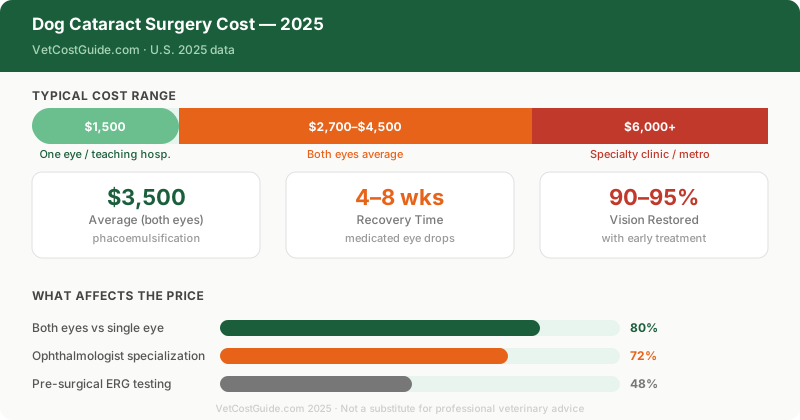
Human cataract surgery is practically a same-day procedure with a modest co-pay. You’re in, you’re out, your vision is clear. Dog cataract surgery doesn’t work that way — and not because the underlying technique is dramatically more complicated. It’s because there’s no assembly line for it. Every case goes through a board-certified veterinary ophthalmologist, requires specialized microsurgical equipment, and demands three months of post-op eye drops administered multiple times daily. Before you leave that referral appointment, you’re looking at $1,500 to $6,000 per eye depending on where you go.
- Single-eye surgery at a teaching hospital costs $1,500–$2,500; a private specialty clinic runs $4,000–$6,000 per eye.
- Both eyes averaged together typically cost $3,000–$5,000 total at a teaching hospital or $7,000–$10,000 at a private practice.
- Pre-surgical testing — ophthalmology exam and an electroretinogram (ERG) — adds $500–$900 before any cutting begins.
- Post-operative eye drops typically run $60–$120 per month for three months, adding $180–$360 per eye to the total cost.
What Dog Cataract Surgery Costs in 2025
| Service | Low | Average | High |
|---|---|---|---|
| Ophthalmologist exam (pre-surgical) | $200 | $300 | $400 |
| Electroretinogram (ERG test) | $300 | $400 | $500 |
| Cataract surgery – single eye (teaching hospital) | $1,500 | $1,900 | $2,500 |
| Cataract surgery – single eye (private specialty clinic) | $3,000 | $4,000 | $6,000 |
| Cataract surgery – both eyes (teaching hospital) | $2,500 | $3,500 | $4,500 |
| Cataract surgery – both eyes (private specialty clinic) | $5,500 | $7,500 | $10,000 |
| Post-op eye drops (per eye, 3 months) | $180 | $250 | $360 |
| Post-op recheck exams (2–3 visits) | $150 | $250 | $400 |
What’s Actually in That Invoice
The surgery itself is called phacoemulsification — an ultrasonic probe breaks up the cloudy lens into fragments, which are vacuumed out, and an artificial intraocular lens (IOL) implant is placed in the empty capsule. This is essentially the same procedure used in human cataract surgery, with the same microsurgical precision requirements.
A typical surgical fee covers the procedure, the IOL implant, anesthesia and monitoring, intraoperative retropulsion testing to verify implant position, and a first post-op exam. Some practices include one or two early recheck visits; others bill those separately.
What’s almost always billed separately: the pre-surgical ophthalmologist consultation ($200–$400), the electroretinogram ($300–$500), take-home eye drops (multiple formulations are usually dispensed), and follow-up visits beyond the first month.
Why There’s No Cheaper Version
There’s no general-practice alternative. Cataract phacoemulsification requires a board-certified veterinary ophthalmologist (DACVO) and specialty microsurgical equipment. You can’t route around this to save money.
The ERG test is non-negotiable. Before surgery, the ophthalmologist must confirm that the retina behind the clouded lens still functions. An electroretinogram measures electrical activity in retinal cells. If the retina has degenerated — as happens in progressive retinal atrophy (PRA), which is hereditary in many of the same breeds prone to cataracts — surgery restores no vision. The $300–$500 ERG prevents spending $3,000–$6,000 on a procedure that can’t help. No responsible ophthalmologist skips it.
Bilateral surgery is common and worth doing in one anesthetic event. Most dogs with cataracts develop them in both eyes. Operating on both during the same anesthetic session costs more upfront but saves a second anesthesia fee, second surgical setup, and the risk of a second recovery. The two-eye total at a specialty clinic ($7,000–$10,000) is significantly less than two separate single-eye procedures would be.
Location moves the price substantially. Ophthalmology practices in New York, Los Angeles, Chicago, or Seattle charge 20–40% more than practices in smaller cities or Midwestern states. The same case that costs $2,500 per eye in Columbus might cost $4,500 per eye in Manhattan.
Delaying surgery too long is a real risk. Mature and hypermature cataracts are harder to remove and carry higher complication rates than immature ones. If your vet identifies a developing cataract, consult an ophthalmologist early — don’t wait until vision is fully gone. Never let anyone skip the ERG to reduce pre-surgical costs — it’s the essential gatekeeping test that prevents futile surgery. And factor in post-op costs before approving the procedure: eye drops, recheck exams, and potential complication management in the three to six months after surgery can add $500–$1,000 to the total.
Insurance Coverage — The Hereditary Condition Problem
Cataract surgery generates some of the highest single claims in veterinary ophthalmology. With a $500 deductible and 80% reimbursement on a $7,000 bilateral surgery, you’d recover approximately $5,200. That’s a compelling number.
The complication: cataracts in dogs are frequently hereditary. Labrador Retrievers, Golden Retrievers, Poodles, Cocker Spaniels, Boston Terriers, and Bichon Frises are all high-risk breeds. Many insurers classify hereditary cataracts as a breed-specific exclusion, particularly if any prior documentation of lens changes exists before the policy start date.
Enroll your dog before any eye symptoms are noted, and specifically ask about hereditary condition coverage during enrollment. If lens cloudiness is already documented in your dog’s records, some policies will exclude the condition as pre-existing. Even a policy that covers only one eye at 80% can return $2,000–$4,000 on a single claim.
Ways to Reduce What You Pay
Request a teaching hospital referral. Veterinary schools with ophthalmology residency programs — Colorado State, Cornell, UC Davis, University of Wisconsin, and others — perform cataract surgery at 25–40% lower cost than private specialty clinics. A DACVO faculty member supervises the resident throughout the case; outcomes are comparable.
Do both eyes in one anesthetic event. If both eyes need surgery, same-session bilateral repair saves the second anesthesia induction, monitoring time, and surgical setup — typically reducing the two-eye total by $800–$1,500.
Ask about the IOL upcharge. Most ophthalmologists include a standard IOL in the surgery price. Premium implant options are sometimes offered at additional cost. The standard lens produces good functional vision in nearly all dogs; the upgrade is rarely medically necessary.
Price medications outside the practice. Post-op eye drops are sometimes available through compounding pharmacies or human pharmacies at lower cost than the practice dispensary. Ask your ophthalmologist whether specific formulations can be filled elsewhere before assuming you must buy them on-site.
Use CareCredit or Scratchpay. Most veterinary specialty clinics accept third-party financing. A 0% APR promotion period of 12–18 months makes a $6,000–$8,000 total bill manageable at $400–$650 per month without interest.
Frequently Asked Questions
Can cataracts in dogs be treated with eye drops instead of surgery? No. Eye drops marketed as cataract treatments for dogs have no peer-reviewed evidence of efficacy. Cataracts are a physical cloudiness of the lens proteins — they can’t be reversed with medication. Surgery is the only treatment that restores vision.
What happens if I don’t do the surgery? Untreated cataracts can progress to lens-induced uveitis (painful intraocular inflammation), glaucoma, and in severe cases lens luxation. Many dogs with untreated mature cataracts develop secondary glaucoma that’s more expensive and painful to manage than the original surgery would’ve been. Even if you decline surgery, regular ophthalmology monitoring is recommended.
How long does recovery take? Most dogs return to normal activity within two to four weeks. The first two weeks require strict Elizabethan collar use and multiple daily eye drop applications. Full resolution of post-surgical inflammation takes six to eight weeks. Long-term outcomes are excellent — roughly 85–90% of dogs that pass pre-surgical testing regain functional vision.
Does my dog need to be a certain age to have cataract surgery? There’s no strict age cutoff, but the ophthalmologist will assess cardiac and anesthetic risk, particularly in older dogs. Pre-surgical bloodwork and sometimes cardiac evaluation are standard for dogs over eight years old. Age alone is rarely a disqualifying factor if the dog is otherwise healthy.
Frequently Asked Questions
Dog cataract surgery typically costs $1,500–$4,500 per eye, depending on your location, the veterinary ophthalmologist's experience, and any pre-operative testing required. If your dog needs both eyes treated, you should budget $3,000–$9,000 total for the complete procedure.
Most pet insurance plans do not cover cataracts because they are considered a pre-existing condition if present before enrollment, or are excluded as a hereditary condition in many breeds. You'll typically pay the full $1,500–$4,500 per eye out-of-pocket, though some accident-only plans may cover cataracts caused by injury.
Recovery from dog cataract surgery takes approximately 3 months, during which your dog requires strict activity restriction, multiple daily eye drops, and frequent follow-up visits to a veterinary ophthalmologist. Full vision restoration typically occurs within 4–6 weeks, but the extended recovery period ensures proper healing and reduces infection risk.