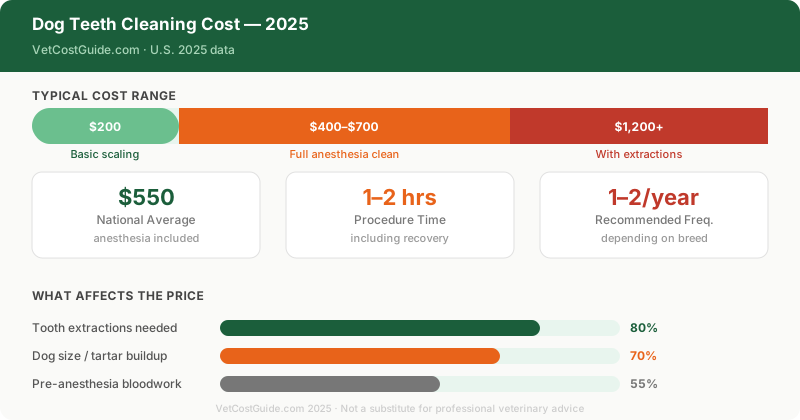
Eighty percent of dogs have measurable periodontal disease by their third birthday — that’s a figure the American Veterinary Dental College has documented consistently, and it’s one that tends to land quietly in the middle of a routine exam when a vet says “your dog’s teeth really need attention.” Most owners had no idea. Dental disease doesn’t bark. It doesn’t limp. It doesn’t show up on the surface of your dog until it’s moved so deep into the jaw that teeth are literally rotting at the roots. By then, what could’ve been a $400 cleaning has become a $1,500 extraction marathon.
The financial case for prevention isn’t complicated. It’s just easy to put off.
- Professional dental cleaning under anesthesia costs $300–$700 at most private vet practices.
- Each tooth extraction adds $150–$500 per tooth — advanced disease can mean 3–8 teeth needing removal.
- Daily tooth brushing is the most effective prevention; dental chews and water additives cost $15–$30/month.
- Annual prevention spending of $180–$360 can defer or eliminate the need for $800–$2,000 dental procedures.
Dog Dental Disease Cost Breakdown
| Service | Low Estimate | High Estimate |
|---|---|---|
| Professional dental cleaning (no extractions) | $300 | $700 |
| Dental cleaning with 1–2 simple extractions | $500 | $1,000 |
| Dental cleaning with multiple extractions (advanced disease) | $800 | $2,000 |
| Single tooth extraction (simple, no root elevation needed) | $150 | $300 |
| Single tooth extraction (surgical, multi-rooted or retained root) | $250 | $500 |
| Dental radiographs (full-mouth series) | $150 | $300 |
| Tooth resorption treatment | $200 | $400 |
| Root canal (specialist) | $1,500 | $3,000 |
| Daily dental chews (e.g. Greenies, Virbac CET) | $15 | $30 |
| Water additive (monthly supply) | $15 | $25 |
| Enzymatic toothpaste and toothbrush | $10 | $20 |
Why the Vet Can’t Just “Scrape the Teeth”
You’ve probably seen the $25 tartar scrapers at the pet store. Here’s why vets won’t use one and call it a dental cleaning.
Periodontal disease lives below the gumline. That’s where bacteria dig into the pockets between tooth and jaw, destroying the bone that holds teeth in place. A cleaning that only addresses visible surface tartar is like mopping the floor while ignoring a burst pipe in the wall — the mouth looks cleaner and the disease keeps progressing.
What a real professional cleaning actually includes:
- Scaling — Ultrasonic and hand instruments remove calculus both above and below the gumline
- Probing — Each tooth pocket is measured individually to detect how deep disease has penetrated
- Full-mouth dental radiographs — Studies show that X-rays change the treatment plan in roughly 50% of dogs, catching bone loss and root disease that’s completely invisible from the surface
- Polishing — Smooths enamel post-scaling to slow future tartar accumulation
- Irrigation — Antibacterial rinse flushed into every pocket
- Anesthesia and monitoring — General anesthesia with IV fluids, intubation, and continuous vital monitoring throughout
Extractions happen during the same appointment when teeth are determined unsalvageable. Simple single-rooted teeth (incisors) run $150–$300. Multi-rooted surgical extractions — carnassials and molars that have to be sectioned and removed root by root — cost $250–$500 each because they’re genuinely difficult surgeries.
One important note on “anesthesia-free” dental cleanings advertised at groomers and mobile services: the American Veterinary Dental College has gone on record calling them inadequate and potentially misleading. They remove surface tartar. They don’t treat disease. And they create a false sense of security that delays actual care while disease worsens invisibly below the gumline.
The Four Stages — and the Four Price Tags
Stage matters more than almost anything else in calculating your bill.
Stage 1 — Gingivitis: Gum redness and mild swelling, but no bone loss yet. Fully reversible. A cleaning now costs $300–$500 and your dog’s mouth is back to normal.
Stage 2 — Early Periodontal Disease: Up to 25% bone loss around some teeth. Still manageable. Clean plus maybe one or two extractions: $400–$700.
Stage 3 — Moderate Disease: 25–50% bone loss. Multiple extractions are likely. You’re looking at $700–$1,200.
Stage 4 — Advanced Disease: Over 50% bone loss. Teeth are mobile or abscessed, and systemic infection is a real concern. Multiple surgical extractions, possible specialist referral: $1,200–$2,500 or more.
The jump from Stage 1 to Stage 4 happens silently over two to three years of skipped dental care. Dogs are stoic — a dog pawing at their mouth or dropping food is already in severe pain. They don’t signal discomfort until it’s overwhelming.
Who Pays More (and Why)
Small breeds get hit hardest. Chihuahuas, Yorkshire Terriers, Dachshunds, and similar breeds have the same number of adult teeth as a Labrador packed into a jaw a fraction of the size. That overcrowding accelerates periodontal disease dramatically — many small dogs need annual cleanings starting at age two or three.
Brachycephalic breeds — Bulldogs, Pugs, French Bulldogs, Shih Tzus, Boxers — have even more severe crowding problems because they’ve got too many teeth for too little jaw. Extraction frequency is high in these breeds.
Large breeds have complex root systems on big teeth. Extracting a lower first molar in a 90-pound Rottweiler is a different undertaking than in a 12-pound Maltese, and it’s priced accordingly.
Geography adds 30–60% in coastal metro areas versus rural mid-America for equivalent services.
Anesthesia-free dental cleanings remove surface tartar cosmetically but do not treat subgingival periodontal disease where infection actually lives. The AVDC considers them inadequate and potentially harmful if they delay proper treatment while disease worsens invisibly below the gum line. Don’t skip dental radiographs to save money — X-rays change the treatment plan in roughly half of all dental cleanings. Skipping them means extracting some teeth that could be saved, and leaving diseased roots behind in others. And don’t wait for visible signs before seeking care: dogs are stoic, and a dog drooling, dropping food, or pawing at their mouth already has severe, painful dental disease. Annual exams with dental assessment catch disease at Stage 1–2 when treatment is simpler and cheaper.
The $200/Year vs. $2,000 Math
Daily tooth brushing — enzymatic toothpaste ($8–$15) plus a finger brush or soft toothbrush ($5–$10) — is the single most effective prevention available. Brushing five days out of seven removes plaque before it mineralizes into the tartar that causes periodontal disease. Startup cost: $15–$25. Ongoing: replace toothpaste every couple of months.
VOHC-accepted dental chews (Greenies, Virbac CET, Purina DentaLife) carry the Veterinary Oral Health Council seal — that means controlled studies confirmed they actually reduce plaque and tartar, not just freshen breath. Cost: $15–$30/month depending on your dog’s size.
Water additives (Healthymouth, TropiClean) work through daily water supplementation to suppress oral bacteria. No brushing required. Less effective than brushing, but far better than nothing. About $15–$25/month.
Dental diet food (Hill’s t/d, Royal Canin Dental) uses specific kibble size and texture for mechanical cleaning during chewing. Runs $40–$80/month. Best option for dogs that won’t tolerate any other prevention method.
The math is simple: $200/year in prevention versus $1,000–$2,000 in advanced dental treatment every year or two. Annual cleanings at Stage 1 combined with consistent home care are dramatically more economical than repeatedly treating advanced disease.
Pet Insurance and Dental Coverage
Standard pet insurance classifies routine dental cleanings as preventive care — typically not covered. However, complications of dental disease (abscesses, oral masses, jaw fractures from severe bone loss) are usually covered as illness or injury. Dental illness add-ons are available from select carriers including Embrace and Nationwide.
If your dog already has documented dental disease, expect pre-existing condition exclusions to apply to any dental claims. Enroll young, before problems develop.
FAQ
Why does my dog need anesthesia for a cleaning? Subgingival scaling requires a motionless patient — there’s no way to safely instrument below the gumline in a conscious dog. Anesthesia also protects the airway from bacteria and debris during the procedure. In healthy adult dogs, serious anesthetic complications occur in fewer than 0.1% of cases.
How often should my dog get a professional cleaning? Depends on the individual. Small and brachycephalic breeds often need annual cleanings starting around age three. Larger breeds who receive consistent home care may only need cleaning every two to three years. Your vet’s oral exam determines the schedule.
What happens if I skip dental care entirely? Advanced periodontal disease is chronically painful, even when a dog doesn’t show it. Abscessed teeth can spread infection. The financial cost of Stage 4 disease is $1,200–$2,500 or more in a single visit — on top of the years of discomfort your dog quietly endured.
Can brushing at home replace professional cleanings? Daily brushing dramatically slows tartar accumulation, but it doesn’t eliminate the need for professional cleanings forever — just like flossing doesn’t replace your own dental checkups. Most dogs still benefit from occasional professional cleanings to address buildup and probe for periodontal pockets that home care can’t reach.
Frequently Asked Questions
Professional dental cleanings at a veterinary clinic typically cost $300–700, depending on your dog's age, health status, and the severity of disease present. Extractions, which are often necessary during the cleaning, add $150–500 per tooth to the total bill.
Most standard pet insurance plans exclude routine dental cleanings and periodontal disease as pre-existing conditions or categorize them as routine care with little to no coverage. You'll typically pay the full $300–700 out-of-pocket unless you purchase a specialized dental rider, which costs extra and often covers only 50–70% of cleaning costs.
Dogs should have their teeth checked annually by a vet, and most dogs benefit from professional cleanings every 1–2 years once disease is caught. Prevention through daily brushing ($15–30 per month in supplies and care) can significantly delay or reduce the need for professional cleanings.