Most people don’t budget for dental X-rays when they schedule their dog’s teeth cleaning. Then they get a call mid-procedure: “We took X-rays and found a few things — your total is going to be higher than the estimate.” If you’ve been through that, you know the helpless feeling of authorizing costs you didn’t see coming while your dog is already under anesthesia.
Here’s how to avoid that surprise, understand what you’re paying for, and know when dental X-rays are genuinely necessary versus nice-to-have.
What Dog Dental X-Rays Cost
| Service | Low | Typical | High |
|---|---|---|---|
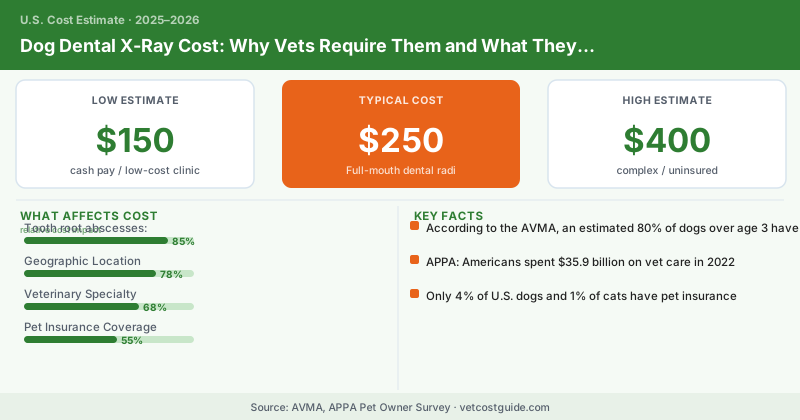
| Full-mouth dental radiographs | $150 | $250 | $400 |
| Partial dental radiographs (specific teeth) | $75 | $130 | $200 |
| Digital dental X-ray upgrade fee (if billed separately) | $50 | $100 | $200 |
| Dental cleaning (for comparison) | $200 | $400 | $800 |
| Cleaning + full-mouth X-rays (bundled) | $400 | $700 | $1,200 |
| Extraction (per tooth, simple) | $75 | $150 | $250 |
| Extraction (surgical, complicated root) | $150 | $350 | $600 |
Many practices include dental radiographs in their cleaning package — and some require them as standard of care. Others offer them as an add-on. If your vet’s cleaning estimate doesn’t mention X-rays, ask explicitly whether they’re included or available, and what they cost if added.
Why Dental X-Rays Are Worth the Cost
This is the number most owners balk at. “They’re just for cleaning, why do we need X-rays?”
Because 60–80% of dental disease in dogs is below the gumline where visual inspection can’t reach. A 2018 study in the Journal of Veterinary Dentistry found that in dogs without any visible abnormality above the gumline, dental radiographs revealed significant pathology — tooth root abscesses, bone loss, fractured root tips, resorptive lesions — in 27% of cases.
The American Veterinary Dental College (AVDC) and the American Animal Hospital Association (AAHA) both recommend full-mouth dental radiographs as standard of care for every dental procedure under anesthesia.
- Tooth root abscesses: Infection at the root tip under intact-looking teeth. Painful, and invisible without X-ray.
- Bone loss (periodontal disease severity): X-rays show how much bone is actually gone around tooth roots — critical for deciding whether a tooth can be saved.
- Fractured roots: Sometimes a tooth looks intact but the root has fractured. That retained root fragment causes ongoing infection without radiographic identification.
- Retained deciduous teeth: Baby teeth that didn’t fall out cause crowding and disease — easy to see on X-ray, invisible on exam.
- Dentigerous cysts: Cysts around unerupted adult teeth that can damage surrounding bone.
- Resorptive lesions: More common in cats but occur in dogs too — areas where the tooth structure breaks down from the inside.
What Digital Dental Radiography Actually Involves
Veterinary dental X-rays use the same technology as your own dentist — small sensors placed in the mouth to capture images of individual teeth and their roots. Under anesthesia, the dog doesn’t feel the sensor placement. A full-mouth series covers all tooth arcades and typically takes 20–40 additional minutes during the anesthetic procedure.
Digital radiography (the current standard) provides immediate images viewable on a monitor, better resolution than older film, and significantly lower radiation dose than film-based systems.
The Real Cost Equation: X-Rays Prevent Expensive Problems
Dogs don’t show tooth pain the way you’d expect. They keep eating. They may favor one side, rub their face, or resist having their muzzle touched — but many owners never notice. According to the AVMA, an estimated 80% of dogs over age 3 have some degree of periodontal disease, much of it causing pain the dog can’t communicate.
A tooth root abscess found on dental X-rays costs $300–$600 to extract (surgical extraction with careful root retrieval). Left undetected, that abscess can penetrate into the orbit (causing eye bulging or blindness), into the nasal cavity (causing chronic nasal discharge), or progress to osteomyelitis (jawbone infection) — any of which costs $1,000–$3,000+ to treat.
The $150–$400 X-ray is genuinely good medicine, not just a revenue line.
When Your Dog’s Dental Cleaning Estimate Goes Up Mid-Procedure
This is the situation most owners find stressful, and it’s worth understanding why it happens. Your vet gives an estimate before the procedure — but they don’t know what the X-rays will show, and they certainly can’t see below the gumline during an awake exam. Once the dog is under anesthesia and X-rays are taken, the real picture emerges.
If significant extractions are needed, costs can add $300–$1,500 on top of the cleaning estimate. What you can do:
- Authorize a range, not a fixed number. Ask your vet to call you mid-procedure if costs exceed the estimate by more than $X, but authorize up to a reasonable amount ($500–$800 above estimate) for necessary treatment.
- Ask about common findings for your dog’s breed and age. A 10-year-old Cavalier King Charles Spaniel is more likely to have significant disease than a 4-year-old Lab. A realistic conversation upfront prevents surprise.
- Don’t refuse X-rays to save money. If extractions are needed and missed because no X-rays were taken, your dog goes home in pain with ongoing infection. That’s not a savings — it’s a deferred cost with suffering attached.
Teeth cleaning without dental radiographs is not the standard of care, according to the AVDC and AAHA. If a practice offers dental cleanings at suspiciously low prices and doesn’t include or offer X-rays, ask specifically about their radiograph protocol. “Anesthesia-free dental cleanings” — offered at some grooming and non-veterinary facilities — are not cleanings at all; they remove visible surface tartar while leaving all subgingival disease untouched, and the AVMA and AVDC both oppose them as ineffective and misleading.
Saving on Dog Dental Care
Schedule before disease advances. Mild-to-moderate periodontal disease requires cleaning and may not need extractions. Severe disease requires extractions and drives costs significantly higher. Annual or biannual dental exams let your vet catch progression before extraction becomes necessary.
Ask about dental cleaning packages. Some practices bundle cleaning + X-rays + pre-anesthetic bloodwork at a package rate 10–20% below itemized pricing.
Dental insurance riders. Some pet insurance plans include dental illness coverage (not just trauma), which can cover cleaning, X-rays, and extractions for periodontal disease. Read your policy carefully — “dental accidents” coverage is not the same as “dental illness” coverage.
Veterinary dental schools. Most vet schools with dental specialty programs offer significantly discounted dental services performed by supervised dental residents. Quality is excellent; wait times are longer.
Frequently Asked Questions
How often should my dog get dental X-rays? The AVDC recommends full-mouth radiographs at every dental cleaning under anesthesia, regardless of frequency. Annual cleanings mean annual X-rays for most adult dogs; dogs with existing periodontal disease may need more frequent monitoring.
Are dental X-rays safe? Yes. Digital dental radiography uses very low radiation doses — well within safe limits for a single annual exposure. The anesthetic risk of the cleaning itself is far greater than any radiation consideration, and anesthetic risk in healthy dogs under proper protocols is under 0.1%.
My vet didn’t mention X-rays — should I ask? Yes. If your vet doesn’t proactively discuss dental radiographs, ask whether they’re included in the procedure and what they’d find if they took them. A practice that doesn’t offer dental radiographs at all may not be following current dental care standards.
Frequently Asked Questions
Dog dental X-rays typically cost $150–$400, depending on your veterinarian's location and the number of X-rays needed. This cost is usually in addition to the teeth cleaning procedure itself, which can range from $300–$800, so budgeting $500–$1,200 total for a complete dental cleaning with X-rays is reasonable.
Most standard pet insurance plans exclude routine dental care, including X-rays, though a few specialized dental plans may cover 50–80% of costs after deductibles. You'll typically pay out-of-pocket for dental X-rays, so it's worth asking your vet for an itemized estimate upfront before anesthesia.
Yes, veterinarians consider dental X-rays medically necessary during professional teeth cleanings because they reveal hidden problems like tooth root infections, bone loss, and abscesses that aren't visible to the naked eye. Without X-rays, your vet cannot safely assess whether teeth should be extracted or identify early-stage disease, making them a standard part of responsible dental care.