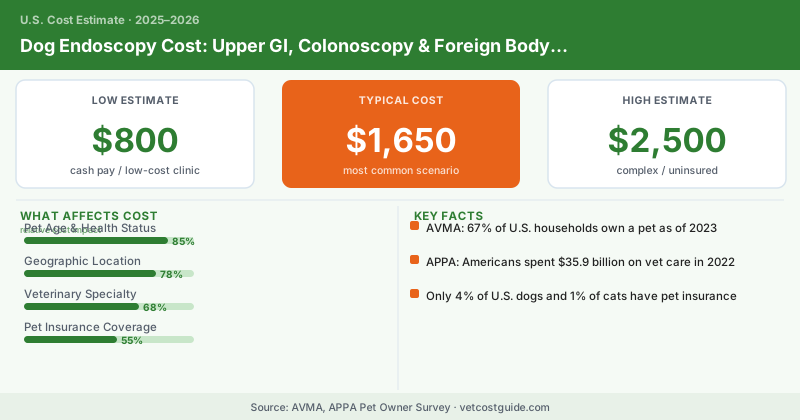
What does it cost when your dog swallows a sock and it doesn’t pass? Or when your vet wants a closer look at chronic vomiting that X-rays can’t explain? Dog endoscopy — the use of a flexible camera-equipped scope to visualize and sometimes treat the GI tract — costs between $800 and $2,500, and it’s often far less invasive than surgery.
Here’s everything you need to know before you get the bill.
Dog Endoscopy Cost Breakdown
| Procedure | General Practice | Specialist (Internist) | Notes |
|---|---|---|---|
| Upper GI Endoscopy (esophagoscopy/gastroscopy) | $800–$1,400 | $1,200–$2,000 | Visualizes esophagus, stomach, upper duodenum |
| Lower GI Endoscopy (colonoscopy) | $900–$1,500 | $1,200–$2,200 | Visualizes colon and rectum |
| Foreign Body Retrieval (endoscopic) | $1,000–$2,000 | $1,500–$2,500 | Removes swallowed objects without surgery |
| Biopsy Collection (GI biopsies) | Add $200–$400 | Add $200–$500 | Multiple samples, sent to pathology |
| Broncoscopy (airways) | $900–$1,600 | $1,200–$2,200 | Visualizes trachea and bronchi |
| Rhinoscopy (nasal) | $700–$1,400 | $1,000–$1,800 | For chronic nasal discharge or suspected nasal foreign bodies |
| Anesthesia (included in most quotes) | $200–$400 | Included | General anesthesia required for all scopes |
Prices at a specialist (board-certified internist) are higher but include a higher level of technical skill and more advanced equipment. If your general practitioner doesn’t have a scope, they’ll refer you to a specialist or university teaching hospital.
What Endoscopy Is Used For in Dogs
Chronic vomiting or regurgitation. When a dog vomits regularly and X-rays and ultrasound are inconclusive, endoscopy provides direct visualization of the mucosal lining. This is how inflammatory bowel disease (IBD), eosinophilic gastroenteritis, and early GI tumors are diagnosed — and differentiated from each other. Without biopsies, you’re guessing.
Swallowed foreign objects. Dogs eat things. Socks, corn cobs, toys, bones — some pass, some don’t. Endoscopy can retrieve objects lodged in the esophagus or stomach without surgery, saving you $2,000–$5,000 and your dog a significant recovery. The key is timing: objects that have passed into the small intestine usually can’t be retrieved endoscopically and may require surgery anyway.
Chronic diarrhea. When dietary changes, deworming, and empirical treatment haven’t resolved chronic diarrhea, colonoscopy with biopsies is the diagnostic gold standard for lower GI disease. The histopathology tells you exactly what type of inflammation is present — critical for choosing the right treatment.
Nasal discharge or epistaxis. Rhinoscopy looks for polyps, fungal infections (like Aspergillus), foreign bodies, and nasal tumors. It’s often performed alongside a CT scan for a complete picture.
Endoscopy is generally preferred over surgery when:
- The foreign body is in the esophagus or stomach (not intestine)
- Diagnostic biopsies are needed from the GI lining
- Surgery carries high anesthetic risk (sick or elderly dog)
- The diagnosis is unclear and surgery would be premature
Surgery is needed when:
- The foreign body has passed into the small intestine
- There’s a bowel obstruction or perforation
- A mass requires full-thickness biopsy or resection
- Endoscopy fails to retrieve the object
Ask your vet explicitly: “Can endoscopy handle this, or are we going to surgery regardless?” A good internist will be honest about when endoscopy is unlikely to be successful before charging you for the attempt.
What the Procedure Involves
Your dog will be fasted for 12–18 hours before the procedure. General anesthesia is required — dogs don’t cooperate with cameras down their throats or up their colons.
The procedure itself takes 20–45 minutes for a straightforward upper GI scope. Colonoscopy requires a prep the day before (a laxative protocol to clean the colon) and takes 30–60 minutes. Recovery from anesthesia is typically 1–3 hours, and most dogs go home the same day.
Biopsies, if taken, are sent to a veterinary pathologist. Results take 5–7 business days and are sometimes the most important piece of the whole workup.
Additional Costs to Anticipate
The endoscopy price is rarely the only cost. Most dogs getting scoped have already had:
- Bloodwork: $150–$300 (pre-anesthetic panel)
- X-rays or ultrasound: $200–$500 (to characterize the problem)
- Pathology on biopsies: $150–$350 (per submission, 6–12 biopsy sites typical)
A complete GI workup including endoscopy and pathology might run $1,500–$3,500 total by the time everything is tallied.
If IBD or another chronic condition is diagnosed, ongoing treatment — immunosuppressants like prednisone or cyclosporine, prescription hydrolyzed protein diets, B12 injections — adds $50–$300/month to ongoing costs.
If your dog swallows a foreign object, time matters. The sooner you call your vet, the higher the chance endoscopic retrieval is possible. Objects that pass into the small intestine within a few hours may be accessible only by surgery. Don’t wait to “see if it passes” for more than 24 hours — and call immediately if you see vomiting, lethargy, abdominal pain, or loss of appetite after a suspected ingestion.
Does Pet Insurance Cover Endoscopy?
Yes, if the underlying condition wasn’t pre-existing. Comprehensive policies (Trupanion, Healthy Paws, Embrace) cover endoscopy and the related diagnostics as part of illness coverage. Deductibles ($250–$500 typically) and coinsurance (80/20) mean you’ll pay some portion out of pocket.
For a $1,800 endoscopy, after a $500 deductible and 20% coinsurance on the remainder, you’d owe approximately $760. That’s a meaningful reduction on an expensive procedure.
If your dog is currently showing signs of GI disease and you don’t have insurance, check the policy terms carefully — many insurers exclude conditions that showed symptoms before enrollment, even if no formal diagnosis was made yet.
Frequently Asked Questions
Dog endoscopy typically costs $800–$2,500, depending on whether it's a basic upper GI scope, colonoscopy, or foreign body retrieval procedure. General practice veterinarians usually charge $800–$1,500, while board-certified specialists may charge $1,500–$2,500 for the same procedure.
Many pet insurance plans cover endoscopy if it's deemed medically necessary, though you'll typically pay 10–30% coinsurance after meeting your deductible ($250–$500). However, plans often exclude coverage for pre-existing conditions or accidental foreign body ingestion if swallowing objects was a known behavior before enrollment.
The procedure itself takes 30–60 minutes, and most dogs go home the same day after 2–4 hours of post-anesthesia monitoring. Most dogs recover fully within 24 hours, though vomiting or mild discomfort for 1–2 days is common as the digestive tract settles.