Marcus was 3 years old when his owner watched him collapse in the kitchen one Tuesday morning. His legs paddled, his jaw chomped rhythmically, and the whole episode lasted about 90 seconds. By the time he came around, disoriented and shaking, she was already on the phone with the vet. She had no idea what had just happened or what it was going to cost.
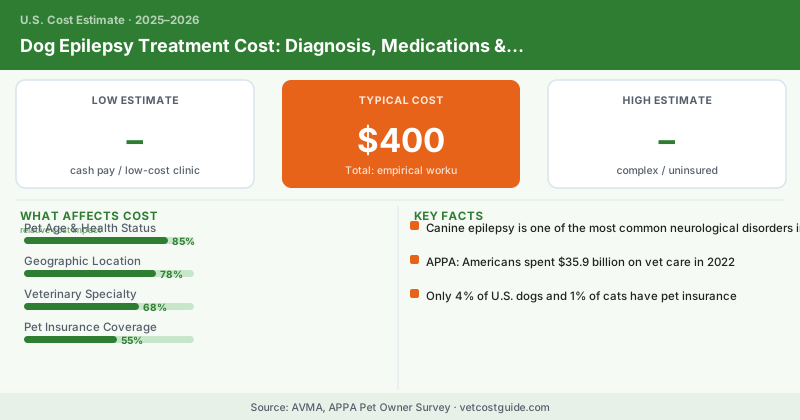
That scenario plays out thousands of times a year. Canine epilepsy is one of the most common neurological disorders in dogs — the AVMA estimates it affects roughly 0.6–0.75% of the dog population, translating to hundreds of thousands of dogs in the US. Most cases are idiopathic epilepsy, meaning there’s no identifiable structural cause. It’s manageable. It’s lifelong. And understanding the costs upfront makes it significantly less terrifying.
What Kind of Epilepsy Does Your Dog Have?
Vets generally classify canine seizure disorders into three categories:
- Idiopathic epilepsy — the most common type, accounting for roughly 60–70% of cases. Genetic in many breeds, with no underlying structural abnormality. Diagnosis is partly a diagnosis of exclusion.
- Structural epilepsy — caused by a brain lesion, tumor, inflammatory disease, or vascular event. Requires MRI to identify.
- Reactive epilepsy — caused by a systemic problem outside the brain: low blood sugar, liver disease, toxin ingestion, kidney failure. Blood work usually reveals the culprit.
Why does the type matter for costs? Because idiopathic epilepsy can often be diagnosed and treated empirically — without a $2,000 MRI. Structural and reactive causes require more diagnostic investment to treat appropriately.
Diagnosis Costs
A first-time seizure evaluation typically includes several steps:
| Diagnostic Test | Typical Cost | Notes |
|---|---|---|
| Physical + neurological exam | $100–$200 | Baseline for all cases |
| Complete blood panel + urinalysis | $200–$400 | Rules out metabolic/reactive causes |
| Bile acids test | $100–$200 | Checks for liver shunts, hepatic disease |
| MRI (brain) | $1,500–$3,000 | If structural cause suspected |
| CSF tap (cerebrospinal fluid) | $300–$600 | Usually performed alongside MRI |
| Total: empirical workup (no MRI) | $400–$800 | Typical for young dogs, normal neuro exam |
| Total: full structural workup | $2,000–$4,200 | For older dogs, abnormal exam, or focal seizures |
For a young dog (under 6 years) of a predisposed breed with a normal neurological exam between seizures, most neurologists accept empirical diagnosis of idiopathic epilepsy — meaning MRI isn’t mandatory before starting medication. For dogs over 6, dogs with abnormal neuro exams, or dogs with focal (partial) seizures rather than generalized ones, MRI becomes much more important.
Medication Options and Monthly Costs
| Medication | Monthly Cost | Monitoring Required | Notes |
|---|---|---|---|
| Phenobarbital | $30–$80 | Liver panel every 6 months | Most common first-line drug; very effective |
| Potassium bromide (KBr) | $20–$50 | Annual serum bromide level | Often added to phenobarbital; slow onset |
| Levetiracetam (Keppra) | $50–$150 | Minimal monitoring | Newer option; well tolerated; short-acting |
| Zonisamide | $60–$150 | Occasional CBC/chemistry | Good alternative or add-on |
| Phenobarbital monitoring panel | $150–$250 (per panel) | Every 6 months | Checks liver values and serum phenobarbital level |
Phenobarbital remains the most prescribed first-line anticonvulsant. It’s cheap, effective, and well-studied — the 2015 ACVIM Consensus Statement on Seizure Management in Dogs still lists it as the top recommendation. The monitoring requirement is real though: phenobarbital is metabolized by the liver, and long-term use can cause hepatotoxicity in some dogs. Those biannual liver panels aren’t optional.
Cluster seizures — more than 2 seizures within a 24-hour period — require emergency care. Even if each individual seizure resolves on its own, the cumulative stress on the brain is dangerous.
Status epilepticus — a single seizure lasting more than 5 minutes, or multiple seizures without full recovery in between — is a life-threatening emergency. Don’t wait to see if it stops.
Emergency treatment typically involves IV diazepam (valium), phenobarbital loading, oxygen support, and monitoring. Emergency ER visits for cluster seizures or status epilepticus typically run $500–$2,000 depending on duration and treatment intensity.
A first seizure lasting more than 5 minutes is a medical emergency. Brain damage and death can occur during prolonged seizure activity. Get to an emergency vet immediately — don’t wait for it to stop on its own.
Ongoing Annual Cost Estimate
Once your dog is stable on medication, annual costs typically look like this:
- Medication: $360–$1,800/year (depending on drug and dog’s weight)
- Monitoring bloodwork: $300–$500/year (two panels)
- Routine vet visits: $150–$300/year
- Emergency episodes (when they occur): $500–$2,000 per event
For a well-controlled dog on phenobarbital with no emergency episodes, expect $800–$2,500/year in total epilepsy-related costs. Larger dogs cost more because medication doses are weight-based.
Predisposed Breeds
Idiopathic epilepsy has a strong genetic component in many breeds. Dogs with higher-than-average prevalence include Border Collies, Australian Shepherds, Labrador Retrievers, Golden Retrievers, Beagles, and Belgian Tervurens. If you own one of these breeds, it’s worth knowing the signs and having a vet relationship in place before a first seizure occurs.
Pet Insurance and Epilepsy
Coverage for epilepsy is available through most major pet insurance plans — with a critical catch. If your dog has any documented seizures, neurological symptoms, or even a vet note saying “rule out epilepsy” before your policy’s enrollment date, the condition is likely excluded as pre-existing.
The math for insured owners can be compelling. A bad year with two emergency episodes, full diagnostics, and monthly medication might total $5,000–$6,000. An 80% reimbursement policy after a $250 deductible covers roughly $3,800 of that. Annual premiums for a mid-sized dog typically run $400–$800/year. Enroll young and healthy.
Frequently Asked Questions
How much does it cost to treat epilepsy in dogs? Diagnosis typically runs $500–$2,000 depending on whether an MRI is needed. Ongoing medications cost $30–$200 per month, plus monitoring blood panels every 6 months at $150–$250 each. Total annual costs for a well-managed epileptic dog often fall between $800 and $2,500.
Does pet insurance cover dog epilepsy? Most pet insurance plans cover epilepsy as long as it’s not a pre-existing condition — meaning your dog had no documented seizures or neurological symptoms before enrollment. Enroll while your dog is healthy and young to get the best coverage. Once epilepsy is on the medical record, it’s typically excluded.
Can epilepsy in dogs be cured? No. Idiopathic epilepsy is a lifelong condition, not a curable disease. Medications control seizure frequency and severity very effectively for most dogs, but they don’t eliminate the underlying condition. The goal is reducing seizures to the point where your dog has a good quality of life — and that’s achievable for the majority of epileptic dogs.
Frequently Asked Questions
Diagnosis typically runs $500–$2,000 depending on whether an MRI is needed. Ongoing medications cost $30–$200 per month, plus monitoring blood panels every 6 months at $150–$250 each. Total annual costs for a well-managed epileptic dog often fall between $800 and $2,500.
Most pet insurance plans cover epilepsy as long as it's not a pre-existing condition — meaning your dog had no documented seizures or neurological symptoms before enrollment. Enroll while your dog is healthy and young to get the best coverage. Once epilepsy is on the medical record, it's typically excluded.
No. Idiopathic epilepsy is a lifelong condition, not a curable disease. Medications control seizure frequency and severity very effectively for most dogs, but they don't eliminate the underlying condition. The goal is reducing seizures to the point where your dog has a good quality of life — and that's achievable for the majority of epileptic dogs.