Your dog just swallowed a corn cob — or a sock, a toy squeaker, or half a tennis ball. It happens fast, and the next 12 to 24 hours matter enormously. Foreign body removal in dogs costs anywhere from $800 for endoscopic retrieval to more than $5,000 for intestinal surgery when the object has passed too far to grab without cutting. Here’s a clear breakdown of what you’ll pay and why.
- Endoscopic retrieval (object still in stomach): $800–$2,000
- Gastrotomy (surgical stomach opening): $1,500–$3,000
- Enterotomy or intestinal resection (intestine involved): $2,500–$5,500
- Emergency stabilization, x-rays, and hospitalization add $500–$1,500 on top of surgery
- The ASPCA Animal Poison Control Center handles 400,000+ cases per year — foreign body ingestions are among the most common emergency calls
What Does the Procedure Actually Cost?
| Procedure Type | Low | Average | High |
|---|---|---|---|
| Initial exam + x-rays | $200 | $375 | $600 |
| Endoscopic retrieval (stomach) | $800 | $1,400 | $2,000 |
| Gastrotomy (surgery) | $1,500 | $2,200 | $3,000 |
| Enterotomy (small intestine) | $2,000 | $3,200 | $4,500 |
| Intestinal resection & anastomosis | $2,800 | $4,000 | $5,500 |
| Hospitalization (1–3 days) | $400 | $800 | $1,500 |
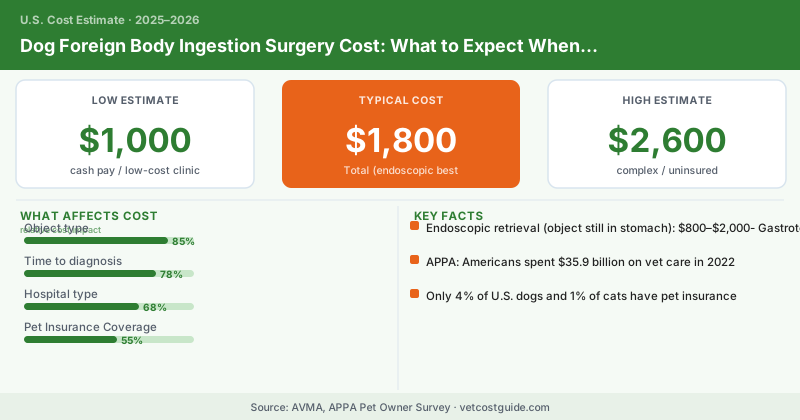
| Total (endoscopic best case) | $1,000 | $1,800 | $2,600 |
| Total (intestinal surgery worst case) | $3,200 | $5,200 | $7,500 |
Why the Location of the Object Changes Everything
The single biggest cost driver isn’t the type of object — it’s where it’s sitting. If your vet catches the problem while the object is still in the stomach, endoscopy might retrieve it without a single incision. That’s the best-case scenario: no major anesthesia risk, 24 hours of observation, and you’re home.
Once the foreign body passes into the small intestine, the calculus changes. The intestinal walls are more delicate, blood supply is critical, and perforation risk goes up with every hour the object sits there. If the tissue has been compromised, your vet has to resect the affected segment and reconnect the healthy ends — that’s a resection and anastomosis, the most complex and expensive outcome.
How long you wait matters. AAHA guidelines emphasize that intestinal compromise from a blocked foreign body can begin within hours. Dogs showing repeated vomiting, a hunched posture, refusal to eat, or visible abdominal pain need to be seen immediately — not the next morning.
What Affects the Final Bill
Object type. Linear foreign bodies — strings, rubber bands, tinsel — are among the most dangerous. They can fold the intestine into an accordion pattern, causing perforations in multiple places. Treatment is more complex and costlier than a single hard object.
Time to diagnosis. Dogs brought in within 4–6 hours of known ingestion often qualify for endoscopy or induced vomiting (if the object is small and non-sharp and the timing is right). Dogs that haven’t eaten for 18 hours and are showing septic signs need more aggressive intervention.
Hospital type. Emergency specialty hospitals charge 40–70% more than daytime general practices. If your regular vet is closed and you’re heading to a 24-hour ER, expect prices on the higher end of every range.
Geographic location. The same gastrotomy runs about $1,800 in rural Tennessee and $3,500 in the San Francisco Bay Area.
Post-operative care. Intestinal surgery dogs go home on restricted diets, antibiotics, and pain medications for 10–14 days. That’s an additional $100–$300 in discharge medications.
Never “wait and see” if you know your dog swallowed a sharp object, a large object, or a battery. Sharp items can perforate the esophagus or stomach before symptoms appear. Batteries cause chemical burns within hours. These are immediate emergency situations — not monitor-at-home cases. If you’re unsure, call your vet or an ASPCA Animal Poison Control hotline before deciding.
When Surgery Can Sometimes Be Avoided
For small, smooth objects (like a button or a small coin) in a dog without symptoms, vets sometimes recommend serial x-rays every 12–24 hours to confirm passage. This works only when the object is truly small relative to the dog’s size, round-edged, and not toxic. If there’s any doubt, surgery is the safer option — the cost of watching and waiting, then having to do emergency surgery after 36 hours is always higher than acting early.
Endoscopy is the real alternative to surgery. It’s less invasive, carries lower anesthetic risk, and typically costs 40–50% less than open surgery. It only works for objects in the esophagus or stomach — once the object passes the pylorus into the small intestine, a scope can’t reach it.
Paying for It: Your Options
Pet insurance covers foreign body removal under most accident-and-illness policies, provided there’s no previous claim for a similar incident. A typical claim on a $4,000 surgical bill with a $250 deductible and 80% reimbursement nets you back $3,000.
If you don’t have insurance, ask about CareCredit or Scratchpay at check-in — both provide 6–12 month interest-free financing for medical bills. Most large emergency hospitals accept them. Vet payment plans are also worth asking about directly.
Frequently Asked Questions
Can I make my dog vomit to get the object out? Only under veterinary direction. Inducing vomiting at home with hydrogen peroxide can cause serious injury and doesn’t reliably clear foreign bodies. Some objects — sharp items, large objects, corrosive substances — should never be brought back up. Always call your vet first.
How do I know if my dog is actually blocked? Classic signs include repeated vomiting (especially if it continues more than 2 hours), refusal to eat, lethargy, abdominal pain when you press on the belly, and a hunched posture. Some dogs with partial obstructions have intermittent symptoms that look like a “bad stomach day.” When in doubt, x-rays confirm it immediately.
Is anesthesia safe for this kind of surgery? For otherwise healthy dogs, yes — with appropriate pre-anesthetic bloodwork. The risk goes up if the dog is in shock, septic, or has organ compromise from a prolonged obstruction. This is why acting early matters: a healthy dog going into planned surgery is very different from an emergency surgical patient.
Frequently Asked Questions
Dog foreign body removal costs between $800 and $5,000+, depending on the retrieval method. Endoscopic retrieval (using a camera to grab the object without surgery) typically costs $800–$1,500, while surgical removal requiring an abdominal incision ranges from $1,500–$5,000+ depending on the location and complexity of the blockage.
Most pet insurance plans do cover foreign body removal if the policy includes accident and illness coverage, though you typically pay out-of-pocket first and then file for reimbursement (usually 70–90% of costs after deductible). Pre-existing conditions and certain plans may exclude coverage, so review your policy details or contact your insurer immediately when foreign body ingestion occurs.
Your dog should be evaluated by a veterinarian within 2–4 hours of ingestion; surgery or endoscopic retrieval is most successful and least costly when performed within 24 hours. Waiting longer increases the risk of intestinal perforation, peritonitis, and emergency surgery, which can cost significantly more and carry greater health risks.