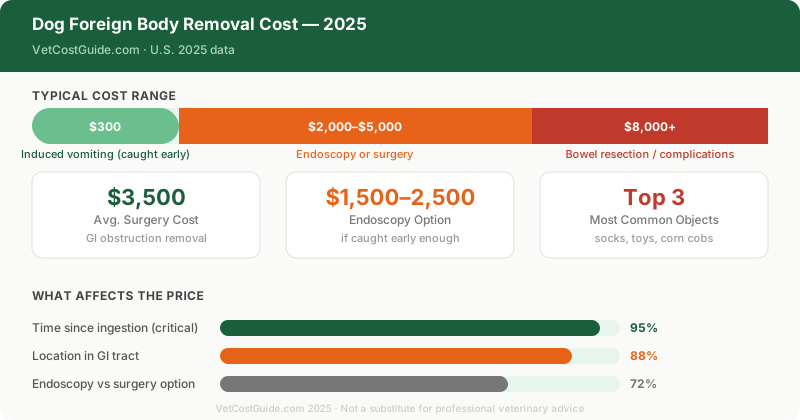
Your dog just ate a sock. Or you think he did — you watched him chew something, lost track of it, and now you’re not sure. Here’s the cost reality, laid out plainly: if you get to the vet within one to two hours, induced vomiting costs $200–$400 and the whole ordeal ends in 15 minutes. If you wait until morning because he seems okay, and by then the object has moved into the intestine, you’re looking at $2,000–$5,000 in surgery. If the intestine perforates before he gets care, costs hit $4,000–$8,000 with no guarantee of survival. The most expensive foreign body cases are rarely bad luck. They’re delayed presentation.
- Induced vomiting at a vet clinic within 1–2 hours of ingestion costs $200–$400 and is the ideal outcome—fast, cheap, and effective for most objects still in the stomach.
- Endoscopic retrieval of objects already in the stomach costs $1,000–$2,500 and avoids surgery when the object is large enough to see but small enough to grasp.
- Intestinal surgery to remove an obstructing foreign body costs $2,000–$5,000, with 2–4 days of hospitalization adding $600–$1,500 on top.
- Bowel resection (removal of necrotic intestine) for late-presenting or perforated obstructions costs $3,000–$8,000 and carries a meaningfully higher mortality risk than early intervention.
What Each Treatment Costs
| Type | Low | Average | High |
|---|---|---|---|
| Induced vomiting (within 1–2 hrs) | $200 | $300 | $400 |
| ER exam + diagnostics (X-rays) | $250 | $400 | $600 |
| Endoscopic retrieval | $1,000 | $1,750 | $2,500 |
| Intestinal surgery (gastrotomy) | $2,000 | $3,500 | $5,000 |
| Bowel resection (necrotic intestine) | $3,000 | $5,500 | $8,000 |
| Hospitalization (2–4 days) | $600 | $1,050 | $1,500 |
| Post-op medications + recheck | $150 | $250 | $400 |
| Total: vomiting-induced resolution | $200 | $350 | $500 |
| Total: full surgical case | $2,600 | $4,750 | $7,000 |
How Each Treatment Works
Induced vomiting uses apomorphine (a dopamine agonist given by IV or conjunctival placement) or, less commonly, hydrogen peroxide. The dog vomits within 10–20 minutes. Done. If successful, the foreign object comes up and the visit is complete. Induction can’t happen if the dog is already in distress, if the object is sharp (esophageal laceration risk on the way back up), if a caustic substance was ingested, or if more than 2–3 hours have passed. An ER exam and abdominal radiographs ($150–$300) are typically done first to confirm the object is still in the stomach.
Endoscopy passes a flexible camera down the esophagus into the stomach to visualize and grasp objects that didn’t come up with induction or were presented too late for induction. The dog is under general anesthesia. It works for objects in the stomach or very proximal small intestine that can be grasped with forceps or a basket retrieval device. Objects too large, too sharp, or too far down the intestine aren’t retrievable this way.
Gastrotomy or enterotomy is surgery to open the stomach or intestine and remove the object. Stomach openings (gastrotomies) heal faster and carry lower complication rates than intestinal openings (enterotomies). Both require general anesthesia, surgical prep, and typically 2–3 days of post-operative hospitalization before the dog can safely eat again.
Bowel resection and anastomosis is required when the intestine has been blocked long enough that tissue has died. The necrotic segment is removed and the healthy ends sutured together. Longer, more complex, with higher risk of the suture line reopening (dehiscence) and higher mortality than a routine enterotomy.
The Factors That Drive the Bill
Time from ingestion to treatment. Every additional hour an obstructing foreign body spends moving through the intestine increases tissue damage, surgery complexity, and the risk of perforation and peritonitis. The cost curve from $300 to $7,000 traces directly to how long you waited.
Object type. Linear foreign bodies — string, ribbon, carpet, fabric — are among the most dangerous. One end anchors at the tongue base or pylorus while the rest bunches and saws through the intestinal wall, frequently causing multiple perforations rather than a single clean obstruction. Linear foreign body surgery is almost always more complex and expensive than removing a single discrete object.
Object size relative to the dog. A corn cob that passes through a Labrador without issue may completely obstruct a Miniature Schnauzer. Toy breeds under 15 pounds are at higher obstruction risk from objects that larger dogs would pass.
Perforation and peritonitis. When intestinal rupture occurs, the dog develops peritonitis — infection of the abdominal cavity. This requires immediate surgery, abdominal lavage, and extended hospitalization with IV antibiotics. GI perforation with peritonitis carries 30–50% mortality even with aggressive treatment, and total costs routinely exceed $6,000–$8,000.
Practice type and location. Emergency hospitals in major metro areas charge 40–60% more for the same procedures than suburban or rural facilities. Specialty surgical centers have higher fees but lower complication rates for complex multi-site intestinal repairs.
- Waiting to see if the object passes on its own when the dog is showing symptoms. A dog with vomiting, lethargy, abdominal pain, or not eating after a known or suspected ingestion has an obstruction until proven otherwise. Do not wait. Every hour of delay directly increases the likelihood of needing surgery, and every hour of surgery delay increases the likelihood of complications. Go to an emergency vet immediately.
- Inducing vomiting at home with salt or hydrogen peroxide without vet guidance. Salt ingestion causes sodium toxicity. Hydrogen peroxide at incorrect concentrations causes hemorrhagic gastritis. Home induction attempts often fail, waste the critical induction window, and create an additional medical problem to treat on top of the foreign body. Call the vet or ASPCA Animal Poison Control before attempting anything at home.
- Assuming X-rays will always show the foreign body. Many common foreign bodies—fabric, rubber, certain plastics, most food items—are not radio-opaque and do not show up on plain radiographs. A negative X-ray does not rule out a foreign body. The combination of history, symptoms, and serial abdominal X-rays or barium study is often needed for confirmation.
Pet Insurance for Foreign Body Cases
Foreign body removal is one of the most frequently filed claims at major pet insurance companies — and one of the clearest financial arguments for coverage. Most accident-and-illness policies cover foreign body ingestion as an accident event. A $4,000 surgical claim with 80% reimbursement after a $300 deductible returns $2,960 — likely more than several years of premiums for a young, medium-sized dog.
Accident-only policies ($15–$30/month) cover foreign body removal and make sense for owners primarily concerned about ingestion and trauma rather than illness. For young dogs with historically high rates of eating things they shouldn’t — Labradors, Golden Retrievers, Beagles, and essentially any adolescent dog — foreign body obstruction isn’t a hypothetical. It’s a risk worth insuring.
Dogs that have had one foreign body surgery have a higher-than-average rate of needing another. Insurance becomes even more valuable for repeat offenders.
Ways to Keep the Cost Down
Get to the vet within two hours. This is the most powerful cost-reduction strategy available. The gap between a $300 induced vomiting procedure and a $4,000 surgery is often only a few hours. Never wait overnight to see if a symptomatic dog improves.
Call before you drive. A quick call to your vet or emergency hospital lets them advise whether induction is appropriate based on what was swallowed, when, and how the dog looks. They can prepare to act quickly when you arrive, maximizing the window for successful induction without surgery.
Dog-proof the likely culprits. Socks, underwear, corn cobs, ribbons, rubber toys, children’s toy parts, and food-scented objects account for the majority of foreign body surgeries. A one-time effort to remove access to these items — particularly during the high-risk 6–24 month adolescent period — prevents most cases.
Ask about endoscopy before surgery. If your dog presents with an object confirmed to be in the stomach and induction isn’t an option, asking specifically about endoscopic retrieval saves $1,000–$2,500 compared to surgery when the object is suitable for endoscopic grasping. Not all ER facilities have endoscopy, but specialty hospitals typically do.
Compare facilities when time permits. If the dog is stable and surgery isn’t immediately life-threatening, asking about same-day transfer to a veterinary school hospital can reduce surgical costs by 20–35% compared to private specialty practice rates.
Frequently Asked Questions
What household items do dogs most commonly swallow? Socks and underwear account for a disproportionate share of GI foreign body surgeries — the texture, smell, and pliability make them attractive to dogs. Corn cobs are particularly dangerous because they conform to the intestinal shape, obstruct completely, and rarely pass. Rubber toys, squeakers, children’s toy parts, cooked bones (which splinter and can perforate intestines), rocks, and string or ribbon are also common.
How do I know if my dog has a foreign body obstruction? Symptoms of GI obstruction include repeated vomiting of undigested food or water, abdominal pain or bloating, lethargy, loss of appetite, and inability to defecate. Symptoms can appear within hours of ingestion or take 24–48 hours to develop depending on where the object is lodged. Any of these symptoms after a known or suspected ingestion is an emergency.
Can a dog pass a foreign body naturally? Small, smooth objects in large dogs sometimes pass without obstruction — but this isn’t predictable and shouldn’t be waited on if the dog is showing any symptoms. Coins, small rocks, and buttons occasionally pass through without intervention. Objects that are sharp, large relative to the dog, string-like, or causing symptoms require immediate veterinary evaluation.
Is surgery always required for foreign body removal? No. Induced vomiting (if caught early) and endoscopy (if the object is in the stomach and retrievable) avoid surgery entirely. Surgery is required only when the object has moved into the small intestine, endoscopic retrieval isn’t possible, or obstruction or perforation has occurred. The treatment method depends on the object’s location, size, and the dog’s clinical status.
Frequently Asked Questions
Induced vomiting typically costs $200–$400 and can be completed in about 15 minutes if done within 1–2 hours of ingestion. This is the least expensive option for foreign body removal, but only works if the object hasn't yet passed into the intestines.
Most pet insurance plans cover foreign body removal surgery after you meet your deductible, though you typically pay 10–20% coinsurance on the $2,000–$5,000 bill. Some policies exclude certain breeds or have annual limits, so check your specific plan before an emergency occurs.
You should contact your vet within 1–2 hours if possible, since induced vomiting is only effective before the object reaches the intestines and costs far less than surgery. If the object has already passed into the intestines or more than a few hours have passed, surgery ($2,000–$5,000) will likely be necessary.