What does a pea-sized bump on a puppy’s belly and a 3 a.m. emergency surgery have in common? Both are hernias — just at opposite ends of the urgency spectrum. Dog hernias range from tiny umbilical defects that often resolve on their own, to strangulated inguinal hernias that become life-threatening within hours. Knowing which type you’re dealing with is the first step to understanding the cost.
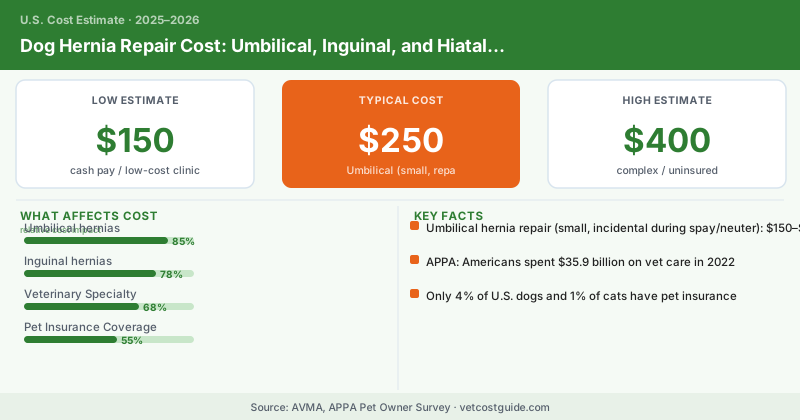
- Umbilical hernia repair (small, incidental during spay/neuter): $150–$400
- Inguinal hernia repair: $400–$2,500 depending on what’s entrapped
- Diaphragmatic hernia repair: $1,500–$4,000+ (often emergency surgery)
- Hiatal hernia surgical correction: $2,000–$5,000
- The AVMA notes that umbilical hernias are among the most common congenital defects in dogs, occurring in approximately 4–5% of all breeds
- Hernias are considered hereditary in many breeds — Basset Hounds, Pekingese, and Cairn Terriers have elevated rates; pet insurance pre-enrollment matters
Dog Hernia Repair Cost by Type
| Hernia Type | Low | Average | High |
|---|---|---|---|
| Umbilical (small, repair during spay/neuter) | $150 | $250 | $400 |
| Umbilical (standalone procedure) | $300 | $500 | $900 |
| Inguinal (non-strangulated) | $400 | $900 | $2,000 |
| Inguinal (strangulated, emergency) | $1,000 | $2,500 | $5,000 |
| Diaphragmatic (traumatic, emergency) | $1,500 | $2,800 | $5,000 |
| Hiatal (chronic, surgical correction) | $2,000 | $3,500 | $5,500 |
| Perineal hernia (older males) | $700 | $1,500 | $3,000 |
The Different Types — and Why Cost Varies So Much
Umbilical hernias are the most common. You’ll see a soft, compressible bump at the belly button. In puppies, small ones (under 1 cm) may close on their own by 6 months. Hernias larger than 1.5 cm, or any that are firm or tender, should be repaired. Most vets recommend fixing them during the spay or neuter appointment — the anesthesia is already happening, and adding the hernia repair costs only $150–$400 more.
Inguinal hernias involve abdominal contents pushing through the inguinal ring in the groin. In female dogs, the uterus or bladder can slide into the hernia sac. In male dogs, it’s often intestine. When tissue becomes trapped and blood supply is cut off (strangulation), it’s a surgical emergency. Non-strangulated inguinal hernias run $400–$2,000. Strangulated ones requiring bowel resection or bladder repair: $1,000–$5,000.
Diaphragmatic hernias occur when abdominal organs (liver, stomach, intestines) herniate through a defect in the diaphragm into the chest cavity, compressing the lungs. Most are caused by blunt trauma — car accidents, kicks, falls from height. These are almost always emergencies. Respiratory distress is the primary sign. Surgery costs $1,500–$5,000; intensive care adds $500–$1,500.
Hiatal hernias involve the stomach sliding up through the diaphragmatic opening where the esophagus passes. Brachycephalic breeds (Bulldogs, French Bulldogs, Pugs) are predisposed. Chronic vomiting and regurgitation are the main signs. Medical management with proton pump inhibitors and feeding changes is tried first. Surgery is reserved for cases that don’t respond to medication — $2,000–$5,500.
Perineal hernias develop in older intact male dogs when the muscles supporting the pelvic floor weaken, allowing rectal contents to push through. Neutering is both treatment (it removes the testosterone driving rectal dilation) and prevention. Surgical repair typically combines neutering with hernia closure: $700–$3,000.
Strangulation: The Reason Hernias Become Emergencies
A hernia itself isn’t always dangerous. A strangulated hernia is. When the herniated tissue is trapped and its blood supply is cut off, necrosis (tissue death) begins within hours. Signs of strangulation include:
- Pain when you touch the hernia site
- The lump becomes firm and non-reducible
- Vomiting, lethargy, or signs of shock
- The skin over the hernia turns red or dark
Any of these signs = same-day emergency veterinary visit. Non-strangulated hernias can often wait for a scheduled appointment. Strangulated hernias cannot.
Combining Hernia Repair with Other Procedures
One of the most cost-effective decisions you can make: repair a hernia during a planned procedure. If your puppy needs a spay or neuter, adding an umbilical hernia repair under the same anesthesia costs $150–$400 instead of $300–$900 as a standalone procedure. Ask your vet at the puppy appointment whether combination scheduling makes sense.
Similarly, if a female dog has an inguinal hernia and needs a spay, both can be corrected through the same abdominal incision in many cases — often at reduced total cost versus two separate surgeries.
Does Pet Insurance Cover Hernia Repair?
Congenital hernias (present at birth — umbilical, inguinal, hiatal in predisposed breeds) may be excluded as pre-existing or hereditary conditions if the dog was already enrolled when diagnosed. The key, as always: enroll before signs appear.
Traumatic hernias (diaphragmatic hernia from a car accident) are covered under accident benefits in virtually all comprehensive plans. Strangulated emergencies are typically covered as surgical emergencies.
Don’t wait to “see if it gets better” with any hernia that causes visible pain or discomfort, or that you can’t push back in easily (non-reducible). Soft, painless hernias in puppies can wait for a scheduled appointment. Any hernia that changes character — becomes hard, hot, or causes the dog distress — is a same-day call to the vet.
The Bottom Line
Dog hernia repair costs run the full spectrum: $150 as an add-on to a spay, to $5,000+ for a complex emergency. Small umbilical hernias in puppies are the most common and least expensive. The cases that get costly are the ones where owners wait too long or where strangulation or trauma is involved. Identify the type, assess urgency with your vet, and combine repairs with planned procedures whenever possible.
Frequently Asked Questions
Dog hernia repair typically costs $150–$4,000 depending on the type and complexity of the hernia. Umbilical hernias are the least expensive at $150–$800, while inguinal and hiatal hernias requiring more complex surgery can range from $1,500–$4,000 or more if emergency care is needed.
Most pet insurance plans cover hernia repair if the hernia is deemed a medical condition rather than a pre-existing or congenital issue. However, many policies exclude coverage for umbilical hernias present at birth, leaving owners with 100% out-of-pocket costs of $150–$800 for this common puppy condition.
Not all hernias require immediate surgery—small umbilical hernias often close on their own by 6–12 months of age and may be monitored instead of surgically repaired. However, strangulated or inguinal hernias are surgical emergencies that must be addressed within hours to prevent life-threatening complications, making emergency repair costs significantly higher than routine procedures.