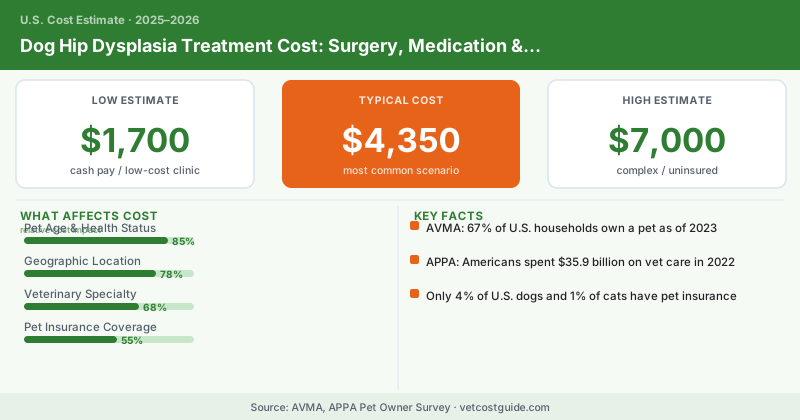
The Orthopedic Foundation for Animals has evaluated millions of dogs for hip dysplasia — and the numbers are striking. OFA data shows hip dysplasia affects roughly 20% of German Shepherds, 12% of Labrador Retrievers, and over 70% of Bulldogs evaluated. It’s the most common orthopedic disease in dogs, full stop. Yet many owners don’t realize how much variation exists in both treatment paths and price.
A young Labrador with a moderate case might get excellent results from $150/month in supplements and NSAIDs. A large Rottweiler with severe joint destruction may need bilateral total hip replacements totaling $12,000–$14,000. Understanding where your dog falls on that spectrum — and what each option actually costs — is the first step.
- Diagnosis requires OFA radiographs ($150–$300) or a PennHIP evaluation ($300–$500) at a certified facility — standard hip X-rays aren’t sufficient for formal scoring.
- Medical management costs $100–$300/month and works well for mild-to-moderate cases; surgery is reserved for cases where pain can’t be controlled medically or when structural changes make early intervention worthwhile.
- Total Hip Replacement (THR) at $4,000–$7,000 per hip is the gold standard for large dogs and restores near-normal function — but it requires a board-certified veterinary orthopedic surgeon.
- Hip dysplasia is often excluded from pet insurance as hereditary — check your policy before your dog shows any symptoms.
What Hip Dysplasia Actually Is
Hip dysplasia is a developmental malformation of the hip ball-and-socket joint. Instead of the femoral head fitting snugly into the acetabulum, the joint is loose. That laxity causes abnormal wear on cartilage, chronic inflammation, and eventually osteoarthritis. It’s not purely a large-breed problem, either — medium-sized breeds like Springer Spaniels and Chow Chows appear in the OFA’s affected lists too.
Symptoms range from subtle stiffness after rest to a pronounced “bunny hop” gait, reluctance to climb stairs, and visible muscle wasting in the hindquarters. In young dogs, you might see a loose-looking walk. In older dogs with chronic osteoarthritis, you’ll see pain.
Diagnosis Costs
Don’t skip formal evaluation. There’s a real difference between a general radiograph taken at your vet’s office and the standardized positioning required for OFA scoring or PennHIP analysis.
- Physical exam: $100–$200. Your vet will check for joint laxity, pain on manipulation, and muscle symmetry.
- OFA hip radiographs: $150–$300. Dogs must be positioned in a specific dorsal recumbency position under heavy sedation. Results are graded by three OFA radiologists: Excellent, Good, Fair, Borderline, Mild, Moderate, or Severe.
- PennHIP evaluation: $300–$500 at a certified practitioner. Measures distraction index — a more predictive tool for future osteoarthritis development, especially useful in young dogs.
| Diagnosis/Treatment | Cost Per Hip | Best For |
|---|---|---|
| Physical exam | $100–$200 | Initial assessment |
| OFA radiographs | $150–$300 | Formal diagnosis |
| PennHIP evaluation | $300–$500 | Young dogs, breeding screening |
| NSAIDs (monthly) | $30–$80 | Mild to moderate pain |
| Joint supplements (monthly) | $20–$60 | All stages, supportive |
| Adequan injection series | $50–$100 | Moderate cases, monthly maintenance |
| Physical therapy (per session) | $50–$100 | Mild to moderate, post-surgical |
| Hydrotherapy (per session) | $40–$80 | Low-impact rehabilitation |
| Juvenile Pubic Symphysiodesis (JPS) | $1,000–$2,000 | Dogs under 5 months only |
| Triple/Double Pelvic Osteotomy | $1,700–$3,500 | Young dogs, good cartilage intact |
| Femoral Head Ostectomy (FHO) | $1,200–$2,500 | Small/medium dogs, budget option |
| Total Hip Replacement (THR) | $4,000–$7,000 | Large dogs, gold standard |
Medical Management: Mild to Moderate Cases
Many dogs do genuinely well without surgery — especially if weight is controlled, NSAIDs are started early, and physical conditioning keeps the supporting muscles strong.
NSAIDs like carprofen, meloxicam, or grapiprant run $30–$80/month depending on your dog’s size and which drug is used. They’re the backbone of pain management. Regular bloodwork ($100–$200 every 6–12 months) is required to monitor kidney and liver function with long-term use.
Joint supplements — glucosamine and chondroitin products like Dasuquin or Cosequin — cost $20–$60/month. Evidence for their efficacy varies, but many orthopedic specialists include them as low-risk adjuncts. Omega-3 fatty acids (fish oil) have stronger anti-inflammatory evidence and cost $15–$40/month.
Adequan (polysulfated glycosaminoglycan) is an injectable joint protectant given in a loading series ($50–$100 for initial 8 injections over a month) then maintained monthly. Many orthopedists recommend it for moderate cases.
Physical therapy and hydrotherapy help maintain muscle mass and reduce joint loading. A certified canine rehabilitation therapist charges $50–$100/session for land-based PT, $40–$80/session for underwater treadmill work. Irregular sessions are better than none, but consistent weekly sessions produce noticeably better outcomes.
Every extra pound of body weight puts approximately 4 pounds of additional force through a dog’s hip joints during normal activity. A German Shepherd who’s 10 pounds overweight is carrying the equivalent of 40 extra pounds of joint stress. Weight management is the single highest-impact, zero-cost intervention available — and it’s frequently under-prioritized.
Surgical Options
Surgery is typically considered when medical management fails to control pain adequately, or when early structural intervention can prevent future joint damage.
Juvenile Pubic Symphysiodesis (JPS): $1,000–$2,000. A minor procedure that fuses a specific growth plate to redirect acetabular growth. Only works in dogs under 5 months of age — timing is everything. It’s the most affordable preventive surgery when caught early.
Triple or Double Pelvic Osteotomy (TPO/DPO): $1,700–$3,500 per hip. The surgeon cuts the pelvis in two or three places and rotates the acetabulum for better coverage of the femoral head. Best results in dogs under 18 months with good remaining cartilage. Doesn’t work once significant arthritis has developed.
Femoral Head Ostectomy (FHO): $1,200–$2,500 per hip. The femoral head (ball) is removed entirely, and a fibrous pseudojoint forms. Pain relief is reliable. Function is good but not perfect — works best in dogs under 50 pounds. Larger dogs generally don’t compensate as well, though it’s used when THR isn’t financially feasible.
Total Hip Replacement (THR): $4,000–$7,000 per hip. The gold standard for dogs with significant hip dysplasia. A prosthetic ball and socket restore near-normal biomechanics. Outcomes in appropriately selected patients are excellent — most dogs return to full activity within 3–4 months. Requires a board-certified veterinary orthopedic surgeon and carries the highest up-front cost, but eliminates ongoing pain management costs.
Total Hip Replacement is not a general practitioner procedure. It requires a board-certified veterinary orthopedic surgeon (DACVS-SA or equivalent), specialized implants, and specific surgical infrastructure. Getting a quote from a general vet for THR or attempting to negotiate the procedure at a non-specialist clinic isn’t advisable — complication rates rise sharply outside specialty settings. Expect to be referred to a veterinary teaching hospital or specialty surgical center.
Breeds Most at Risk
German Shepherds, Labrador Retrievers, Golden Retrievers, Rottweilers, and Bulldogs top the OFA’s affected lists. Saint Bernards, Great Danes, and Mastiffs are also heavily represented. If you own one of these breeds, ask your vet about early OFA screening — ideally before symptoms appear and while surgical options like JPS or TPO are still on the table.
The Insurance Problem
Hip dysplasia is a notoriously tricky insurance situation. Most major pet insurers — including Healthy Paws, Embrace, and Nationwide — classify it as a hereditary or congenital condition and exclude it outright, or exclude it if symptoms were present before enrollment. The ACVIM’s clinical guidelines on hereditary musculoskeletal disease underscore why early enrollment matters: a dog showing any signs of gait abnormality at the first vet visit creates a documentation trail that most insurers will use to deny claims.
Enroll your dog in insurance before any symptoms appear. That’s the window. Once a vet has noted anything about gait, joint laxity, or hip concerns in the medical record, coverage becomes unlikely.
Frequently Asked Questions
How much does dog hip dysplasia surgery cost? It depends entirely on which procedure fits your dog’s age, size, and disease severity. FHO runs $1,200–$2,500 per hip, TPO/DPO is $1,700–$3,500 per hip, and Total Hip Replacement costs $4,000–$7,000 per hip. Many dogs with bilateral disease need treatment on both sides, which doubles costs.
Is surgery always necessary for hip dysplasia? No. Mild-to-moderate cases in many dogs respond well to medical management — NSAIDs, weight control, joint supplements, and physical therapy. Surgery becomes the better option when pain management fails, or when early structural intervention (JPS or TPO) can prevent long-term joint damage in a young dog.
Does pet insurance cover hip dysplasia? Usually not if it’s classified as hereditary or if symptoms exist at enrollment. Enroll before any signs appear and verify your policy’s specific language around hereditary orthopedic conditions. Some policies do cover it under comprehensive illness plans when no prior history is documented.
Frequently Asked Questions
Surgery costs vary by procedure: Femoral Head Ostectomy (FHO) runs $1,200–$2,500 per hip, Triple/Double Pelvic Osteotomy (TPO/DPO) is $1,700–$3,500 per hip, and Total Hip Replacement (THR) — the gold standard — costs $4,000–$7,000 per hip. Most dogs with bilateral disease need treatment on both sides.
No. Mild-to-moderate hip dysplasia in many dogs is managed successfully with NSAIDs, joint supplements, weight control, and physical therapy. Surgery becomes the better option when medical management stops controlling pain adequately or when a dog is young with significant structural abnormality.
It depends heavily on timing. Many insurers classify hip dysplasia as a hereditary or congenital condition and exclude it from coverage. Enrolling before any symptoms are documented gives you the best chance of coverage. Some policies cover it under accident-and-illness plans if no prior diagnosis exists at enrollment.