Your Bulldog has been licking one paw obsessively for a week. You check between the toes and find a swollen, red lump the size of a grape — tender when you touch it. That’s almost certainly an interdigital cyst (more accurately called an interdigital furuncle), and it’s one of the most common, most frustrating skin problems in certain dog breeds.
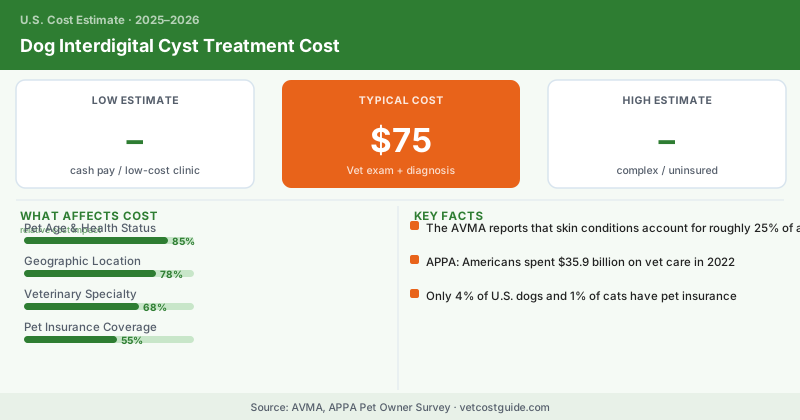
The AVMA reports that skin conditions account for roughly 25% of all dog veterinary visits each year. Interdigital furuncles are a big chunk of that. If your dog is a Bulldog, Labrador Retriever, Boxer, or any other short-coated breed, there’s a decent chance you’ll be dealing with this at some point. Here’s exactly what treatment costs and why some dogs end up spending far more than others.
Typical Cost Ranges
| Service | Typical Cost | Notes |
|---|---|---|
| Vet exam + diagnosis | $75–$200 | Physical exam; paw evaluation |
| Bacterial culture & sensitivity | $50–$150 | Identifies bacteria strain; guides antibiotic choice |
| Antibiotics (4–8 week course) | $60–$180 | Long courses needed for deep infection |
| Medicated soaks & topicals | $20–$60 | Epsom salt soaks; chlorhexidine solution |
| Single-episode medical management | $100–$300 | Exam + meds for one flare |
| Surgical excision (recurrent cysts) | $400–$900 | Removes affected tissue between toes |
| CO2 laser surgery | $600–$1,200 | Less bleeding; faster healing; preferred for recurrence |
| Allergy workup (if underlying cause) | $200–$500 | Blood or skin testing to find root trigger |
Why the Cost Varies So Much
A dog with a first-time interdigital cyst — caught early, treated promptly with antibiotics and warm soaks — might cost you $150–$250 total. That’s a reasonable vet visit plus a month of medication.
The problem is recurrence. Interdigital furuncles form when hair follicles between the toes become blocked, often due to trauma, moisture, or (most commonly) underlying allergies. Short, coarse hairs on the webbing between the toes can actually puncture the follicle wall from the inside, especially in breeds like Bulldogs and Labs. The inflammation triggers a deep infection that needs extended antibiotic treatment — typically 4–8 weeks, not the one-week course you’d use for a minor skin scrape.
If your vet just treats the infection without identifying why it keeps happening, you’ll be back in 6–8 weeks paying another $150–$250. Repeat that four or five times and you’ve spent $600–$1,200 on the same problem — and often ended up with a more resistant bacterial infection to boot.
The Allergy Connection
Here’s what drives the highest costs: a large percentage of dogs with recurring interdigital cysts have an underlying allergy — environmental, food, or contact — that causes chronic inflammation in the paw tissue. That inflammation makes the follicles vulnerable to infection repeatedly.
If your vet recommends allergy testing after a second or third cyst episode, that’s not upselling. It’s the only way to break the cycle. Allergy testing runs $200–$500, and if immunotherapy (allergy shots) is prescribed, that adds $800–$2,000 per year. But for dogs with severe recurring disease, that investment often ends up cheaper than continuous rounds of antibiotics and vet visits.
Short-coated, webbed-paw breeds have the highest rates of interdigital furuncles. The most commonly affected: English Bulldogs, Labrador Retrievers, Boxers, Bull Terriers, Mastiffs, and Great Danes. If you own one of these breeds, ask your vet about preventive paw hygiene — keeping paws clean and dry between vet visits can reduce the frequency of flares significantly.
Medical vs. Surgical Treatment
Most first-time or early-stage cysts respond to medical management: a culture-guided antibiotic course (4–8 weeks), warm water or Epsom salt soaks twice daily, and chlorhexidine topicals. Cost for this approach: $100–$300 per episode.
When cysts become recurrent — typically defined as three or more episodes, or cysts that haven’t resolved after two full medical treatment courses — surgery becomes the recommended option. Surgical excision removes the affected tissue from between the toes and prevents regrowth in that spot. Costs run $400–$900 for traditional excision.
CO2 laser surgery is increasingly preferred because it cauterizes as it cuts, reducing bleeding and post-operative swelling. It also allows more precise tissue removal and typically results in faster healing. Laser procedures run $600–$1,200 but often mean fewer follow-up visits and a lower recurrence rate at the treated site.
Don’t skip the culture and sensitivity test when your vet recommends it. Treating an interdigital infection with the wrong antibiotic — or stopping antibiotics early because the cyst looks better on the outside — is the most common reason these infections become drug-resistant. A 4–8 week course feels long, but the infection is deep in the follicle and needs the full run to clear.
Does Pet Insurance Cover Interdigital Cysts?
Most comprehensive pet insurance plans cover interdigital furuncle treatment as an illness or dermatological condition — as long as it’s not a pre-existing condition. If your dog’s first cyst is diagnosed after you enroll, the treatment should be reimbursable. Typical reimbursement: 70–90% after your deductible.
For breeds prone to recurring cysts, enrolling in a policy before any diagnosis appears in your dog’s records is especially worthwhile. A single surgical episode can easily exceed your annual premium.
What to Ask Your Vet
If your dog is on a second round of antibiotics for the same paw, push for a bacterial culture before starting treatment again — not after. Ask specifically whether allergy testing makes sense given the recurrence pattern. And if surgery is on the table, ask whether your vet offers laser excision or if a referral to a veterinary dermatologist would be appropriate.
Getting ahead of the underlying cause costs more upfront but nearly always saves money — and your dog a lot of discomfort — over a 2–3 year window.
Frequently Asked Questions
Dog interdigital cyst treatment typically costs $100–$1,200 depending on severity, diagnostic imaging, and whether surgery is needed. Mild cases managed with topical treatments and antibiotics run $100–$300, while surgical removal or laser treatment ranges from $600–$1,200. Location and your veterinarian's experience level can also affect the final bill.
Most pet insurance plans cover interdigital cyst treatment as an accident or illness claim, though you typically pay the vet upfront and receive reimbursement of 70–90% after deductible. Some insurers may exclude chronic skin conditions or breed-specific issues if your dog has a history of cysts, so review your policy carefully before treatment.
Treatment options include antibiotics and topical creams for mild cases (1–2 weeks), laser ablation or chemical cauterization (recovery in 7–10 days), or surgical removal for severe or recurring cysts (10–14 days recovery with sutures). Your vet may recommend allergy management or foot soaks as preventive care, since chronic licking and allergies are common underlying causes.