It happens without warning. Your Dachshund yelps, goes stiff, and within hours can’t use their back legs. Or your French Bulldog starts walking like they’re drunk and crying when you pick them up. Intervertebral disc disease is the most common spinal disorder in dogs — and it affects specific breeds so disproportionately that IVDD is practically a breed-specific tax for Dachshund, Corgi, and Basset Hound owners.
The costs range from $500 for strict medical management of mild cases to $8,000 or more for emergency spinal surgery. Where you land on that spectrum depends on severity — and timing.
Understanding IVDD Grades: Why Severity Determines Everything
Veterinary neurologists grade IVDD from I to V:
- Grade I: Pain only; no neurological deficits. Dog yelps, has muscle spasm, walks normally.
- Grade II: Pain plus mild paresis; dog walks but stumbles or knuckles.
- Grade III: Moderate paresis; dog walks with obvious difficulty or needs support.
- Grade IV: Severe paresis to paralysis; dog can’t walk but retains deep pain sensation.
- Grade V: Paralysis with absent deep pain sensation — worst grade.
Treatment recommendations correlate directly to grade. Grade I and mild Grade II cases are often managed medically. Grade III and above — and any case not improving with medical management — typically needs surgery.
Medical Management Costs
| Service or Medication | Cost | Notes |
|---|---|---|
| Initial exam + neurological assessment | $150–$300 | Establishes baseline grade |
| Spinal radiographs (x-rays) | $200–$400 | Screens for obvious disc herniation; limited detail |
| MRI (definitive diagnosis) | $1,500–$3,000 | Gold standard; localizes disc(s) precisely |
| CT scan | $800–$1,500 | Alternative to MRI; good for bone changes |
| Prednisone (short course) | $20–$60 | Anti-inflammatory; debated in early cases |
| Methocarbamol (muscle relaxant) | $30–$80 | Reduces muscle spasm |
| Gabapentin (pain/nerve pain) | $30–$80/month | Ongoing neuropathic pain management |
| Strict cage rest (2–4 weeks) | $0–$300 | At home; possibly boarding if compliance is issue |
| Physical therapy consultation | $100–$200 | For recovery planning |
Total medical management for a Grade I–II case: $500–$1,500 depending on whether MRI is pursued.
Many vets recommend MRI before committing to medical management — even for Grade II cases. Here’s why: x-rays show bones, not soft tissue. You can see disc space narrowing on x-rays, but not where exactly a disc has herniated or how severely. An MRI shows the soft tissue and spinal cord directly.
Knowing the location and severity changes the plan:
- If the MRI shows significant cord compression, surgery becomes more clearly indicated even for a dog that can still walk
- If the MRI shows mild herniation without cord compression, confident medical management is appropriate
- If your dog worsens under medical management, having the MRI done means surgery can begin immediately — no delay for imaging
MRI cost: $1,500–$3,000. It’s a real investment, but it prevents treating blindly and potentially missing a case that needed surgery sooner.
Surgery Costs
Spinal decompression surgery — hemilaminectomy or ventral slot depending on location — is performed by a board-certified veterinary neurologist or surgeon. The procedure removes the extruded disc material and relieves pressure on the spinal cord.
| Cost Component | Estimated Cost | Notes |
|---|---|---|
| Pre-surgical MRI (if not done) | $1,500–$3,000 | Required for surgical planning |
| Surgical consult + exam | $200–$400 | Specialty neurologist evaluation |
| Hemilaminectomy (thoracolumbar) | $3,000–$6,000 | Most common IVDD surgery |
| Ventral slot (cervical IVDD) | $3,000–$5,000 | Neck disc herniation repair |
| Fenestration (preventive at adjacent levels) | $300–$600 | Reduces future disc herniation risk |
| Post-op hospitalization (2–3 days) | $300–$600/day | Includes nursing care and monitoring |
| Total (MRI + surgery + hospitalization) | $5,000–$10,000 | Typical all-in range for Grade III–V cases |
Surgical Outcomes: What the Numbers Say
Surgery has compelling success rates when performed before complete, prolonged loss of deep pain sensation:
- Grade II–III: 90–95% of dogs regain the ability to walk
- Grade IV: 80–90% of dogs regain walking ability
- Grade V with acute loss of deep pain (under 24–48 hours): 50–60% may regain walking
- Grade V with chronic pain loss (over 48–72 hours): 10–30% — the window is real and closing
Timing is everything for Grade V cases. The AVMA and most veterinary neurologists recommend that Grade V IVDD cases be evaluated for surgery within 12–24 hours of onset for the best prognosis. That often means an emergency referral on a Saturday night.
If your dog loses deep pain sensation — their leg is pinched firmly near the toe and they don’t react at all — this is a neurological emergency. Don’t wait until Monday. The window for surgical success narrows dramatically after 24–48 hours of complete loss. Call a 24-hour emergency neurological center immediately.
Rehabilitation Costs After Surgery
Spinal surgery doesn’t return a dog to normal function on its own. Physical rehabilitation — canine physical therapy — is essential for dogs recovering from IVDD surgery, particularly those starting from paralysis.
A typical post-surgical rehabilitation program:
- Initial PT evaluation: $100–$200
- Individual therapy sessions: $80–$200/session
- Typical weekly frequency: 2–3 sessions/week for 4–8 weeks, then tapering
- Hydrotherapy (underwater treadmill): $50–$100/session
- Total rehab course: $1,000–$4,000
Many owners supplement professional rehab with home exercises taught by the therapist — passive range of motion, sling-assisted walking, massage. These at-home components cost nothing after the initial instruction and significantly accelerate recovery.
Breed-Specific Risk and Planning
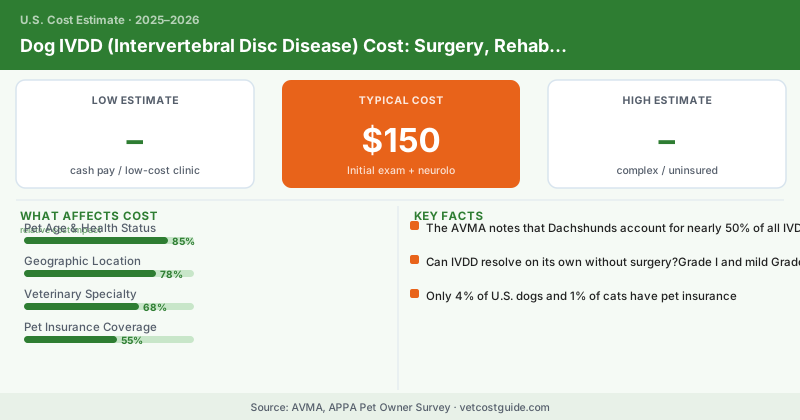
Chondrodystrophic breeds — those with shortened, abnormal spinal disc cartilage — account for the vast majority of IVDD cases. The AVMA notes that Dachshunds account for nearly 50% of all IVDD cases despite being a small percentage of the total dog population.
High-risk breeds: Dachshund, Basset Hound, Beagle, Cocker Spaniel, Shih Tzu, French Bulldog, Pembroke Welsh Corgi, Lhasa Apso, Pekingese.
If you own a Dachshund, IVDD isn’t a question of if — it’s when. Financial preparation (a savings account or pet insurance) before the first episode is the most actionable advice that applies to this specific breed. Annual premiums of $400–$800 for a Dachshund can prevent a $7,000 surprise.
Frequently Asked Questions
Can IVDD resolve on its own without surgery? Grade I and mild Grade II cases often do resolve with strict cage rest and pain management — studies show 80–90% of mild cases improve with conservative management. Grade III and above, or any case not improving within 48–72 hours of medical management, carries higher stakes for permanent deficits without surgery.
What’s the difference between IVDD and a slipped disc? “Slipped disc” is a colloquial term for the same condition. IVDD refers to the degeneration of the intervertebral discs, which leads to either bulging (Type II, more chronic) or sudden rupture and extrusion (Type I, more acute and more common in chondrodystrophic breeds).
Will my dog need another surgery later? Possibly. Dogs with IVDD can have recurrence at different disc levels — they don’t run out of discs. Fenestration of adjacent disc spaces (prophylactic removal of disc material) during the primary surgery reduces but doesn’t eliminate this risk. Overall recurrence rate after surgery: roughly 30–40% over a lifetime.
Frequently Asked Questions
IVDD surgery typically costs $3,000–$8,000, depending on the severity of the disc herniation, your location, and whether imaging (MRI or CT scan) is included. Additional costs for pre-operative diagnostics can add $500–$2,000 to the total bill.
Most pet insurance plans cover IVDD if it's not classified as a pre-existing condition, but you'll typically pay 10–30% out-of-pocket after your deductible ($250–$1,000). Some insurers exclude hereditary spine conditions or have breed-specific exclusions, so review your policy carefully before surgery.
Surgical recovery takes 6–8 weeks of strict crate rest and restricted activity, while medical management (rest, medication, physical therapy) typically requires 4–6 weeks of conservative care but has higher relapse rates. Dogs that undergo surgery show improvement within 24–48 hours if the procedure is successful, whereas medical management can take 2–4 weeks to show noticeable results.