A dog skipping on three legs doesn’t always mean the knee is dislocating. In small breeds, it often does — but the grade of luxation determines whether surgery is the answer or whether watchful waiting makes more sense. That distinction matters enormously, because recommending surgery for a grade 1 luxation is as problematic as missing a grade 4. And yet owners hear “your dog needs knee surgery” without any explanation of the grading system and walk out of the office confused, scared, and sometimes pointed in the wrong direction.
Here’s what the grades actually mean — and what each one typically costs to treat.
- Grade 1–2 (mild): Often managed without surgery; periodic rechecks $60–$120
- Surgical repair (general practitioner): $1,200–$2,000 per knee
- Surgical repair (board-certified surgeon): $2,000–$4,000 per knee
- Bilateral surgery (both knees): $2,500–$7,000 total
- Post-op rehabilitation therapy: $50–$100 per session (6–12 sessions)
- Pre-surgical diagnostics (X-rays): $150–$350
What Is a Luxating Patella?
The patella (kneecap) normally sits in a groove at the end of the femur called the trochlear groove. When that groove is too shallow — or when the surrounding soft tissue alignment is off — the kneecap can pop out of the groove (luxate) to the inside (medial, by far more common) or outside (lateral) of the leg.
In small and toy breeds, medial luxation is the most common orthopedic problem seen by veterinary surgeons. The Orthopedic Foundation for Animals (OFA) has evaluated hundreds of thousands of dogs and reports that breeds with the highest rates of luxating patella include Yorkshire Terriers, Pomeranians, Chihuahuas, Miniature Poodles, and Boston Terriers. It’s also seen in medium and large breeds, though less frequently.
The OFA Grading Scale: 1 Through 4
The OFA grading system is the standard framework veterinary orthopedists use to classify luxating patella severity. Here’s what each grade means clinically:
| Grade | What Happens | Clinical Signs | Typical Recommendation |
|---|---|---|---|
| Grade 1 | Patella luxates only when manually pushed; immediately self-reduces | Often none; occasional skipping | Monitor; no surgery usually needed |
| Grade 2 | Patella luxates spontaneously with flexion/extension; self-reduces with extension or manually | Intermittent skipping; occasional lameness | Surgery if causing functional problems |
| Grade 3 | Patella mostly luxated but can be manually reduced; re-luxates immediately when released | Chronic lameness; abnormal stance | Surgery recommended |
| Grade 4 | Patella permanently luxated; cannot be manually reduced; often associated with bone deformity | Severe lameness; crouching stance; bone rotation | Surgery required; complex reconstruction |
The key takeaway: grades 1 and 2 are a conversation about quality of life and clinical signs. Grades 3 and 4 require surgery — the structural deformity won’t resolve on its own and will get worse over time, often progressing to arthritis.
Surgical Techniques
Luxating patella correction isn’t a single procedure — it’s a combination of techniques tailored to the grade and anatomy. The American College of Veterinary Surgeons (ACVS) guidelines describe the standard surgical approach as involving up to three components:
Trochleoplasty deepens the trochlear groove so the patella has a proper channel to sit in. For moderate-to-severe cases, a wedge or block trochleoplasty removes and replaces the cartilage-bearing surface to create a deeper groove.
Tibial crest transposition moves the attachment point of the patellar ligament to realign the entire mechanism. A small bone cut and a pin or suture anchors the crest in its new position.
Soft tissue reconstruction tightens the joint capsule on the side the patella was luxating toward and releases it on the opposite side, helping keep the patella in place.
For grade 4 cases with significant bone deformity (femoral or tibial rotation), the surgery is more involved and typically requires a board-certified veterinary surgeon.
Cost: General Practitioner vs. Board-Certified Surgeon
| Setting | Cost Per Knee | Notes |
|---|---|---|
| General practitioner (experienced) | $1,200–$2,000 | Appropriate for grades 2–3; varies significantly by region |
| Board-certified surgeon (DACVS) | $2,000–$4,000 | Recommended for grade 4; recurrent cases; complex anatomy |
| University teaching hospital | $1,500–$3,000 | Residency-trained surgeons; good option in college towns |
The outcomes data favors board-certified surgeons for complex cases. That said, many experienced general practice veterinarians perform routine patella repairs with excellent results for grades 2 and 3. For grade 4 — where bone deformity requires more complex reconstruction — referral to a specialist is strongly worth considering.
Bilateral Cases: More Common Than You Think
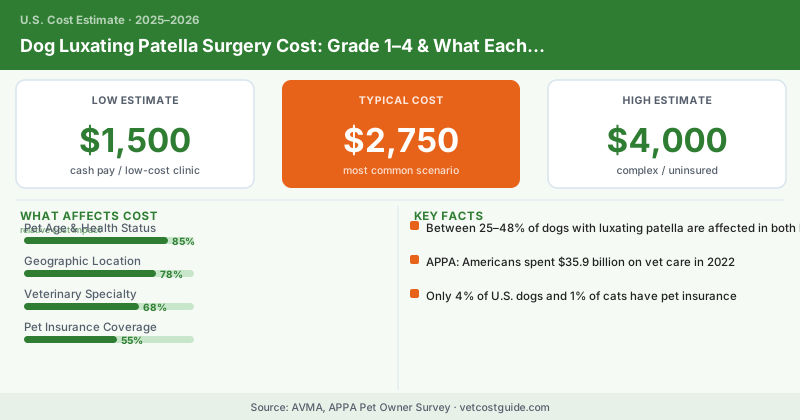
Between 25–48% of dogs with luxating patella are affected in both knees, according to OFA data. In many of those dogs, the second knee is a lower grade than the first, but it’s worth checking both knees at the initial exam.
If both knees are surgical candidates, you have two options:
- Simultaneous bilateral surgery: One anesthesia event, one recovery period. Total cost is typically 1.5–1.8x the single-knee cost (most surgeons offer some discount for the second knee).
- Staged surgery (one knee at a time, 6–12 weeks apart): Full cost for each knee. The advantage is that the dog has one good leg to bear weight on during each recovery.
Most surgeons prefer staging when both knees are grade 3–4, to make recovery more manageable for the dog. Discuss both options with your surgeon.
Post-Op Rehabilitation
Recovery from patella surgery takes 8–12 weeks for full return to activity. Structured physical rehabilitation significantly improves outcomes and reduces recovery time. A veterinary rehabilitation therapist will design a program of:
- Passive range-of-motion exercises (home exercises)
- Underwater treadmill therapy ($50–$100/session)
- Cold laser therapy ($30–$60/session)
- Controlled leash walking progression
Plan for 6–12 rehabilitation sessions depending on grade and recovery. That’s an additional $300–$1,000 — worth budgeting for.
Don’t let grade 1 or 2 dogs gain weight. Excess body weight dramatically accelerates progression of mild luxating patella to moderate-to-severe. It also increases the already elevated risk of cruciate ligament (ACL equivalent) injury in these same small breeds. Weight management is the single most effective non-surgical intervention for grades 1 and 2 — and it costs essentially nothing.
What About Pain Management Without Surgery?
For grade 1 dogs and some grade 2 dogs who aren’t good candidates for surgery (very old, concurrent serious illness), medical management is an option. NSAIDs ($30–$80/month for veterinary-grade), joint supplements (glucosamine/chondroitin, fish oil), and weight management can reduce discomfort. These don’t fix the underlying structural problem — and grades 3 and 4 typically progress despite medical management — but they’re appropriate for the right dog.
The conversation about “wait and watch vs. operate” is one worth having with a veterinary orthopedist, not just rushing to surgery or avoiding it indefinitely based on cost alone. An orthopedic consult runs $150–$300 and can save you from an unnecessary surgery — or from delaying a necessary one.
Frequently Asked Questions
Grade 1 almost never needs surgery — the kneecap luxates only when manually pushed and immediately returns to position. Many grade 1 dogs live their whole lives without any intervention. Grade 2 depends on clinical signs: if your dog is skipping regularly and showing discomfort, surgery may be recommended; if it's an incidental finding with no functional impact, watchful waiting is appropriate. Your vet or a veterinary orthopedist is the right person to make that call based on your individual dog.
Some surgeons offer a modest discount for bilateral surgery done at the same anesthesia event — typically 10–20% off the second knee's fee. Others charge full price for each. Always ask upfront. Doing both knees simultaneously has the advantage of one anesthesia event and one recovery period, though bilateral recovery can be more challenging since the dog can't fully weight-bear on either leg.
Excellent for grades 3 and 4. The American College of Veterinary Surgeons reports that 90–95% of dogs return to normal or near-normal function after luxating patella surgery. Success rates are highest when performed by a board-certified veterinary surgeon (DACVS). The risk of recurrence or complication is real but relatively low (5–10%). Post-op rehabilitation therapy speeds recovery and optimizes outcomes.