Low-grade mast cell tumors are frequently cured with surgery alone — and a dog can live out a normal lifespan. High-grade tumors are aggressive and require multimodal treatment. The difference in cost is $1,500 vs. $15,000+. Here’s how oncologists classify which is which — and what that classification means for your wallet and your dog’s prognosis.
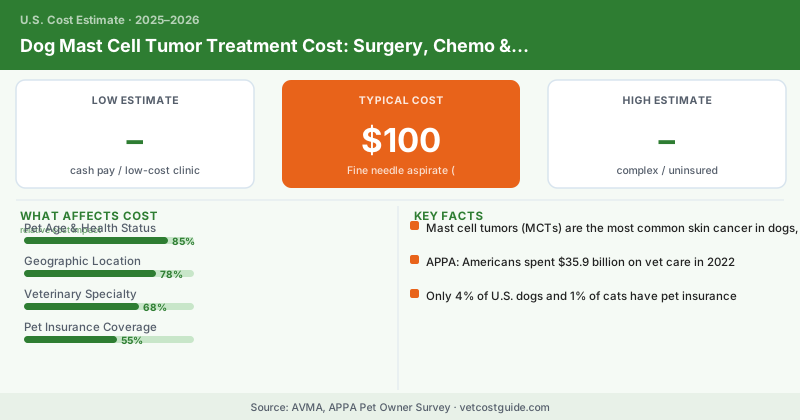
Mast cell tumors (MCTs) are the most common skin cancer in dogs, according to the AVMA. They account for 16–21% of all skin tumors diagnosed in dogs. That’s a lot — and because they can look like almost anything (a small raised bump, a soft subcutaneous mass, an inflamed skin lesion), they’re easy to miss or dismiss until they’ve been sitting there for months.
Don’t dismiss lumps on your dog. Aspirate first, then decide.
- Fine needle aspirate (FNA diagnosis): $100–$200
- Biopsy with histopathology and grading: $200–$400
- Staging workup (bloodwork + ultrasound + lymph node biopsy): $500–$800
- Surgery for low-grade MCT: $500–$2,000
- Stelfonta injection (non-resectable tumors): $500–$1,000
- Toceranib (Palladia) chemotherapy: $150–$300/month
- CCNU (lomustine) chemotherapy: $300–$400 per cycle
- Radiation therapy (full course): $8,000–$15,000
What Mast Cell Tumors Actually Are
Mast cells are normal immune cells found throughout the body’s connective tissue, particularly in the skin. They contain granules packed with histamine, heparin, and other inflammatory chemicals — released as part of allergic and inflammatory responses.
When mast cells become cancerous, those granules can release their contents inappropriately. That’s why mast cell tumors can cause systemic symptoms beyond the tumor itself: ulcers from histamine-stimulated stomach acid overproduction, localized swelling that appears and disappears (called Darier’s sign), and serious systemic reactions when the tumor is manipulated without antihistamine pretreatment.
Before any surgery involving a suspected mast cell tumor, most vets pretreat with diphenhydramine (Benadryl) to reduce the risk of a systemic degranulation reaction during manipulation.
Two Grading Systems: Patnaik and Kiupel
For decades, mast cell tumors were graded using the Patnaik system (Grades 1, 2, and 3):
- Grade 1: Well-differentiated, low mitotic rate — excellent prognosis with surgery
- Grade 2: Intermediate — variable behavior, wide range of outcomes
- Grade 3: Poorly differentiated, high mitotic rate — aggressive, poor prognosis
The problem: Grade 2 tumors were wildly variable in behavior, making prognosis and treatment decisions difficult.
The Kiupel 2-tier system (Low Grade vs. High Grade), published in 2011, resolves this ambiguity with a cleaner classification based primarily on mitotic index (how rapidly cells are dividing). The Veterinary Cancer Society now recognizes the Kiupel system as clinically more useful for treatment decision-making, though many pathology reports include both classifications.
Low-grade (Kiupel): Surgery is often curative. Median survival with complete excision: >2 years, frequently much longer.
High-grade (Kiupel): Aggressive behavior. Metastasis to lymph nodes, spleen, liver, and bone marrow is common. Median survival even with aggressive treatment: 4–6 months.
Diagnostic Costs: From Lump to Diagnosis
| Diagnostic Step | Cost | Purpose |
|---|---|---|
| Fine needle aspirate (FNA) | $100–$200 | Confirms mast cell tumor; quick in-clinic |
| Biopsy with histopathology | $200–$400 | Required for grading; sent to pathologist |
| Complete blood count + chemistry | $100–$200 | Baseline; checks for systemic involvement |
| Abdominal ultrasound | $250–$500 | Checks spleen and liver for metastasis |
| Regional lymph node FNA or biopsy | $100–$300 | Staging; is it already in the lymph nodes? |
| Chest radiographs | $100–$200 | Pulmonary metastasis check (high-grade cases) |
| Bone marrow aspirate | $200–$400 | Advanced staging for high-grade tumors |
Surgery: The Primary Treatment
Surgery is the first-line treatment for most mast cell tumors. The challenge: mast cell tumors require wide surgical margins — meaning the surgeon removes not just the visible tumor but a significant cuff of normal tissue around and beneath it. Typical margins are 2–3 cm laterally and one fascial plane deep.
This is why location matters enormously. A mast cell tumor on the trunk is relatively easy to excise with adequate margins. A tumor on the face, around the eye, on the paw or digit, or over a joint may not have enough adjacent tissue for adequate margins — which changes the treatment approach.
Surgery cost: $500–$2,000 at a general practice. More complex locations, or cases referred to a board-certified surgeon, run $1,500–$3,000 or more.
After surgery, the excised tissue goes to a veterinary pathologist who:
- Confirms the tumor type
- Grades it (Patnaik and/or Kiupel)
- Evaluates surgical margins (complete, close, or incomplete)
- May run c-kit mutation testing ($150–$300) — relevant to targeted therapy eligibility
The pathology report takes 5–7 business days and costs $200–$400.
Stelfonta: When Surgery Isn’t an Option
Stelfonta (tigilanol tiglate) is a botanical-derived drug injected directly into the tumor. It causes tumor destruction through localized cell death, leaving a wound that heals over 4–6 weeks. FDA-approved in 2020 for non-resectable cutaneous and subcutaneous mast cell tumors in dogs.
Cost: $500–$1,000 per treatment. A second treatment may be needed for larger tumors.
It’s not a replacement for surgery when surgery is feasible — complete excision with pathologic evaluation is still preferred. But for tumors in difficult locations where adequate surgical margins can’t be achieved, Stelfonta provides an effective non-surgical alternative.
Chemotherapy for High-Grade Mast Cell Tumors
High-grade tumors that have metastasized, or low-grade tumors with incomplete margins where further surgery isn’t possible, typically require systemic therapy.
Toceranib phosphate (Palladia) is an oral targeted therapy that inhibits the c-kit receptor tyrosine kinase — a mutation present in roughly 30% of mast cell tumors. It’s FDA-approved specifically for mast cell tumors in dogs and is given daily or every-other-day.
- Cost: $150–$300/month depending on the dog’s weight and dose
- Requires regular bloodwork monitoring ($100–$200 every 4–6 weeks)
- Common side effects: GI upset, lameness, protein-losing nephropathy — monitoring is essential
CCNU (lomustine) is an oral alkylating chemotherapy agent used in mast cell tumor protocols, often in combination or for dogs where Palladia isn’t appropriate.
- Cost: $300–$400 per cycle (typically every 3–4 weeks)
- Requires CBC monitoring before each cycle due to bone marrow suppression risk
Radiation Therapy
Radiation is used when surgical margins are incomplete and further surgery isn’t possible, or as adjuvant therapy after surgery for high-grade tumors. Full courses involve daily or every-other-day treatments over 3–4 weeks, requiring anesthesia for each session.
Full radiation course: $8,000–$15,000 at a specialty facility. Available at veterinary teaching hospitals and specialty oncology centers; not at most general practices.
Palliative radiation — fewer fractions, aimed at controlling a tumor or managing pain rather than cure — runs $1,500–$4,000 and is less burdensome for the dog.
High-Risk Breeds
Mast cell tumors aren’t evenly distributed. Certain breeds have dramatically elevated rates:
- Boxers: among the highest rates of any breed; often develop multiple tumors, but many are low-grade
- Boston Terriers: similar predisposition to Boxers
- Golden Retrievers: high overall cancer rates; MCT is common
- Labrador Retrievers: MCT is one of their most common skin tumors
- Pugs and Bulldogs: shorter-nosed breeds appear overrepresented
- Shar-Peis: notably high-grade tumor rates compared to other breeds — their MCTs tend to be more aggressive
If you own a Boxer or Boston Terrier, every new skin lump gets aspirated. That’s just the rule.
Don’t manipulate or aggressively squeeze a suspected mast cell tumor before your vet visit. Mechanical stimulation can cause degranulation — the release of histamine and other mediators from the tumor’s granules — which can cause local swelling, redness, and in severe cases, systemic reactions including low blood pressure and shock. If you find a lump, leave it alone and get it aspirated. Your vet will pretreat with antihistamines before any manipulation or surgery.
Building a Realistic Cost Plan
Low-grade MCT caught early: $800–$2,500 total (FNA + surgery + pathology). Often a one-time cost with cure achieved.
High-grade MCT requiring multimodal treatment: $5,000–$20,000+ over the dog’s remaining life. Consider pet insurance enrollment before any diagnosis is documented — or discuss realistic goals and quality of life with a veterinary oncologist who can help you understand what various treatment paths actually achieve.
Frequently Asked Questions
For low-grade mast cell tumors with complete surgical margins, yes — surgery alone is frequently curative and the dog can live out a normal lifespan. The key phrase is 'complete margins.' If the pathology report shows that tumor cells were present at or close to the surgical edges (incomplete or narrow margins), your vet will discuss whether additional surgery, radiation, or medical management is warranted. High-grade tumors have a much higher recurrence and metastasis rate even with clean surgical margins, which is why they typically require additional treatment.
Fine needle aspiration (FNA) — a quick, minimally invasive in-clinic procedure — can usually diagnose mast cell tumors on the spot. Your vet inserts a small needle into the lump, collects a few cells, and examines them under a microscope. Mast cells have a characteristic appearance with visible granules that stain readily with common stains. FNA costs $100–$200 and takes about 15 minutes. However, FNA can't grade the tumor — grading requires a full tissue biopsy examined by a veterinary pathologist. Don't skip the biopsy after surgery; the grade determines everything about what happens next.
Stelfonta (tigilanol tiglate) is an injectable drug approved by the FDA in 2020 for treating non-resectable cutaneous mast cell tumors in dogs. It's injected directly into the tumor — the drug causes localized destruction of the tumor mass, typically resulting in a wound that heals over 4–6 weeks. It's an option when surgery isn't feasible due to the tumor's location (on the face, around joints, or in areas where getting adequate surgical margins would cause functional problems). Cost is $500–$1,000 per treatment. It's not appropriate for all mast cell tumors — your vet or a veterinary oncologist will assess candidacy.