Why does the exact same MRI machine cost your dog $2,500 when your own MRI with insurance might run you a $50 copay? It’s not overcharging — it’s a fundamentally different cost structure, and understanding it will help you make sense of the quote you just got.
Dogs can’t be told to hold still for 45-90 minutes inside a loud, claustrophobic machine. That means every canine MRI requires general anesthesia, a dedicated anesthesia monitoring team, and — critically — a board-certified veterinary radiologist or neurologist to interpret the images, since MRI interpretation for suspected disc disease, brain tumors, or spinal cord compression requires specialized training most general practitioners don’t have. All of that gets bundled into one veterinary bill instead of being split (and often subsidized) across insurance networks the way human imaging is.
- Anesthesia and monitoring: $300–$700
- The scan itself (machine time): $800–$2,500
- Specialist interpretation (radiologist/neurologist): $200–$500
- Pre-anesthetic bloodwork: $80–$200
- Overnight hospitalization if needed: $150–$400/night
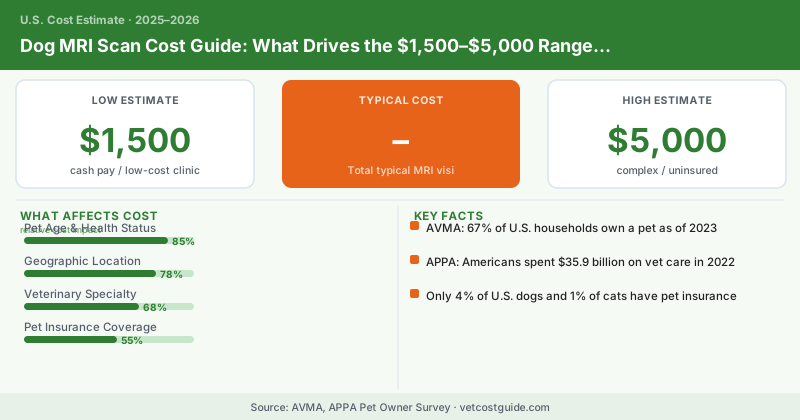
- Total typical range: $1,500–$5,000
Full Cost Breakdown
| Component | Low End | High End | Notes |
|---|---|---|---|
| Pre-anesthetic bloodwork | $80 | $200 | Required before any general anesthesia |
| Anesthesia and monitoring | $300 | $700 | Scales with scan duration |
| MRI scan (machine time) | $800 | $2,500 | Body region and complexity dependent |
| Specialist interpretation (radiologist) | $200 | $500 | Board-certified read required |
| Contrast dye (if needed) | $100 | $250 | For certain suspected conditions |
| Overnight hospitalization | $150 | $400 | Per night, if recovery monitoring needed |
| Follow-up consultation with results | $75 | $200 | Discussing findings and next steps |
| Total typical MRI visit | $1,500 | $5,000 | Full package for one region |
What Determines Where You Land in the Range
Body region scanned is the single biggest variable. A brain MRI for suspected seizures or a tumor typically costs less than a full spinal MRI, which requires imaging multiple vertebral segments to locate a lesion like a herniated disc. Scanning more than one region in the same visit (say, brain plus cervical spine) adds significantly to machine time.
Where the MRI is performed matters too. University veterinary teaching hospitals and large specialty referral centers tend to have the most current equipment and deepest specialist bench, but pricing is often comparable to or only slightly above private specialty practices in the same region — the bigger driver is regional cost of living, not institution type.
Your dog’s size affects anesthesia dosing and machine positioning time, though less dramatically than for most surgeries. A 90-pound Labrador and an 8-pound Chihuahua both need the same scan duration; the anesthesia costs scale with weight but represent a smaller fraction of the total than in surgical procedures.
When Is an MRI Actually Necessary?
Vets typically recommend MRI when clinical signs point to a neurological problem that X-rays and bloodwork can’t diagnose — sudden hind-limb weakness or paralysis suggesting a herniated disc, seizures with no clear metabolic cause suggesting a brain lesion, or a head tilt and loss of balance suggesting inner ear or brainstem disease. X-rays show bone; MRI shows soft tissue, including the spinal cord, brain, and disc material that X-rays simply can’t image.
Your vet will often recommend a CT scan instead in some cases — CT is faster, cheaper ($800-$2,000), and better for certain bone and some brain conditions, while MRI remains superior for soft tissue and spinal cord detail. Ask which imaging modality actually fits your dog’s suspected condition before assuming MRI is required.
- Confirm the quote includes anesthesia, the scan, AND specialist interpretation — some estimates only list the scan itself
- Ask whether a CT scan could answer the diagnostic question at lower cost for your dog’s specific symptoms
- Get pre-anesthetic bloodwork done ahead of time if your regular vet can do it more cheaply than the imaging center
- Ask if surgery is likely to follow the MRI — many practices offer a combined MRI-plus-surgery quote that’s more cost-effective than scheduling separately
Managing the Cost
If surgery is likely to follow a positive MRI finding (as with a herniated disc requiring decompression), ask the specialty hospital for a bundled quote covering both the imaging and the likely surgical intervention — many will provide this since it’s a common sequence, and it can save you the cost of two separate anesthesia events. Pet insurance purchased before any neurological symptoms appear typically covers a significant portion of MRI costs, making this one of the strongest arguments for enrolling dogs in insurance while they’re still young and healthy.
Frequently Asked Questions
A dog MRI costs $1,500–$5,000 partly because dogs require general anesthesia to stay perfectly still during the 45-90 minute scan, whereas human patients simply hold still on request. The anesthesia, monitoring team, and specialist radiologist interpretation are bundled into the veterinary price, unlike human MRI billing which is typically separated across multiple providers and often subsidized by insurance.
Most comprehensive pet insurance plans cover MRI scans when they're medically necessary for diagnosing a covered condition, typically reimbursing 70-90% of the cost after your deductible. Coverage depends on enrolling before symptoms appear, since insurers exclude diagnostics related to pre-existing conditions.