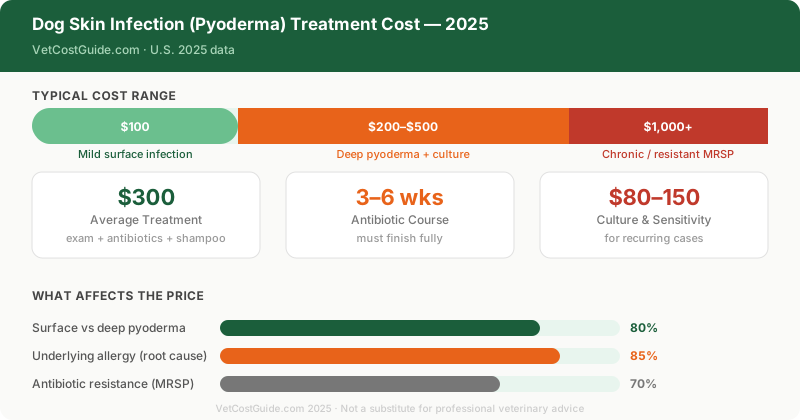
Here’s a frustrating pattern that plays out constantly in veterinary practices: a dog comes in with a skin infection (pyoderma), gets antibiotics, clears up in two weeks, and comes back with the same infection two months later. And again two months after that. Each visit costs $150–$300. After four or five cycles, the owner has spent $800–$1,500 — and now the dog has a drug-resistant infection that requires $150–$400 per month in specialized antibiotics.
The dogs racking up the highest pyoderma bills almost universally share one thing: an underlying allergy that was never identified and treated. The infection keeps coming back because the root cause was never addressed. Understanding this one fact — that pyoderma is often a symptom, not the disease — will save you money and your dog significant discomfort.
- Mild to moderate pyoderma costs $150–$400 to treat: exam, skin cytology, a 3–4 week antibiotic course, and medicated shampoo.
- Deep pyoderma (infection reaching the hair follicles and dermis) requires 8–12 weeks of antibiotics and costs $300–$700 per episode.
- MRSP (methicillin-resistant) infections require culture-guided specialized antibiotics that run $150–$400/month and are a direct consequence of repeated antibiotic exposure without resolving the underlying cause.
- Allergy testing to identify and treat the underlying trigger costs $200–$600 but eliminates the root cause—saving far more than it costs over a dog’s lifetime of recurrent pyoderma.
Dog Pyoderma Treatment Cost Breakdown
| Type | Low | Average | High |
|---|---|---|---|
| Vet exam fee | $50 | $65 | $80 |
| Skin cytology (impression smear) | $40 | $60 | $80 |
| Culture & sensitivity test | $80 | $115 | $150 |
| Oral antibiotics (3–6 week course) | $40 | $80 | $120 |
| Medicated shampoo (chlorhexidine) | $20 | $32 | $45 |
| Topical spray or wipes | $20 | $30 | $40 |
| Deep pyoderma antibiotics (8–12 weeks) | $100 | $175 | $250 |
| MRSP specialized antibiotics (monthly) | $150 | $275 | $400 |
| Allergy blood or skin testing | $200 | $400 | $600 |
| Total: mild first-time pyoderma | $150 | $240 | $360 |
| Total: recurring or resistant pyoderma | $400 | $700 | $1,200 |
What Diagnosis and Treatment Actually Include
Skin cytology is the most important $40–$80 you’ll spend at a pyoderma visit. The vet presses a glass slide against a lesion, stains it with Diff-Quik, and looks at it under a microscope for 5–10 minutes. They’re looking for cocci (spherical bacteria, typically Staphylococcus pseudintermedius) and inflammatory cells. This tells them what organism is causing the infection and guides antibiotic choice. It should happen before every antibiotic prescription — including refills. Vets who skip it and prescribe antibiotics by appearance alone are guessing.
Culture and sensitivity (C&S) testing goes a step further. A swab goes to an outside lab (results in 3–5 days) and comes back with the exact bacteria present and a list of which antibiotics will and won’t kill them. This is essential for any infection that didn’t respond to the first antibiotic, any recurrence after a completed treatment course, or any dog suspected of drug-resistant infection. Some vets defer C&S on first presentations to reduce upfront cost — that’s often reasonable. But ordering it after a second treatment failure is too late. Two failures mean empirical antibiotics aren’t working; culture-guided therapy should’ve started.
Standard antibiotics for Staphylococcus pyoderma usually mean amoxicillin-clavulanate, cephalexin, or trimethoprim-sulfamethoxazole. A 3–4 week course for mild pyoderma runs $40–$80 for a medium-sized dog. Deep pyoderma needs 8–12 weeks — longer because bacteria protected deep in the follicle and dermis require sustained therapeutic antibiotic levels to eliminate.
Medicated shampoos and topicals with chlorhexidine (2–4%) or benzoyl peroxide aren’t optional extras. They reduce surface bacterial load, accelerate resolution, and meaningfully reduce recurrence. Bathing two to three times weekly during treatment is standard. Between infections, twice-weekly medicated baths in allergy-prone dogs can stretch the interval from 8 weeks to several months.
Allergy management is where this all comes together. Allergies — environmental atopy or food allergy — disrupt the skin barrier, letting Staphylococcus colonize. Without treating the allergy (Apoquel at $50–$80/month, Cytopoint at $80–$180 per injection, immunotherapy at $150–$250/month, or a prescription elimination diet), infections will reliably recur every 6–12 weeks regardless of how well the individual episode was treated.
What Makes Pyoderma More Expensive
Depth of infection. Surface pyoderma clears fastest with topicals. Superficial pyoderma (into the hair follicles) requires oral antibiotics. Deep pyoderma (into the dermis and subcutaneous tissue) needs the longest courses, sometimes combined with systemic anti-inflammatories and drain flushing for furunculosis — ruptured follicles that form abscesses. Cost scales directly with how deep the infection has penetrated.
Whether a culture was done. A first-time infection treated empirically usually works — Staphylococcus pseudintermedius is predictably sensitive to first-line antibiotics in treatment-naive dogs. But empirical treatment of a dog that’s already had multiple antibiotic courses is guesswork. Culture-guided therapy resolves infections faster and costs less per successfully treated episode than repeated failed empirical trials.
Antibiotic resistance. MRSP — methicillin-resistant Staphylococcus pseudintermedius — develops in dogs that have received multiple antibiotic courses without ever clearing the underlying cause. It’s resistant to standard antibiotics and requires specialized agents like rifampicin, linezolid, or fusidic acid that are significantly more expensive and require monitoring for side effects. Prevention through judicious antibiotic use and allergy management is far cheaper than treating MRSP.
Underlying allergy control. An allergy-controlled dog on Apoquel or Cytopoint might get pyoderma once a year. The same dog uncontrolled gets it every 6–8 weeks. Over a year: 2 episodes at $250 each = $500. Or 8 episodes at $250 each = $2,000 in treatment costs alone — before antibiotic resistance compounds the problem.
Breed anatomy. Dogs with skin folds — English Bulldogs, Pugs, Shar-Peis — develop fold pyoderma from chronic moisture and friction in those folds. In severe cases, surgical fold reduction ($500–$1,500 per site) is the only lasting solution. Cocker Spaniels, Labrador Retrievers, and Golden Retrievers are among the highest-pyoderma-rate breeds overall.
- Treating recurrent pyoderma without investigating the underlying cause. If a dog has had two or more pyoderma episodes within 12 months, treating each one in isolation without pursuing an allergy diagnosis is clinically and financially counterproductive. Each treated-but-recurred infection adds to antibiotic exposure (increasing resistance risk) and delays the diagnosis that would actually solve the problem.
- Using antibiotics without skin cytology. Prescribing antibiotics for skin lesions that turn out to be fungal (Malassezia dermatitis), yeast overgrowth, or demodicosis (mite infestation) is ineffective and adds unnecessary antibiotic exposure. Cytology is essential before antibiotics—it’s fast, cheap, and changes treatment decisions in a meaningful percentage of cases.
- Stopping antibiotics when the skin “looks better.” Superficial pyoderma typically looks much better after 1–2 weeks, but requires a full 3–4 week course for complete bacterial elimination. Deep pyoderma needs 8–12 weeks. Stopping early almost always means treatment failure and recurrence within 4–6 weeks, restarting the treatment cycle and increasing resistance risk.
Pet Insurance for Skin Disease
Pet insurance covers pyoderma under illness policies — but the value depends heavily on timing and policy language. Dogs enrolled before any documented skin disease history are in the best position: recurring pyoderma covered at 80% with a $200 deductible can represent $1,500–$4,000 in annual savings for frequently affected dogs.
Skin disease is consistently among the top three most common pet insurance claims, and insurers know it. Some policies have specific dermatology sublimits or exclusions worth reading carefully. For dogs with already-documented recurring skin infections, new insurers may classify the condition as pre-existing and limit coverage.
One underused option: a veterinary dermatologist consultation ($200–$400 initial visit) is typically covered and often one of the highest-ROI specialty referrals available. Dermatologists get to definitive diagnoses faster and reduce total annual treatment costs significantly for dogs with complex or recurring skin disease.
How to Spend Less
Get skin cytology at every appointment. The $40–$80 test prevents paying for the wrong antibiotic. It identifies yeast-predominant infections (need antifungal shampoo, not oral antibiotics) and mixed infections (need combined treatment). Skipping cytology saves $60 and risks $200–$400 in ineffective treatment.
Medicated shampoo between infections. Chlorhexidine 2–4% shampoo twice weekly in allergy-prone dogs significantly extends the interval between episodes. A $25 bottle of preventive shampoo is materially cheaper than a $300 infection treatment.
Pursue allergy diagnosis after the second episode. Allergy testing ($200–$600) followed by immunotherapy or Apoquel addresses the root cause. If allergy control prevents four pyoderma episodes per year at $250 each, it pays for itself within four to eight months.
Ask for a written prescription for generic antibiotics. Generic cephalexin and amoxicillin-clavulanate at retail pharmacies via GoodRx commonly cost $20–$40 for a 30-day supply for a 50-lb dog — versus $60–$100 at clinic retail. Ask your vet for a written prescription to fill elsewhere.
See a dermatologist for complex cases. The $250–$400 initial consultation fee is typically recovered within the first year in reduced failed treatment costs for dogs with recurring disease. Dermatologists resolve in one or two visits what general practitioners sometimes struggle with for months.
Frequently Asked Questions
What does pyoderma look like on a dog? Classic surface and superficial pyoderma presents as red bumps (papules) or pus-filled bumps (pustules) resembling acne, often on the abdomen, groin, or armpits where the skin is hairless or sparsely haired. As pustules rupture, they leave behind circular rings of crust called epidermal collarettes — highly characteristic of pyoderma. Affected areas may be itchy, and some dogs develop patchy hair loss in infected areas.
Can I treat a dog’s skin infection at home without a vet? Medicated chlorhexidine shampoos and wipes can reduce surface bacterial load and may help very mild cases, but they’re not reliable substitutes for prescription antibiotics in established infections. Over-the-counter antibiotic ointments aren’t appropriate for infections covering larger areas or involving multiple lesions. A vet visit for cytology and proper antibiotic selection is necessary for anything beyond very mild localized irritation.
How long does it take for pyoderma to clear up? Mild superficial pyoderma shows visible improvement in 7–10 days but needs a full 3–4 week antibiotic course for complete resolution. Deep pyoderma requires 8–12 weeks. Treatment should continue for 2 weeks past apparent clinical resolution to eliminate residual bacterial populations.
What is MRSP and how does it happen? MRSP (methicillin-resistant Staphylococcus pseudintermedius) is a strain resistant to beta-lactam antibiotics and commonly cross-resistant to multiple other antibiotic classes. It develops primarily through repeated, prolonged antibiotic exposure — particularly in dogs who receive multiple courses without ever resolving the underlying cause of their recurring infections. MRSP cannot be treated with standard first-line antibiotics and requires expensive specialized agents.
Frequently Asked Questions
Mild skin infections typically cost $100–$500 for initial diagnosis and antibiotics, while deep or resistant infections run $500–$1,500 or more. Recurring infections can become expensive quickly, with repeat visits at $150–$300 each potentially reaching $800–$1,500 after multiple cycles, especially if the infection becomes drug-resistant and requires specialized treatment at $150–$400 per month.
Most pet insurance plans cover pyoderma treatment as an illness, but coverage depends on your specific policy and whether the condition is deemed pre-existing. Typical out-of-pocket costs range from 10–30% after your deductible ($250–$500) is met, meaning you might pay $50–$200 for a mild case after insurance.
Recurring pyoderma often stems from underlying allergies, poor skin barrier function, or incomplete treatment rather than the antibiotic failing, which is why dogs can reinfect within weeks of treatment ending. Identifying and treating the root cause—whether through allergy testing ($200–$400), medicated baths, or environmental changes—can prevent the costly cycle of repeat $150–$300 vet visits and reduce the risk of developing drug-resistant infections.