Most skin tags on dogs are completely harmless. You notice a soft, flesh-colored bump on your dog’s chest or armpit, mention it at the annual exam, and your vet confirms it’s a benign fibroma. You leave it alone. No cost, no problem.
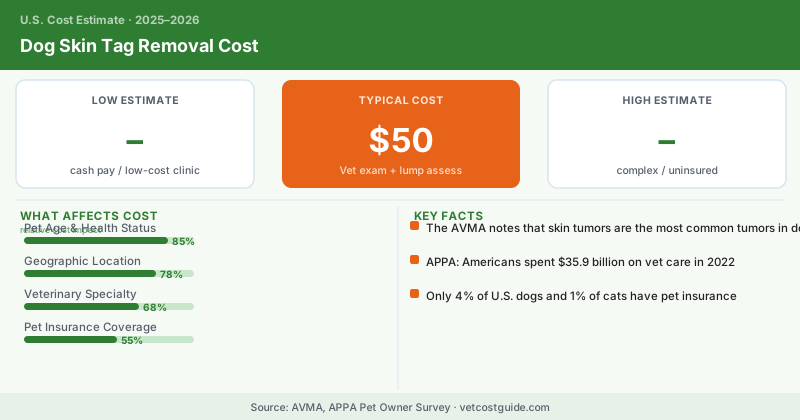
But here’s what changes the math: any lump that’s growing quickly, feels firm, has irregular pigmentation, or sits in a spot where it gets constantly irritated needs a closer look. The AVMA notes that skin tumors are the most common tumors in dogs, and that 20–40% of canine skin masses turn out to be benign — meaning the majority are not. That’s why vets are careful about assuming a lump is “just a skin tag” without confirmation.
Typical Cost Ranges
| Service | Typical Cost | Notes |
|---|---|---|
| Vet exam + lump assessment | $50–$100 | Includes physical palpation |
| Fine needle aspirate (FNA) | $50–$150 | Quick in-office cytology; doesn't require sedation |
| Skin tag removal under local anesthesia | $100–$350 per tag | Best for small tags in accessible areas |
| Sedation for anxious dogs or sensitive areas | $150–$300 | Added cost on top of removal fee |
| General anesthesia (multiple tags) | $300–$800 | Full anesthetic event for large or multiple tags |
| Histopathology (tissue biopsy) | $80–$200 per sample | Confirms benign vs. malignant; strongly recommended |
| Laser removal | $200–$600 | Less bleeding; faster healing; good for facial or eyelid tags |
| Cryosurgery | $100–$400 | Freezes and destroys small surface lesions |
When Removal Is Actually Necessary
Not every skin tag needs to come off. Your vet will typically recommend leaving a tag alone if it’s small, soft, slow-growing, and in a low-friction area. The cost for that approach: $0 beyond your routine exam.
Removal becomes the right call in a few situations:
The tag is irritated or infected. Tags on the armpit, groin, or collar line get rubbed constantly. That friction causes bleeding, crusting, and secondary infection. Removing an irritated tag before it becomes an infected wound is significantly cheaper than treating both the tag and an infection.
The location causes problems. Tags near the eye, eyelid, or lip can interfere with function — rubbing against the cornea, for example, causes chronic eye irritation. Those need to come off regardless of their benign nature.
It’s growing fast. A lump that doubles in size in four to six weeks isn’t behaving like a benign skin tag. It needs a fine needle aspirate (FNA) at minimum, and likely excisional biopsy.
You want peace of mind. Some owners simply don’t want to watch a lump and wonder. That’s a perfectly valid reason for removal, and it’s not expensive when done under local anesthesia.
A fine needle aspirate (FNA) is quick and cheap ($50–$150). A needle draws out a few cells, which the vet or a lab examines under a microscope. It’s a good screening tool but can miss certain tumor types — mast cell tumors in particular sometimes look unremarkable on FNA. Histopathology ($80–$200) examines the full removed tissue sample and gives a definitive diagnosis. For any lump that’s been removed, histopathology is almost always worth the extra cost.
The Mast Cell Tumor Problem
Here’s the thing pet owners need to know: mast cell tumors — one of the most common and potentially serious canine cancers — can look exactly like a benign skin tag. They’re soft. They can be small. They don’t always behave in obviously alarming ways early on.
The standard line in veterinary dermatology is “any lump, any bump, get it tested.” That doesn’t mean every skin tag needs a biopsy the day you find it. But it does mean that any lump your vet removes — even one that looks completely benign — should have histopathology run on it. If it turns out to be a grade II or III mast cell tumor, knowing that changes the entire treatment plan. Finding out a year later that a “skin tag” you had removed was actually a low-grade mast cell tumor means you’ve lost the chance for clean-margin surgery.
Anesthesia: The Biggest Cost Variable
The biggest driver of skin tag removal cost is whether anesthesia is needed. A small tag on the back or chest can often be removed under local anesthesia — a quick lidocaine injection numbs the area, the tag is snipped or excised, and your dog goes home the same morning. Total cost: $150–$450 including the exam and histopathology.
Add sedation or general anesthesia and the bill jumps. Anesthesia for a healthy adult dog adds $150–$400 to the procedure. But some situations require it: anxious dogs who won’t hold still, tags near the face or eyes where precision matters, dogs having multiple tags removed in one session, and brachycephalic breeds (Pugs, French Bulldogs) who need careful anesthetic monitoring.
If your dog has three or four tags that should come off, removing them all in one anesthetic event is almost always cheaper than three separate sedation procedures.
Never attempt to remove a skin tag at home by tying it off or cutting it. Home removal risks infection, excessive bleeding, and — more importantly — eliminates any possibility of testing the tissue. If a lump turns out to be a mast cell tumor, degranulation from trauma can trigger a systemic reaction. Any lump your dog has should be evaluated by a vet before anyone touches it.
Does Pet Insurance Cover Skin Tag Removal?
Most comprehensive pet insurance plans cover skin tag removal when it’s medically indicated — irritation, infection, functional impairment, or when a mass is removed for diagnostic purposes. Cosmetic removal of a tag that’s completely harmless and not bothering the dog is typically excluded.
The histopathology fee is almost always covered as part of a diagnostic workup. If you’re going to submit a claim, make sure your vet documents the clinical reason for removal (irritation, location, growth pattern) rather than framing it as elective cosmetic surgery.
Bottom Line
A single benign skin tag removed under local anesthesia with histopathology runs $230–$600 at most practices. If you’ve got an anxious dog or multiple tags requiring general anesthesia, budget $500–$1,000 for the whole event. The histopathology fee — $80–$200 — is always worth paying. Knowing exactly what was on your dog costs far less than finding out it wasn’t benign after the window for treatment has passed.
Frequently Asked Questions
Dog skin tag removal typically costs $100–$800, depending on the removal method (surgical excision, laser, or cryotherapy), whether anesthesia is required, and if histopathology testing is performed on the removed tissue. A simple in-office removal under local anesthesia may cost $100–$300, while general anesthesia and lab analysis can push costs to $500–$800.
Most pet insurance plans classify benign skin tag removal as an elective or cosmetic procedure and do not cover it, though some plans may cover removal if the tag is causing irritation or infection. Chronic condition exclusions may also apply if your dog has a history of skin issues; check your specific policy for details on what your plan considers medically necessary versus cosmetic.
Anesthesia is not always necessary—small, benign skin tags can often be removed with local anesthesia only, taking 10–15 minutes and costing $100–$250. However, if the tag is large, in a sensitive location, or your vet wants to biopsy it for histopathology, general anesthesia is typically recommended, adding $200–$400 to the total cost and extending recovery to 24–48 hours.