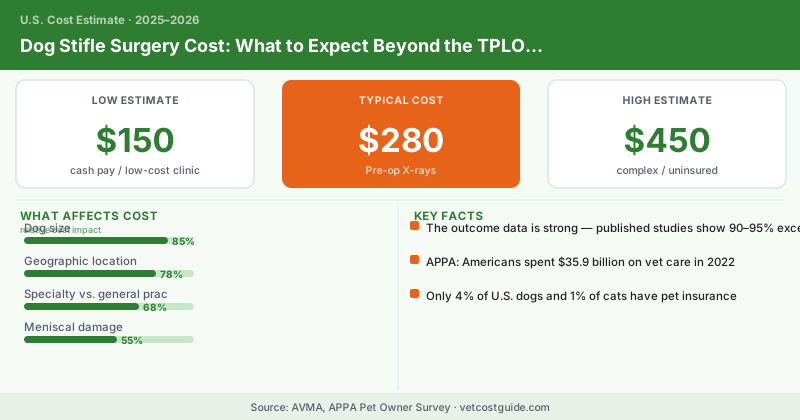
Your vet just handed you a $4,800 estimate for stifle surgery. You nodded, said you’d think about it — and then panicked in the parking lot. That’s a completely normal reaction. Here’s what that number actually includes, what it probably doesn’t, and what the full bill looks like when all is said and done.
- Stifle surgery (all methods) typically runs $1,500–$7,500 depending on technique and your dog’s size
- TPLO — the most common method for medium and large dogs — averages $3,500–$6,500
- Lateral suture repair costs less upfront ($1,500–$2,800) but carries higher failure rates in dogs over 30 lbs
- Pre-op diagnostics, anesthesia, and rehabilitation often add $800–$2,500 on top of the surgery quote
- Pet insurance with orthopedic coverage can recover $2,500–$4,500 on a TPLO claim
The Full Cost Picture — Not Just the Surgery Line
Most quote sheets show one number: the surgery. What they often leave off is everything surrounding it.
| Cost Component | Low | Average | High |
|---|---|---|---|
| Pre-op X-rays | $150 | $280 | $450 |
| Pre-op bloodwork + urinalysis | $80 | $185 | $320 |
| Anesthesia + monitoring | $250 | $450 | $750 |
| Stifle surgery (lateral suture) | $1,500 | $2,000 | $2,800 |
| Stifle surgery (TPLO or TTA) | $3,500 | $4,800 | $6,500 |
| Pain meds + anti-inflammatories (3–4 wks) | $60 | $120 | $240 |
| 6-week recheck X-ray | $120 | $220 | $380 |
| 12-week recheck + final X-ray | $120 | $220 | $380 |
| Formal rehabilitation therapy (optional) | $600 | $1,200 | $2,500 |
| E-collar + sling + joint supplement | $40 | $90 | $160 |
So if your vet quoted $4,800 for TPLO, your true out-of-pocket — including pre-op diagnostics, post-op rechecks, medications, and a basic rehabilitation course — is likely closer to $6,200–$7,500 by the time your dog is fully cleared at 12 weeks.
Why “Stifle” Instead of “Knee” or “ACL”
The dog’s stifle joint is the anatomical equivalent of the human knee. The ligament that ruptures — called the cranial cruciate ligament (CCL) — is functionally similar to the human ACL. Veterinary surgeons use “stifle surgery” as the umbrella term because there are multiple procedures that can stabilize it, and the approach differs depending on your dog’s size, age, degree of arthritis already present, and the surgeon’s training.
According to the AVMA, CCL disease is the leading cause of rear-leg lameness in dogs and one of the most common orthopedic conditions treated in small animal practice — affecting roughly 600,000 dogs per year in the United States. That prevalence means pricing is fairly predictable, but it also means a lot of practices perform these surgeries with varying levels of specialization.
The Method That Moves the Number Most
Lateral suture / extracapsular repair: A strong suture is placed around the outside of the joint to replace the stabilizing function of the torn ligament. Costs the least, heals the fastest initially, and is genuinely appropriate for dogs under 25–30 lbs. In bigger dogs, that suture fatigues under repeated loading and failure rates climb significantly.
TPLO (Tibial Plateau Leveling Osteotomy) and TTA (Tibial Tuberosity Advancement): Both cut and reposition bone to change joint mechanics so the missing ligament becomes biomechanically irrelevant. These require specialty implants, intraoperative fluoroscopy at some facilities, and a surgeon experienced in bone-cutting procedures. The outcome data is strong — published studies show 90–95% excellent or good long-term results in appropriate candidates.
If your vet is recommending TPLO for a 60-pound Labrador, that’s not upselling. It’s evidence-based.
What Drives the Price Up or Down
Dog size. Bigger dogs need more implant material, longer surgeries, and higher anesthetic doses. A 90-pound dog’s TPLO will cost more than the same procedure on a 45-pound dog at the same practice.
Geographic location. A $5,000 TPLO in a major coastal city might be $3,400 in a mid-size Midwestern market. The surgery is the same. The overhead is different.
Specialty vs. general practice. Board-certified veterinary surgeons (DACVS) at orthopedic specialty centers charge more than general practitioners. For TPLO and TTA, that premium is backed by documented outcomes — the precision of bone cuts matters.
Meniscal damage. About 40–60% of CCL tears involve concurrent meniscal injury. When the surgeon finds it intraoperatively, meniscal treatment adds $300–$600. You won’t always know this beforehand.
Bilateral involvement. Studies suggest that 40–60% of dogs who tear one CCL will tear the other within 12–18 months. If your dog eventually needs both legs repaired, some practices offer package pricing when both surgeries are scheduled within 60 days.
Don’t accept a single-line surgery quote without asking for a full itemized estimate. Ask specifically: “Does this include anesthesia, pre-op bloodwork, post-op rechecks, and discharge medications?” Many quotes don’t. Also ask whether rehabilitation is recommended — skipping it after TPLO increases re-injury risk and long-term arthritis progression. The AAHA strongly recommends formal post-surgical rehabilitation for large-breed dogs following stifle repair.
How to Reduce the Bill Without Cutting Corners
Veterinary teaching hospitals perform TPLO and TTA at 30–50% lower cost than private specialty practices. Residents work under direct DACVS supervision. Outcomes are comparable. If there’s an accredited veterinary school within 90 minutes of you, it’s worth a call.
Pet insurance is most valuable here when purchased before injury. Comprehensive plans with orthopedic coverage and an 80/20 reimbursement model can recover $3,000–$5,000 on a TPLO claim after your deductible. If your dog is a high-risk breed — Labrador, Golden Retriever, Rottweiler, German Shepherd — and doesn’t already have a diagnosis, this is a legitimate financial priority.
CareCredit and Scratchpay both offer 0% APR promotional financing for 6–18 months, which converts a $5,000+ bill into manageable monthly payments without interest.
Match the surgery to the dog honestly. If your 18-pound dog has a CCL tear, lateral suture repair is legitimate medicine and saves you $2,000–$4,000 versus TPLO. Your surgeon should be guiding this choice on clinical grounds, not just patient preference.
Frequently Asked Questions
Can I wait on this surgery? For complete tears in medium-to-large dogs, waiting reliably leads to progressive joint damage, worsening arthritis, and potentially a more complicated surgery later. Most orthopedic surgeons recommend proceeding within 4–8 weeks of diagnosis.
How long is recovery? Most dogs are comfortably weight-bearing within 2–4 weeks post-TPLO and fully cleared for normal activity at 12–16 weeks. Full bone healing and return to athletic activity is typically confirmed at the 12-week recheck X-ray.
Is there a non-surgical option? In dogs under 15–20 lbs with partial tears, strict rest and rehabilitation occasionally produces acceptable functional outcomes. In dogs over 25 lbs with complete tears, non-surgical management consistently results in progressive deterioration. Surgery is the standard of care for most patients.
Frequently Asked Questions
Dog stifle surgery costs between $1,500 and $7,500 depending on the surgical method, your dog's size, and the complexity of the injury. TPLO (tibial plateau leveling osteotomy), the most common technique, typically ranges $3,500–$5,500, while less invasive options like TTA (tibial tuberosity advancement) or arthroscopic procedures may cost $2,000–$4,500 at most veterinary clinics.
Most pet insurance plans cover stifle surgery if the knee injury occurred after your policy's start date, though many impose breed-specific exclusions for conditions like ACL tears in predisposed breeds. You can typically expect to pay 10–30% out-of-pocket after meeting your deductible ($250–$1,000) and factoring in your plan's co-insurance, leaving you responsible for $800–$3,000 of the total bill.
Standard vet estimates often omit pre-surgical bloodwork ($150–$300), orthopedic imaging like CT scans ($800–$2,000), pain management medication for post-op recovery ($200–$500), and follow-up physical therapy sessions ($100–$200 per visit for 4–8 sessions). These hidden costs can add $1,200–$3,000 to your final bill, so always ask for an itemized breakdown before committing.