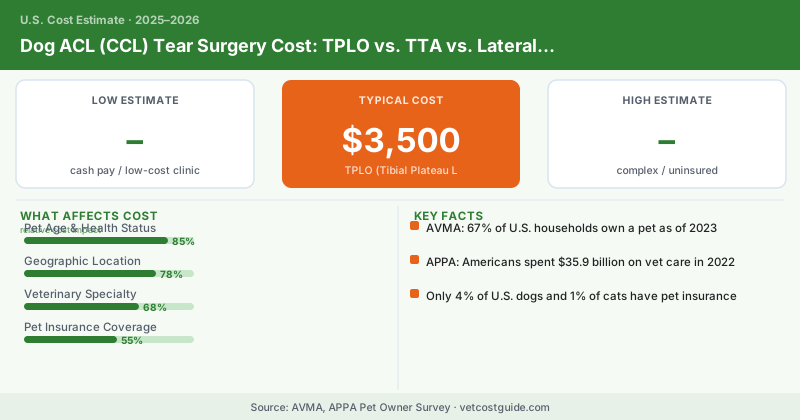
CCL rupture is the most common orthopedic injury in dogs, and it’s also one of the most expensive to treat. The American Veterinary Medical Association reports that over 1 million dogs are treated for CCL tears annually in the United States — and with surgical repair costing between $1,500 and $6,500 per knee, it’s a bill that catches a lot of pet owners off guard. If your dog just came up three-legged lame after a run in the backyard, this guide walks you through exactly what you’re looking at.
What Is a CCL Tear?
The cranial cruciate ligament (CCL) is the dog equivalent of the human ACL — it stabilizes the knee joint and prevents the tibia from sliding forward under the femur. Unlike human ACL injuries, which usually result from a single traumatic event, CCL rupture in dogs is most commonly a degenerative process. The ligament weakens over time — often due to genetics, conformation, or body weight — until it partially or completely tears.
Labrador Retrievers, Rottweilers, Newfoundlands, and other large breeds are disproportionately affected. Obesity is a major risk factor. That said, it can happen in any dog at any age.
Diagnosis requires an orthopedic exam (the “drawer test” and tibial thrust test) plus radiographs to assess joint swelling and rule out other issues. Budget $200–$400 for this initial diagnostic workup.
| Surgery Type | Cost Range | Dog Size | Recovery Time |
|---|---|---|---|
| TPLO (Tibial Plateau Leveling Osteotomy) | $3,500–$6,500 | Medium to giant breeds (30+ lbs) | 12–16 weeks |
| TTA (Tibial Tuberosity Advancement) | $3,000–$5,500 | Medium to large breeds (25+ lbs) | 10–14 weeks |
| Lateral Suture / Extracapsular Repair | $1,500–$3,000 | Small dogs under 30 lbs | 8–12 weeks |
| Diagnosis (exam + radiographs) | $200–$400 | All sizes | N/A |
| Post-op rehab (per session) | $100–$150 | All sizes | 8–12 sessions typical |
The Three Surgical Options
TPLO — $3,500 to $6,500
Tibial Plateau Leveling Osteotomy is the gold standard for medium, large, and giant breed dogs. The surgeon cuts and rotates the top of the tibia to change the angle of the joint, eliminating the need for the CCL entirely. It’s a complex bone surgery requiring specialized equipment — a radial saw, bone plates, and fluoroscopic guidance — and it must be performed by a board-certified veterinary surgeon (ACVS Diplomate).
The results justify the cost. Published outcomes show over 90% of dogs return to normal or near-normal function after TPLO. It’s also more durable long-term than the lateral suture approach for heavier dogs.
TTA — $3,000 to $5,500
Tibial Tuberosity Advancement achieves a similar biomechanical correction through a different cut geometry. Outcomes are comparable to TPLO for most dogs, but it’s less widely used in the U.S. Some surgeons prefer it for certain body conformations. It still requires a board-certified surgeon and carries a similar complication profile.
Lateral Suture / Extracapsular Repair — $1,500 to $3,000
This older technique uses a heavy nylon suture to temporarily stabilize the joint while scar tissue forms. It’s appropriate for dogs under 30 lbs and costs significantly less because it doesn’t require bone cutting or specialized implants. General practitioners with surgical training can perform it — though outcomes in heavier dogs aren’t as reliable.
TPLO’s higher price reflects the surgeon’s training, the implants (bone plates and screws run $400–$700 in hardware alone), specialized OR equipment, and the post-op radiographs needed to confirm bone healing. For a 70-lb Labrador, TPLO isn’t just the best option — it’s the only one with long-term data supporting durable outcomes. A $1,800 lateral suture that fails in 18 months and requires a $5,000 TPLO is more expensive than doing TPLO first.
The Bilateral Problem
Here’s a stat that surprises most owners: the American College of Veterinary Surgeons estimates that 40–60% of dogs who rupture one CCL will rupture the other knee within two years. This isn’t a coincidence — the same degenerative process affects both ligaments simultaneously, and the intact leg takes on extra load while the surgical leg heals.
Bilateral TPLO (both knees) costs $7,000–$13,000 total. Some surgeons will do staged bilateral procedures (both knees in the same surgery) to reduce total anesthesia exposure and hospital time. If your dog has early-stage ligament laxity in the “good” knee, ask your surgeon about this option.
Non-Surgical Management
Strict rest, NSAIDs, joint supplements, and physical therapy can manage pain and slow progression — but they don’t restore joint stability. The tibia continues to slide forward with every step, progressively damaging the meniscus and accelerating osteoarthritis. Non-surgical management is typically only appropriate for very small dogs (under 15 lbs), elderly dogs with other health problems, or cases where financial constraints are absolute. Even then, it’s a management strategy, not a fix.
Post-Op Rehab Costs
Rehabilitation after CCL surgery is strongly recommended and significantly improves outcomes. Sessions typically include underwater treadmill therapy, laser therapy, massage, and targeted exercises. Expect $100–$150 per session and 8–12 sessions over 12 weeks. Full recovery — including return to off-leash activity — takes 4–6 months with proper rehab.
TPLO and TTA are not general practice procedures. They require a board-certified veterinary surgeon (ACVS Diplomate) with specialized training and equipment. A surgeon without this credential performing these osteotomies has substantially higher complication and failure rates. When you’re spending $3,500–$6,500, verify your surgeon’s board certification at the ACVS member directory before scheduling.
Pet Insurance and Payment Options
If you have pet insurance, CCL repair is one of the most commonly covered orthopedic procedures — but only if the injury occurs after your policy’s waiting period (typically 6–14 days for orthopedic conditions). Most policies that cover orthopedic surgery will reimburse 70–90% of the surgical cost after your deductible.
If you don’t have insurance, ask about CareCredit or Scratchpay, which both offer veterinary financing with promotional interest-free periods. Many specialty practices also offer payment plans.
What to Ask the Surgeon
Before you commit to a procedure, ask:
- Are you an ACVS board-certified surgeon or residency-trained?
- What’s included in the quoted price — implants, post-op radiographs, recheck exams?
- What’s your TPLO complication rate?
- Do you recommend staged bilateral if the other knee shows laxity?
Getting answers to these questions takes 10 minutes and can save you from a painful surprise down the line.
Frequently Asked Questions
The terms are used interchangeably by many owners, but the correct veterinary term is CCL — cranial cruciate ligament. It's the same functional structure as the human ACL, stabilizing the knee joint. Dogs tend to rupture it through chronic degeneration rather than a single traumatic event, unlike most human ACL tears.
Yes — TPLO and TTA are complex osteotomies that require specialized equipment and training. An ACVS Diplomate has completed a residency specifically in veterinary surgery. General practitioners who perform these surgeries without that training have significantly higher complication rates. The added cost is worth it.
Non-surgical management — strict rest, NSAIDs, physical therapy — can reduce pain but does not restore joint stability. Without surgery, most dogs over 30 lbs develop progressive osteoarthritis, chronic pain, and eventual meniscal injury. Surgery is strongly recommended for all dogs over 15–20 lbs.