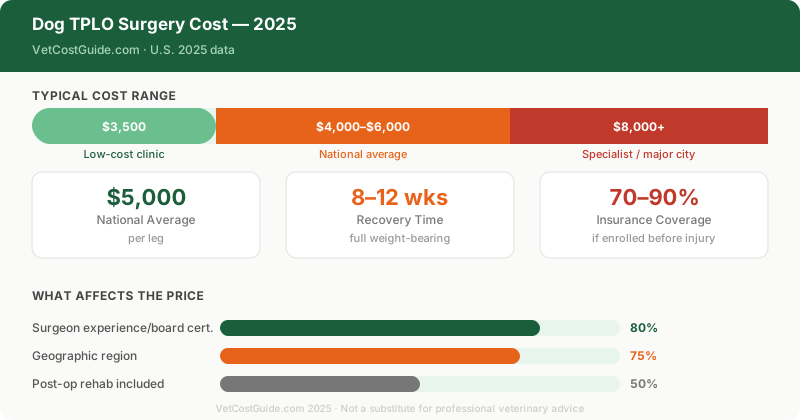
If your dog has just been diagnosed with a CCL rupture, you’re probably searching for a number. Here it is: $3,500 to $7,000 per leg for TPLO surgery at a US specialty center in 2025. That’s the procedure — Tibial Plateau Leveling Osteotomy — that most orthopedic surgeons now recommend for medium to large dogs. And here’s the part they don’t always lead with: about 60% of dogs that tear one CCL will tear the other leg within two years. That’s potentially a $10,000+ total investment. Worth planning for from day one.
- TPLO costs $3,500–$7,000 per leg at US specialty clinics in 2025.
- The procedure requires a board-certified veterinary surgeon, which is the main cost driver.
- Diagnostic imaging (X-rays, sometimes CT) before surgery adds $200–$800.
- Post-op physical rehabilitation is strongly recommended and costs $500–$2,000 over 12 weeks.
- Pet insurance with orthopedic coverage can reimburse $2,500–$5,500 depending on your plan.
The Full Cost Breakdown
Pre-surgical diagnostics, the procedure, and post-operative care each add to the total. Here’s a realistic range across the US in 2025.
| Cost Component | Low | Average | High |
|---|---|---|---|
| TPLO Surgery (procedure + anesthesia) | $3,200 | $4,800 | $6,500 |
| Pre-op X-rays | $150 | $300 | $600 |
| Pre-op bloodwork | $80 | $150 | $220 |
| CT scan (if ordered) | $700 | $1,200 | $2,000 |
| Post-op X-ray recheck | $100 | $200 | $400 |
| Physical rehabilitation (12 weeks) | $500 | $1,200 | $2,000 |
| Pain meds + antibiotics (4 weeks) | $80 | $150 | $280 |
| Total per leg estimate | $4,110 | $7,000 | $12,000 |
What You’re Actually Paying For
The TPLO quote from your orthopedic surgeon typically covers the surgeon’s fee, anesthesia, a titanium bone plate and screws to stabilize the tibia, intraoperative X-rays to confirm implant placement, and one or two post-operative rechecks. Nursing care during recovery and pain medications for the first several days are also usually bundled in.
What makes TPLO expensive is the expertise it demands. The procedure involves precisely cutting and rotating the tibial plateau — the top surface of the shin bone — then securing it with a specialized bone plate. The geometry of the cut determines the outcome. A board-certified veterinary surgeon (DACVS) performs this. There’s no lower-cost version that produces equivalent results.
The titanium plate and screws cost the clinic $300–$700 wholesale. Some facilities use generic implant brands that are clinically equivalent to branded systems but cheaper; ask your surgeon if cost is a real constraint.
Post-operative care is where bills escalate past the initial quote. Most dogs need 8–12 weeks of strict activity restriction, then a graduated return to exercise. Physical rehabilitation — hydrotherapy, laser therapy, targeted strengthening — improves outcomes and reduces re-injury risk. It’s technically optional, but dogs that skip it have worse long-term results.
What Moves the Price
Surgeon certification. A board-certified DACVS surgeon commands higher fees than a general practitioner performing TPLO — complication rates are measurably lower with experienced specialists. You’re paying for that track record.
Dog size. A 90-pound Labrador needs larger implants, more anesthesia, and longer operating time than a 35-pound Border Collie. The cost difference is real and can be $500–$1,000.
Geographic region. Specialty orthopedic clinics in Boston, San Francisco, and New York run 25–40% above national averages. Rural practices with TPLO-trained surgeons are often significantly cheaper for the same procedure.
Concurrent meniscal damage. Some dogs have concurrent meniscal tears requiring treatment during the same surgery, adding $300–$600. Your surgeon assesses this intraoperatively.
Bilateral repair. Some surgeons offer a 10–15% discount if both legs are repaired during the same anesthetic event. It’s not universally recommended due to the complexity of recovering on two operated legs simultaneously.
- “Discount” TPLO from a non-specialist. Some general practices offer TPLO at $1,500–$2,500. Complication rates — implant failure, infection, incorrect plateau angle — are measurably higher with inexperienced surgeons. A revision surgery costs as much or more than doing it right the first time.
- The second-leg bill. Plan financially for a second CCL tear within 18–24 months. It happens in more than half of affected dogs. Pet insurance purchased before the second injury occurs can cover it.
- Rehabilitation costs underestimated. Many owners skip rehab to save money and then face a dog with persistent lameness or muscle atrophy. Budget for at least 6 sessions with a certified canine rehabilitation therapist ($60–$120 per session).
The Pet Insurance Calculation
TPLO is the single procedure most frequently cited by pet insurance policyholders as their biggest claim — and the one most likely to justify years of premiums in a single incident. A policy with a $500 deductible and 80% reimbursement on a $5,500 procedure returns $4,000 to you. For large-breed dogs — Labs, Golden Retrievers, Rottweilers, German Shepherds — who have significantly elevated CCL tear rates, insurance isn’t just worth it; it’s close to essential.
One critical caveat: CCL and cruciate injuries are frequently excluded as “bilateral conditions” once one leg is affected. Once your dog tears the first CCL, the second leg is often considered a pre-existing or related condition by many insurers. Buy insurance before any symptoms appear. If you’re reading this post-injury for the first time, call your insurer immediately to understand your second-leg coverage before it becomes relevant.
Practical Ways to Reduce Your Bill
Get quotes from multiple specialty centers. Prices for identical procedures vary by $500–$2,000 between clinics in the same metro area. Always get two written estimates before committing.
Ask about resident-supervised surgery. At university teaching hospitals, DACVS-supervised residents perform TPLO at 30–50% reduced cost. Outcomes are equivalent when faculty supervision is rigorous.
Finance with 0% interest. CareCredit and Scratchpay both offer promotional periods of 6–18 months at 0% APR. A $5,000 surgery becomes $280–$835/month, interest-free.
Ask about generic implants. Some clinics offer a choice between branded and generic implant systems. Both meet ASTM standards. Switching can save $200–$400 without compromising clinical outcome.
Time the second surgery strategically. If your dog needs bilateral TPLO, buying insurance between the first and second surgery (before the second shows symptoms) may allow partial coverage for the second procedure on some plans.
Frequently Asked Questions
How long is recovery after TPLO? Full recovery takes 4–6 months. The first 8 weeks involve strict exercise restriction — leash walks only, no running or jumping. Most dogs return to normal activity around 16–20 weeks post-op, with formal physical clearance confirmed by a recheck X-ray.
What happens if I don’t do surgery? Without surgery, most medium and large dogs don’t return to normal function. Chronic lameness, progressive joint arthritis, and muscle atrophy are the typical outcomes. In small dogs under 25 pounds, conservative management (strict rest, weight control, anti-inflammatories) is sometimes successful, but it takes 3–6 months and carries significant failure risk.
Is TPLO better than TTA or lateral suture repair? For dogs over 40 pounds, the orthopedic consensus favors TPLO or TTA over lateral suture due to lower long-term complication and re-injury rates. The evidence base for TPLO is the largest of the three. Your surgeon will recommend the technique best suited to your dog’s anatomy and activity level.
Will my dog need pain medication long-term? Most dogs are weaned off prescription pain medications within 4–6 weeks of surgery. Dogs with pre-existing arthritis may need longer-term NSAID management. Discuss your dog’s specific joint health with your surgeon before the procedure.
Frequently Asked Questions
TPLO surgery costs between $3,500 and $7,000 per leg at US specialty centers in 2025. The price typically includes the surgical procedure, anesthesia, post-operative imaging, and initial pain management, though facility location and surgeon expertise can push costs toward the higher end of this range.
Most pet insurance plans cover 70–90% of TPLO surgery costs after you meet your deductible, leaving you responsible for $350–$2,100 out-of-pocket per leg depending on your coverage level. However, many policies exclude coverage if your dog has a pre-existing knee condition, so review your policy details before scheduling.
Most dogs require 8–12 weeks of restricted activity and physical rehabilitation following TPLO surgery, with gradual return to normal walking beginning around 6 weeks. Full recovery and return to unrestricted play typically takes 4–6 months, depending on your dog's age, size, and adherence to post-operative care instructions.