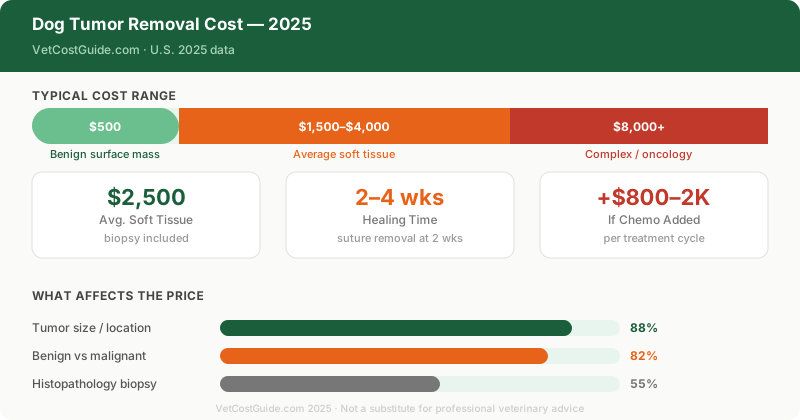
Two owners can walk into the same veterinary clinic with lumps on their dogs. One leaves with a $600 lipoma removal and a clean bill of health. The other walks into a six-month oncology process that costs $12,000. The difference isn’t their budget — it’s the biology of what’s actually growing. Dog tumor removal spans $500 to $8,000 or more depending on whether that mass is a harmless fatty deposit or a mast cell tumor staged for chemotherapy. Before any surgical plan is agreed to, you need to know which category you’re in.
- Simple benign surface mass removal (lipoma, sebaceous cyst) costs $500–$1,200 at most general practices.
- Mast cell tumor removal costs $1,500–$4,000 depending on grade and whether wide surgical margins are needed.
- Soft tissue sarcoma removal costs $2,000–$5,000 and often requires a board-certified surgeon.
- Internal or abdominal tumor surgery runs $3,000–$8,000 and carries the highest anesthetic and surgical risk.
- Histopathology biopsy — essential for any mass — adds $150–$300 to the total and determines whether further treatment is needed.
Cost by Tumor Type
The price of removal scales with tumor type, depth, and the expertise required. Surface masses at a general practice sit at one end; oncology surgery at a specialty center sits at the other.
| Tumor Type | Low | Average | High |
|---|---|---|---|
| Benign surface mass (lipoma, cyst) | $500 | $800 | $1,200 |
| Mast cell tumor (low grade) | $1,500 | $2,200 | $3,000 |
| Mast cell tumor (high grade / wide margins) | $2,500 | $3,200 | $4,000 |
| Soft tissue sarcoma | $2,000 | $3,500 | $5,000 |
| Abdominal / internal tumor | $3,000 | $5,500 | $8,000 |
| Histopathology (biopsy, any tumor) | $150 | $225 | $300 |
| Chemotherapy – per cycle (post-surgical) | $800 | $1,400 | $2,000 |
What Each Scenario Includes
For a routine surface mass removal at a general practice, the fee covers anesthesia induction and monitoring, the excision itself, basic surgical closure, and take-home pain medication. Histopathology — sending the removed tissue to a pathology lab for definitive diagnosis — is almost always billed separately, but it should be treated as mandatory for any mass without an obvious benign identity.
For malignant or suspected malignant tumors, the package expands considerably. Wide surgical margins mean removing a rim of healthy tissue around the tumor to reduce recurrence risk — this requires more extensive dissection and sometimes reconstructive closure techniques like skin flaps. Surgical oncology referrals add a pre-operative consultation, advanced imaging to stage the tumor, the surgery, and post-operative rechecks. Internal or abdominal tumor removal adds the cost of exploratory laparotomy and potential organ involvement.
What Moves the Price
Benign vs. malignant. A confirmed lipoma sitting away from any joints? Often you can leave it alone or remove it simply. A mast cell tumor — which ranges from low-grade (often cured by surgery alone) to high-grade (requiring wide margins, chemotherapy, and oncology oversight) — demands an entirely different surgical approach. Never assume a lump is benign without cytology or histopathology first.
Tumor location and depth. A mass on the skin surface is far easier to remove than one embedded in muscle, adjacent to major vessels, or attached to an organ. Depth adds surgical time, demands more expertise, and increases anesthetic risk — all of which increase cost.
Histopathology. Fine needle aspirate cytology ($50–$150) gives a quick preliminary read but isn’t definitive for many tumor types. Histopathology of the excised mass — analyzed by a veterinary pathologist — provides tumor grade, margin assessment, and a definitive diagnosis. At $150–$300, it determines whether your dog needs chemotherapy, radiation, or simply monitoring. It’s worth every dollar.
Specialist vs. generalist. General practitioners handle most benign surface masses well. Mast cell tumors, soft tissue sarcomas, and internal tumors benefit from — and in many cases require — a board-certified veterinary surgeon (DACVS). Inadequate surgical margins on a malignant tumor are among the leading causes of expensive revision surgeries and local recurrence.
Chemotherapy follow-up. High-grade mast cell tumors, soft tissue sarcomas with incomplete margins, and several other malignant tumor types require chemotherapy after surgery. At $800–$2,000 per cycle over four to six cycles, post-surgical treatment can easily dwarf the surgery itself. Ask your oncologist for a full projected treatment estimate before committing to anything.
- Skipping the biopsy to save $200. The histopathology report is not optional for any mass you are not 100% certain is benign. Treating a high-grade mast cell tumor with simple excision and no follow-up because the biopsy was skipped is a genuinely dangerous cost-cutting measure.
- Incomplete surgical margins. Pressure to save money by taking minimal tissue around a malignant tumor frequently leads to local recurrence within months, followed by a more complex and expensive revision surgery. Getting clean margins the first time is almost always cheaper than a second operation.
- Underestimating ongoing oncology costs. If your dog’s tumor type requires adjuvant chemotherapy, the surgical bill is only the beginning. Request a full projected treatment cost — including chemotherapy cycles, monitoring bloodwork, and recheck imaging — before finalizing your financial plan.
Pet Insurance and Cancer Coverage
Tumor removal — especially for malignant masses — is one of the highest-utilization categories for pet insurance claims. A comprehensive policy with a $500 deductible and 80% reimbursement on a $5,000 soft tissue sarcoma surgery returns $3,600. Factor in chemotherapy at $1,200 per cycle for five cycles ($6,000), and the same policy returns an additional $4,400 — $8,000 total back on a $12,000 treatment course.
The critical caveat: cancer is frequently excluded as a pre-existing condition if any prior documentation of lumps or masses exists in your dog’s records. Enroll while healthy, before any lump ever appears in a vet note, and confirm your policy covers oncology without a sublimit. Some policies cap cancer coverage at $5,000 per year — which won’t cover a full chemotherapy protocol.
How to Reduce What You Pay
Get cytology before surgery. A fine needle aspirate ($50–$150) in your vet’s office takes minutes and can distinguish lipomas and sebaceous cysts from masses that need oncology workup. Confirming a mass is truly benign prevents unnecessary specialist referral costs.
Request a teaching hospital referral for complex cases. Veterinary schools with surgical oncology services perform the same specialist procedures at 25–40% below private specialty hospital prices. If your dog has a soft tissue sarcoma or internal tumor, the nearest veterinary school is worth calling.
Stage before surgery, not after. For malignant tumors, imaging to assess spread (staging) should happen before operating. A $200–$400 chest X-ray before a $5,000 surgery is money well spent on decision-making — if the cancer has already spread distantly, surgery may not meaningfully extend life.
Compare chemotherapy protocols. Some post-surgical protocols use oral medications administered at home ($100–$300 per month) rather than IV infusions at a clinic. Ask your veterinary oncologist whether a metronomic or oral protocol is medically appropriate for your dog’s tumor type.
Use veterinary financing. CareCredit and Scratchpay both offer 0% APR promotional periods. For a $6,000–$10,000 combined surgical and chemotherapy course, 18-month 0% financing runs $330–$555 per month without interest charges.
Frequently Asked Questions
Should I remove a benign lipoma? Not necessarily. Lipomas that are small, slow-growing, and not interfering with movement or comfort can be safely monitored. Vets typically recommend removal when a lipoma affects gait, sits in an irritating location (armpit, groin), or grows rapidly — rapid growth can signal a liposarcoma, the malignant variant.
What is a mast cell tumor and why does it cost so much to treat? Mast cell tumors are the most common malignant skin tumor in dogs. Graded I through III (or low/high grade under newer systems), their biological behavior varies wildly. Low-grade tumors are often cured by surgery alone; high-grade tumors metastasize rapidly and require chemotherapy. Grade can only be determined by histopathology — which is why that test is non-negotiable. Surgical planning, including how wide the margins need to be, also depends on grade.
My vet wants to watch and wait on a lump. Is that reasonable? For confirmed benign masses in dogs where anesthetic risk is elevated, watchful waiting is sometimes appropriate. But “watch and wait” shouldn’t substitute for cytology or biopsy. If your vet recommends monitoring without ever submitting the mass for analysis, ask specifically why tissue sampling isn’t indicated.
How do I know if my dog needs a specialist for tumor removal? Any mass where cytology suggests malignancy, any tumor in a complex anatomical location (around the eye, on a limb, in the abdomen), and any tumor where achieving wide surgical margins requires reconstructive techniques should go to a board-certified surgeon. Your general practitioner can and should help you triage this decision.
Frequently Asked Questions
Dog tumor removal typically costs $500 to $8,000, with benign tumors like lipomas on the lower end ($500–$1,500) and malignant tumors requiring oncology surgery, staging, or chemotherapy reaching $5,000–$12,000 or more. The final cost depends on tumor size, location, whether biopsy or imaging is needed, and if follow-up treatments are required.
Most pet insurance plans cover tumor removal surgery as an accident and illness benefit, typically reimbursing 70–90% after your deductible ($250–$1,000). However, many policies exclude pre-existing conditions and have annual or lifetime limits, so chemotherapy or multi-stage oncology treatment may not be fully covered; review your specific policy for tumor and cancer exclusions.
Surgical removal typically takes 30–90 minutes depending on tumor size and location, with most dogs recovering within 10–14 days with activity restriction and suture removal. If the tumor is malignant and requires chemotherapy, the treatment timeline extends to 12–26 weeks with multiple clinic visits, making total recovery and treatment protocols significantly longer.