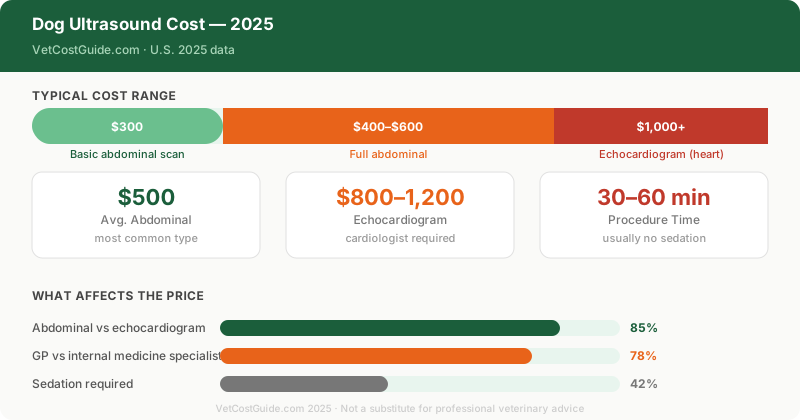
Picture this: your vet has just finished reviewing a chest X-ray, and there’s a shadow near the spleen that shouldn’t be there. “I’d like to get an ultrasound,” she says. That’s when the sticker shock starts — somewhere between $300 and $800, depending on what’s being scanned and who’s doing the scanning. Understanding why ultrasound costs what it does — and what each scan type actually reveals — makes that number feel a lot less arbitrary.
- A standard abdominal ultrasound costs $300–$600 at most US veterinary practices in 2025.
- A cardiac echocardiogram (echo) runs $400–$800 and should be performed by a cardiologist.
- Ultrasound-guided fine needle aspirate (FNA) or biopsy adds $150–$400 to the procedure.
- Mobile ultrasound services visit general practices and often charge $250–$450 for abdominal scans.
- Sedation is required in less than 20% of ultrasound cases — most dogs tolerate the exam awake.
What Does a Dog Ultrasound Cost?
Prices vary by scan type, facility, and whether a specialist performs the exam versus a general practitioner with ultrasound training.
| Ultrasound Type | Low | Average | High |
|---|---|---|---|
| Abdominal ultrasound (GP) | $250 | $380 | $550 |
| Abdominal ultrasound (specialist) | $350 | $500 | $700 |
| Echocardiogram (cardiologist) | $400 | $600 | $850 |
| Focused FAST scan (emergency) | $150 | $220 | $320 |
| Ultrasound-guided FNA | $150 | $250 | $380 |
| Ultrasound-guided biopsy | $200 | $350 | $500 |
| Mobile/visiting sonographer | $250 | $380 | $500 |
| Sedation add-on (if needed) | $80 | $150 | $250 |
Four Types of Scans — and What Sets Them Apart
Abdominal Ultrasound is the workhorse of veterinary soft-tissue imaging. A transducer pressed against your dog’s clipped belly sends sound waves through organs, bouncing back in patterns the machine assembles into real-time images on a screen. A thorough survey — liver, spleen, kidneys, bladder, intestines, adrenal glands, lymph nodes — takes 30 to 60 minutes. Yes, they’ll shave a patch of belly fur; air trapped in the coat scrambles the signal, so clipping isn’t negotiable. It grows back within weeks.
Cardiac Echocardiogram (Echo) is a fundamentally different procedure, and the distinction matters. Echos are performed with specialized cardiac transducers and software that measures chamber dimensions, valve function, and blood flow via Doppler technology. A general practitioner with basic ultrasound training is not the right choice here — you want a board-certified veterinary cardiologist. For Cavalier King Charles Spaniels and Dobermans especially, the difference between correctly and incorrectly graded mitral valve disease or dilated cardiomyopathy determines whether your dog gets treatment at the right time.
FAST Scan (Focused Assessment with Sonography for Trauma) is the triage scan — a 5 to 10 minute look at one question: is there fluid where it shouldn’t be? It’s used in shock and trauma cases, not as a substitute for a full diagnostic survey.
Ultrasound-Guided Aspirates and Biopsies let the sonographer watch a needle enter a mass or lymph node in real time on screen. A fine needle aspirate pulls cells for cytology; a core biopsy takes tissue for histopathology. Answers typically come back in 48 to 72 hours — and both are far less invasive than going in surgically.
What Drives the Price Up
Who performs it. A general practitioner with ultrasound training costs less and handles many common presentations well. Complex cases — and any cardiac evaluation — need a board-certified internist or cardiologist charging $400–$800. The equipment and the expertise behind it genuinely aren’t comparable.
Scope of the scan. Investigating a single question (“is there a bladder stone?”) costs less than a full abdominal survey. Some practices price these differently, so it’s worth a quick ask.
Mobile versus in-clinic. Visiting sonographer services schedule regular days at general practices and typically charge $250–$500. You pay the practice’s exam fee plus the sonographer’s fee — but it often beats a full specialty hospital referral appointment on cost.
Add-on procedures. When a suspicious mass turns up mid-scan, the sonographer often samples it right then. That adds lab fees: cytology runs $80–$200, histopathology $150–$350, on top of the imaging charge.
Where you live. Coastal metro practices run 30–50% higher than the national average for specialist procedures. That’s real estate, staffing costs, and equipment financing — not padding.
- Cardiologist vs. GP for heart disease. A general practitioner can hear a murmur, but grading it accurately and determining whether it’s causing heart enlargement requires an echocardiogram by a cardiologist. Incorrect grading leads to missed treatment windows — particularly critical for Cavalier King Charles Spaniels and Dobermans, where early intervention changes outcomes.
- Cytology is not histopathology. An FNA gives cellular information (benign vs. malignant, inflammation vs. tumor type) but cannot assess tissue architecture. Some masses require a core biopsy for a definitive diagnosis. Ask your vet which is appropriate.
- Empty bladder affects abdominal quality. A full bladder is actually helpful for bladder ultrasound — but your dog urinating right before the scan makes evaluation difficult. If bladder assessment is the goal, withhold an opportunity to urinate for 2–3 hours before the appointment.
Does Your Dog Actually Need One?
Clear yes: Unexplained weight loss with abnormal X-rays. A heart murmur that needs grading. Suspected abdominal mass or organ enlargement. Ascites — fluid in the abdomen with an unknown cause. Any trauma case where internal bleeding is possible.
Strongly recommended: Elevated liver enzymes that need characterization. Suspected adrenal mass (Cushing’s evaluation). Bladder stones or recurrent UTIs. Splenic masses — the spleen really can’t be fully assessed on X-ray alone.
Probably not necessary: Serial ultrasounds for a known stable benign finding. Routine wellness scanning in a dog with no clinical signs. These are rarely indicated and aren’t covered by most wellness plans.
Getting the Cost Down
Ask about mobile sonographer days. Many general practices bring in a visiting ultrasonographer once or twice a month. Scheduling on those days gets you specialist-quality imaging without the full specialty hospital referral price.
Combine with bloodwork on the same day. One visit fee instead of two. If you’re investigating a liver issue, do the blood draw and the ultrasound together.
Ask whether immediate biopsy is needed. For certain obvious benign findings, your vet may recommend monitoring rather than immediate tissue sampling — that’s $150–$400 saved.
Price-check veterinary school clinics. Internal medicine departments at vet schools perform high-quality abdominal ultrasounds and echocardiograms at 30–50% below what private specialty hospitals charge.
Frequently Asked Questions
Does my dog need to be shaved for an ultrasound? For abdominal ultrasound, yes — a small area of the belly is clipped to allow good transducer contact. It grows back within a few weeks. For cardiac ultrasound, the technician typically works through the rib spaces from the side; shaving is minimal or avoided.
Is sedation required for a dog ultrasound? Most dogs tolerate abdominal ultrasound awake with gentle restraint. Sedation is occasionally needed for very anxious or painful dogs or when precise needle guidance for biopsy is required. Fewer than 20% of routine scans require any sedation.
How long does a dog ultrasound take? A complete abdominal survey takes 30–60 minutes. A focused scan targeting one organ takes 15–20 minutes. An echocardiogram takes 45–75 minutes including Doppler measurements. Plan for an hour at the clinic when scheduling.
What’s the difference between ultrasound and X-ray for abdominal issues? X-rays are better for detecting gas patterns (obstruction, bloat), large masses that displace organs, and gross size abnormalities. Ultrasound is better for organ texture and architecture, small masses, lymph nodes, vascular flow, fluid pockets, and real-time guided sampling. The two are complementary — many cases require both.
Frequently Asked Questions
A dog abdominal ultrasound typically costs between $300 and $600, depending on your veterinary clinic's location, experience level, and whether a specialist performs the scan. Some emergency or specialty veterinary hospitals may charge toward the higher end of this range or beyond.
Most pet insurance plans cover ultrasounds as part of diagnostic imaging, typically reimbursing 70–90% after you meet your deductible, though coverage varies by policy and provider. However, many plans exclude pre-existing conditions, so review your specific policy details before scheduling the scan to understand your out-of-pocket costs.
A typical dog ultrasound takes 30 minutes to 1 hour, and most pets can go home the same day without recovery time. Your vet may ask you to withhold food for 6–8 hours before an abdominal ultrasound to get clearer images, though this requirement varies depending on what's being evaluated.