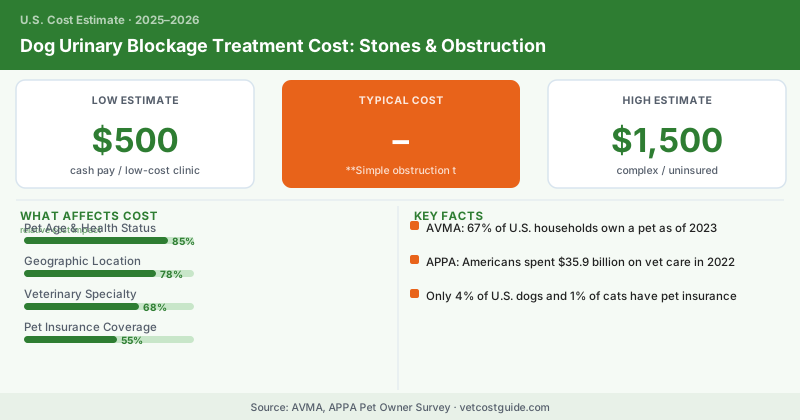
A dog that’s straining to urinate, crying when he squats, or going in and out without producing urine isn’t having “a little trouble.” He may be obstructed — and a complete urinary obstruction causes kidney failure and death within 48–72 hours if untreated. The cost of treatment ranges from $500 for a simple catheterization to $4,000 for major bladder stone surgery. Here’s how the numbers break down and what drives the difference.
- Simple urinary obstruction (catheterization only): $500–$1,500 total.
- Bladder stone surgery (cystotomy): $1,500–$4,000 for the full episode.
- Perineal urethrostomy (permanent surgical widening): $1,500–$3,500 for recurrent blockers.
- Prescription urinary diet to prevent recurrence: $50–$80/month ongoing.
- Male dogs are significantly more likely to obstruct than females due to urethral anatomy.
Emergency Catheterization: The First Step
When a dog presents with signs of urinary obstruction, the first priority is relieving the blockage. That means passing a urinary catheter under sedation or light anesthesia to flush out the obstruction — often small stones, urinary crystals, or mucus plugs lodged in the urethra. This is almost always an emergency procedure.
| Service | Low End | High End | Notes |
|---|---|---|---|
| Emergency exam | $150 | $350 | After-hours surcharge applies |
| Urinalysis + sediment | $45 | $90 | Identifies crystal type |
| Bladder radiograph (x-ray) | $150 | $350 | Detects most stone types |
| Abdominal ultrasound | $250 | $550 | Better for small stones and soft tissue |
| Bloodwork (chemistry + BUN/creatinine) | $100 | $250 | Checks kidney function |
| Catheterization under sedation | $200 | $500 | Core treatment for obstruction |
| IV catheter + IV fluids (4–6 hours) | $150 | $300 | Post-catheterization support |
| Hospitalization (1 night) | $150 | $400 | Monitoring after relief |
| **Simple obstruction total** | **$500** | **$1,500** | No stones requiring surgery |
Bladder Stone Surgery (Cystotomy)
If x-rays or ultrasound reveal bladder stones — calculi that are too large to pass through the urethra or too numerous to flush out — surgical removal (cystotomy) is the standard treatment. The bladder is opened, stones are removed, and samples are sent to a lab for stone composition analysis, which guides post-operative diet recommendations.
The AVMA notes that certain breeds are genetically predisposed to specific stone types — and breed-specific recurrence rates are high enough that stone analysis isn’t optional. Knowing whether you’re dealing with struvite, calcium oxalate, or urate stones changes the entire long-term management plan.
| Service | Low End | High End | Notes |
|---|---|---|---|
| Pre-surgical bloodwork | $100 | $250 | Required before anesthesia |
| Cystotomy (open bladder surgery) | $800 | $2,200 | Surgeon time + anesthesia + sutures |
| Anesthesia and monitoring | $200 | $500 | Standard during surgery |
| 1–2 night hospitalization | $200 | $600 | Post-surgical recovery |
| Stone analysis (lab) | $60 | $150 | Identifies stone composition |
| Post-op pain management | $50 | $150 | Take-home medications |
| Follow-up x-ray (2–4 weeks) | $100 | $250 | Confirm no stones remain |
| **Cystotomy total** | **$1,500** | **$4,000** | Full surgical episode |
Urethrostomy: When Anatomy Is the Problem
Some male dogs — particularly English Bulldogs, Dalmatians, and other breeds prone to recurrent urinary stones — have a narrow urethra that makes stone passage dangerous or near-impossible repeatedly. For these dogs, a perineal urethrostomy (PU) creates a wider permanent urethral opening. It’s a more complex and permanent procedure, and it doesn’t cure the underlying stone tendency — but it eliminates the anatomical bottleneck that causes the emergency.
| Procedure | Cost Range | Notes |
|---|---|---|
| Perineal urethrostomy (PU) | $1,500–$3,500 | Surgeon specialist preferred |
| Board-certified surgeon (vs GP) | +$500–$1,500 | Better outcomes for complex anatomy |
| Post-op urinary culture | $60–$150 | Infections are a risk post-PU |
Male dogs can develop complete urinary obstructions that female dogs rarely experience due to their shorter, wider urethra. If your male dog is straining to urinate, going outside repeatedly with no output, or crying during urination attempts, this is an emergency — not something to monitor overnight. Kidney damage from even 24–36 hours of complete obstruction can be permanent. Go to an emergency vet immediately.
Breeds at Higher Risk
Certain breeds have a documented genetic predisposition to specific stone types:
- Dalmatians: Urate stones (due to uric acid metabolism differences); nearly universal with age
- English Bulldogs, French Bulldogs: Bladder stones, structural urethral narrowing
- Miniature Schnauzers: Calcium oxalate and struvite stones
- Bichon Frises: Calcium oxalate stones
- Shih Tzus: Struvite stones
- Yorkshire Terriers: Multiple stone types
If you own one of these breeds, annual urinalysis at the regular vet checkup is worth doing every year — catching crystalluria (crystals in urine) before they become stones is both medically better and significantly cheaper than waiting for an emergency.
Long-Term Management & Prevention Costs
Stone recurrence is the main concern after a first episode. Prevention depends on stone type:
- Prescription urinary diet (Hill’s u/d, s/d, or c/d; Royal Canin Urinary): $50–$80/month
- Increased water intake (wet food vs. dry, pet water fountains): $20–$60 one-time for fountain; wet food adds $30–$60/month
- Urine monitoring strips (at-home pH checking): $15–$30 for a 3-month supply
- Periodic urinalysis: $45–$90 every 6 months at the vet
For an overview of what a urinalysis and basic vet diagnostics cost, see our average vet visit cost guide. For help planning a payment strategy for emergency surgery costs, CareCredit for vet bills is widely accepted at emergency hospitals.
Bottom Line
A simple urinary obstruction relieved by catheterization runs $500–$1,500. Bladder stone surgery (cystotomy) adds another $1,000–$2,500, bringing the total episode to $1,500–$4,000. Dogs that form stones recurrently may need $50–$80/month in prescription diet ongoing. Pet insurance that covers urinary conditions will cover bladder stones — confirm with your insurer that stones are not classified as a breed-specific exclusion before assuming coverage. The biggest cost-saver is catching crystalluria before stones form: annual urinalysis at a routine wellness exam is $45–$90 and can prevent a $3,000 surgical episode.
Frequently Asked Questions
A simple urinary obstruction treated with catheterization costs $500–$1,500, while bladder stones requiring surgical removal run $1,500–$4,000 depending on severity and complications. Emergency after-hours treatment typically adds 20–50% to these base costs.
Most pet insurance plans cover urinary blockage as an accident or illness claim after you meet your deductible, typically reimbursing 70–90% of eligible costs. However, plans with pre-existing condition exclusions may deny coverage if your dog had previous urinary issues, so review your policy details before treatment.
A complete urinary obstruction is a medical emergency requiring treatment within 24–48 hours to prevent kidney failure and death. Your dog should see a veterinarian immediately if straining to urinate, crying when squatting, or unable to produce urine, as delaying care dramatically increases treatment complexity and cost.