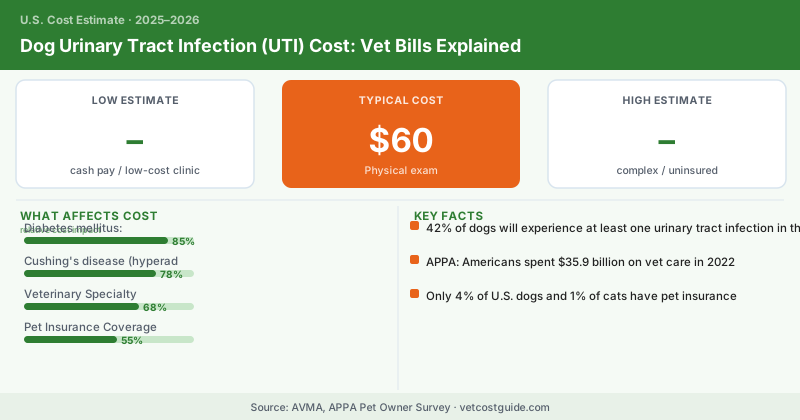
42% of dogs will experience at least one urinary tract infection in their lifetime, according to AVMA companion animal health data. Female dogs are especially prone — their shorter, wider urethra makes it easier for bacteria to travel up into the bladder.
A straightforward UTI caught early costs $150–$400 to diagnose and treat. Leave it untreated, let it recur, or miss an underlying cause, and you’re looking at a very different bill. Here’s what the vet actually charges and why.
What Makes a UTI “Simple” vs. “Complicated”
Vets classify UTIs on a spectrum that directly affects cost:
- Simple uncomplicated UTI: First or second episode, no structural or metabolic cause identified. Responds to a 7–14 day antibiotic course.
- Recurrent UTI: Three or more episodes per year, or relapse within 6 months of treatment. Requires a workup to find the underlying reason.
- Complicated UTI: Associated with bladder stones, anatomical abnormalities (like vulvar fold dermatitis or ectopic ureter), Cushing’s disease, diabetes, or immunosuppression.
Treating a complicated UTI like a simple one — giving antibiotics without addressing the root cause — is one of the most common (and expensive) mistakes owners make. You’ll be back in the clinic in a few weeks.
- Vet exam: $60–$120
- Urinalysis: $50–$100
- Urine culture and sensitivity: $80–$180
- Antibiotic course (7–14 days): $25–$80
- Abdominal ultrasound: $200–$500
- Bladder stone removal (cystotomy): $1,000–$3,000
- Cushing’s disease workup: $300–$700
Cost Breakdown: Diagnosis to Treatment
| Service | Cost Range | Notes |
|---|---|---|
| Physical exam | $60–$120 | Required; palpation of abdomen and bladder |
| Urinalysis (dipstick + sediment) | $50–$100 | First-line test; checks pH, white cells, bacteria |
| Urine culture and sensitivity | $80–$180 | Identifies organism and best antibiotic |
| Antibiotic course (oral) | $25–$80 | Amoxicillin, trimethoprim, or targeted drug |
| Recheck urinalysis | $40–$80 | 7 days post-treatment to confirm clearance |
| Abdominal radiograph | $100–$250 | Screens for bladder stones |
| Abdominal ultrasound | $200–$500 | Detects stones, polyps, structural changes |
| Cystotomy (stone removal surgery) | $1,000–$3,000 | Depends on stone burden and complexity |
Urinalysis vs. Culture: You Often Need Both
A dipstick urinalysis plus sediment exam ($50–$100) looks for white blood cells, red blood cells, bacteria, and crystals under a microscope. It’s fast and gives useful information, but it can’t tell your vet which specific bacteria is present or which antibiotic will kill it.
A urine culture and sensitivity test ($80–$180) sends the sample to an external lab, grows any bacteria present, and then tests it against a panel of antibiotics. Results take 48–72 hours. This step matters most when:
- The infection doesn’t respond after a full antibiotic course
- The same infection keeps coming back
- There’s any suspicion of an underlying condition
The ASPCA notes that antibiotic resistance in uropathogens like Escherichia coli and Staphylococcus pseudintermedius has increased substantially over the past decade. Without a culture, your vet is guessing at which antibiotic will work — and guessing wrong means another round of treatment and another vet visit.
Collecting a Urine Sample: Cystocentesis vs. Free-Catch
Your vet will want a urine sample, and how it’s collected affects both quality and cost.
- Free-catch: You catch a midstream sample at home in a sterile cup. No cost, but carries a higher contamination risk (skin bacteria can skew the results).
- Cystocentesis: The vet uses a needle under ultrasound guidance to collect urine directly from the bladder. Adds $30–$60 to the visit cost but produces a sterile, uncontaminated sample — the gold standard for culture.
For a first-ever UTI in an otherwise healthy dog, free-catch may be fine. For a recurrent case where culture accuracy matters, cystocentesis is worth the extra cost.
When Bladder Stones Are Driving Repeat Infections
Bladder stones (uroliths) are a major cause of recurrent UTIs in dogs. The stones create a rough surface for bacteria to adhere to, making infections both more likely and harder to clear with antibiotics alone.
Struvite stones are frequently associated with UTIs and can sometimes be dissolved with a prescription diet (cost: $60–$120/month for 2–4 months). Calcium oxalate stones — more common in certain breeds including Miniature Schnauzers, Bichon Frises, and Shih Tzus — cannot be dissolved and require surgical removal.
Cystotomy (surgical removal of bladder stones): $1,000–$3,000 depending on the vet’s location, the size of the stone burden, and whether any complications arise. The surgery itself is typically successful, but dietary management afterward is essential to prevent recurrence.
An abdominal radiograph ($100–$250) or ultrasound ($200–$500) should be done before concluding any case of recurrent UTI.
Hormonal and Metabolic Disease: The Hidden Drivers
Two conditions dramatically increase a dog’s susceptibility to UTIs:
Diabetes mellitus: High glucose in urine creates a perfect bacterial growth medium. UTIs are extremely common in diabetic dogs. Treating the UTI without controlling blood sugar is like patching a tire on a car with no engine. A diabetic workup adds $150–$350 to costs, with ongoing insulin management on top.
Cushing’s disease (hyperadrenocorticism): Excess cortisol suppresses the immune system and increases urination, which dilutes the urine’s antibacterial properties. The ACVIM notes that UTIs occur in approximately 40–50% of dogs with untreated Cushing’s disease. A Cushing’s workup (LDDS or HDDS test) runs $200–$500.
If your middle-aged dog keeps getting UTIs despite appropriate antibiotic treatment, ask your vet about screening for these conditions.
Never give leftover antibiotics from a previous prescription to treat a new UTI. Different bacteria require different drugs, and using the wrong antibiotic at the wrong dose creates resistant infections that are significantly harder to treat. Always get a new diagnosis — and ideally a culture — before starting any antibiotic course.
Typical Total Cost by Scenario
- Simple first-time UTI, resolved with one course of antibiotics: $150–$350
- First-time UTI with culture performed: $250–$500
- Recurrent UTI with full workup (radiographs or ultrasound, culture): $400–$800
- UTI caused by bladder stones requiring surgery: $1,200–$3,500
- UTI in a dog with newly diagnosed diabetes or Cushing’s: $600–$1,500+ (workup + initial management)
Prevention: What Actually Works
Water intake. Dogs who drink more urinate more frequently, which flushes bacteria from the bladder before it can colonize. Wet food, broth mixed into kibble, and water fountains all increase intake in dogs who are poor drinkers.
Hygiene in predisposed dogs. Female dogs with deep vulvar folds can harbor bacteria that migrate into the urethra. Routine cleaning and sometimes perineal surgery (vulvoplasty, $500–$1,200) resolve this anatomical problem.
Don’t skip the recheck. A follow-up urinalysis 7–10 days after finishing antibiotics confirms the infection cleared. Sub-clinical infections that appear resolved but persist are common — and they breed antibiotic resistance with every incomplete course.
Frequently Asked Questions
A straightforward UTI diagnosis and treatment typically costs $150–$400, which usually includes a urinalysis, urine culture, and a course of antibiotics. If your dog has recurrent infections or underlying causes like bladder stones or hormonal imbalances, costs can escalate to $500–$3,000 or more depending on additional diagnostics and treatment needed.
Most pet insurance plans cover UTI diagnosis and treatment as part of accident and illness coverage, though you'll typically pay 10–30% coinsurance after meeting your deductible ($250–$1,000). Some plans may exclude chronic or recurrent UTIs, so review your policy details and consider that out-of-pocket costs for a simple UTI often fall within the $150–$400 range.
Most dogs show improvement within 5–7 days of starting antibiotics, with treatment typically lasting 7–14 days depending on the infection severity. Your vet will usually recommend a follow-up urinalysis 1–2 weeks after treatment ends to confirm the infection has cleared and rule out underlying conditions that could cause recurrence.