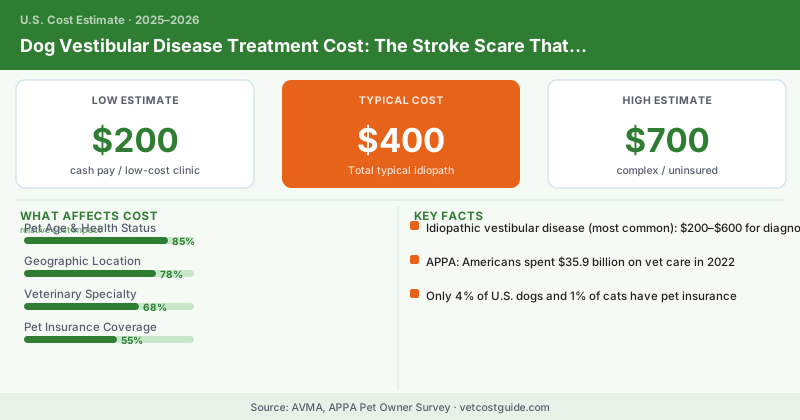
Most owners assume the worst the moment they see it: their dog can’t stand, is tilting its head sideways, and rolling its eyes. The fear is “stroke” or “brain tumor.” The reality, in most older dogs, is idiopathic vestibular disease — a surprisingly common condition that resolves almost completely within 72 hours, often without expensive treatment. But you still need to know the difference — because some cases are more serious, and missing that distinction is costly in a different way.
- Idiopathic vestibular disease (most common): $200–$600 for diagnosis and supportive care
- Inner ear infection causing vestibular signs: $300–$800
- Neurologic workup required (MRI, CSF tap): $2,000–$4,500
- AVMA classifies vestibular disease as one of the most frequently misdiagnosed “emergency” presentations in senior dogs — most cases are benign and self-limiting
- Idiopathic vestibular disease affects dogs of all ages but peaks in dogs over 10 years; summer and fall are most common (earning it the nickname “old dog vestibular disease”)
- The head tilt and rolling typically improve dramatically within 72 hours and resolve nearly completely in 1–3 weeks
Vestibular Disease Treatment Cost Breakdown
| Service | Low | Average | High |
|---|---|---|---|
| Neurologic exam + assessment | $100 | $200 | $350 |
| Blood panel + thyroid check | $120 | $220 | $400 |
| Ear exam + cytology (rule out infection) | $60 | $100 | $200 |
| Anti-nausea medication (maropitant) | $30 | $60 | $120 |
| Meclizine (vestibular support) | $15 | $30 | $60 |
| Hospitalization for supportive care (per day) | $200 | $400 | $700 |
| MRI brain (if neurologic cause suspected) | $1,500 | $2,500 | $4,000 |
| CSF tap (cerebrospinal fluid analysis) | $300 | $600 | $1,000 |
| Total typical idiopathic case | $200 | $400 | $700 |
| Total with ear infection | $300 | $600 | $1,000 |
| Total with full neuro workup | $2,000 | $3,500 | $5,500 |
The Vestibular System — What’s Actually Happening
The vestibular system controls balance, eye coordination, and spatial orientation. It has two components: the peripheral vestibular system (inner ear) and the central vestibular system (brainstem and cerebellum). When either malfunctions, you get:
- Head tilt (often dramatic — 45–90 degrees to one side)
- Nystagmus (eyes flicking rapidly side to side or up and down)
- Ataxia (stumbling, falling, rolling)
- Nausea and vomiting (motion sickness from conflicting balance signals)
Peripheral disease (inner ear) is usually benign and resolves. Central disease (brainstem) is more serious and requires neurologic workup.
Idiopathic Vestibular Disease: The Good-News Diagnosis
“Idiopathic” means the cause is unknown — and this is actually the most common vestibular syndrome in older dogs. Something disrupts the peripheral vestibular apparatus temporarily, and then it restores itself. The dog looks terrifying for 12–48 hours, then starts improving. Most dogs are functionally normal within 2–3 weeks, though a mild persistent head tilt may remain.
Treatment is supportive:
- Anti-nausea medication (maropitant/Cerenia) for the first 48–72 hours
- Meclizine for dizziness
- Help with eating, drinking, and going outside during the acute phase
- Padded surfaces to prevent injury from falling
Many of these cases require only a single vet visit. Total cost: $200–$500.
When It’s Not Idiopathic: The Red Flags
The cases that need an MRI and full neurologic workup:
- Facial nerve paralysis alongside vestibular signs
- Horner’s syndrome (drooping eyelid, small pupil) on the same side as the tilt
- Vertical nystagmus (eyes moving up and down rather than side-to-side)
- Worsening symptoms after 72 hours instead of improving
- Known ear canal disease suggesting otitis interna
- Any history of head trauma, ear polyp, or tumor
These signs suggest central vestibular disease — brainstem lesion, tumor, infarct, or meningoencephalitis — requiring MRI ($1,500–$4,000) and possible cerebrospinal fluid analysis ($300–$1,000). Treatment depends on the underlying cause and can involve corticosteroids, antifungals, surgery, or radiation.
Ear Infections as a Cause
Inner ear infections (otitis interna) are the second most common cause of peripheral vestibular syndrome. The infection spreads from the outer ear through the middle ear to the inner ear. Signs are similar to idiopathic disease, but often accompanied by:
- Head shaking and pawing at the ear
- Pain when touching the ear or jaw
- Discharge visible in the ear canal
- Smell from the ear
Treatment: antibiotics for 4–8 weeks (usually fluoroquinolones like enrofloxacin or marbofloxacin for their inner ear penetration), ear cleaning, anti-nausea support. Total: $300–$800. Most dogs recover fully with appropriate antibiotic treatment.
If your dog suddenly can’t stand, is rolling, and showing rapid eye movement — don’t panic, but do call your vet immediately. Take a 60-second video of the eye movements and head position before you go. That video is genuinely useful diagnostic information. Describe when it started and whether there’s been any recent ear issues. Most of these cases turn out to be the benign version, but a same-day vet evaluation is still the right call.
Helping Your Dog at Home During Recovery
Idiopathic vestibular disease can be distressing to watch — and exhausting to manage. Practical tips:
- Block stairs and elevated surfaces — a disoriented dog can fall
- Non-slip surfaces — yoga mats or rubber-backed rugs help traction
- Hand-feed and hold the water bowl close for the first few days
- Support the hind end when going outside; a belly sling or beach towel works
- Keep interactions calm — loud noises and activity worsen nausea
Most dogs are dramatically better within 3 days. If you’re not seeing improvement by day 4–5, call your vet.
Does Pet Insurance Cover Vestibular Disease?
Idiopathic vestibular disease is an illness and covered under comprehensive plans. Neurologic workups including MRI are covered under policies that include specialty care. The only exception: if the underlying cause is a hereditary tumor in a known breed — that may be covered or excluded depending on the policy’s hereditary condition clause and when you enrolled.
The Bottom Line
Dog vestibular disease treatment costs $200–$600 for the most common benign form, and $2,000–$5,500 when full neurologic investigation is needed. The vast majority of senior dogs presenting with sudden rolling and head tilt have the idiopathic form — scary to see, but genuinely self-limiting. Know the red flags that warrant an MRI, and don’t skip the initial vet visit just because this article reassured you. Confirming it’s the benign version is worth the $200.
Frequently Asked Questions
Treatment costs typically range from $200 to $2,500 depending on severity and diagnostics needed. Mild cases that resolve on their own may only require a vet visit ($150-$300), while cases requiring bloodwork, MRI, or hospitalization can reach $1,500-$2,500.
Most pet insurance plans cover vestibular disease diagnosis and treatment after you meet your deductible (typically $250-$500), though some policies exclude neurological conditions or require higher out-of-pocket costs. Check your specific policy, as coverage varies significantly between providers.
Idiopathic vestibular disease typically improves dramatically within 72 hours and resolves almost completely within 1-2 weeks without expensive intervention. However, seek emergency care immediately if your dog shows progressive symptoms, loss of consciousness, or worsening after 3 days, as these signs may indicate a stroke, tumor, or infection requiring urgent imaging and treatment.