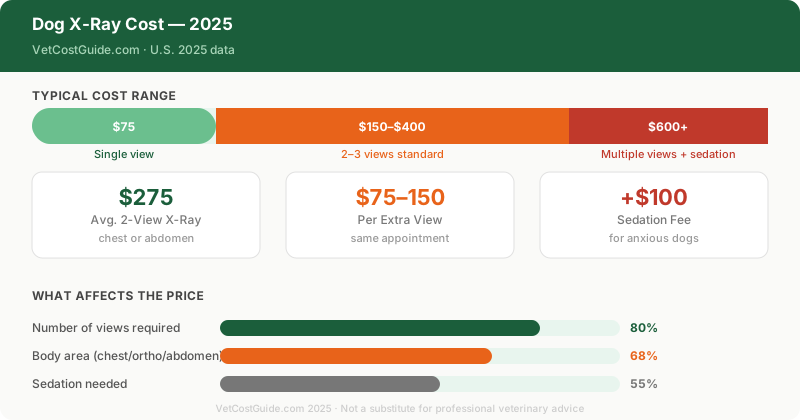
Most owners expect to pay for the X-ray. What surprises them is paying for three of them — or discovering later that the one view their vet took didn’t capture what mattered. The number of views is the single biggest driver of cost, and it’s not arbitrary. A standard chest series is three views because each angle reveals something the others miss. Skimp on views to save $40, and you might miss the finding that changes the diagnosis. Dog X-rays run $75 to $400 for most cases, and knowing the logic behind the bill makes the number much easier to understand.
- A single X-ray view costs $75–$150 at most general practices in 2025.
- A two- or three-view series (standard for chest, abdomen, or joint evaluation) runs $150–$400.
- Sedation or anesthesia adds $75–$250 and is often needed for accurate limb or spine films.
- A radiologist consultation (remote read) adds $50–$120 on top of the imaging fee.
- Emergency X-rays at 24-hour hospitals typically cost 40–60% more than daytime general practice rates.
What Does a Dog X-Ray Cost?
Costs vary by body region, number of views, facility type, and whether sedation is required. The table below reflects 2025 national averages at general practice clinics.
| X-Ray Type | Low | Average | High |
|---|---|---|---|
| Single view (any region) | $75 | $120 | $175 |
| Two-view series (limb/joint) | $110 | $175 | $250 |
| Chest series (2–3 views) | $130 | $200 | $310 |
| Abdominal series (2 views) | $120 | $190 | $290 |
| Spine series (per region) | $130 | $210 | $320 |
| Dental X-rays (full mouth) | $100 | $175 | $280 |
| Sedation/anesthesia add-on | $75 | $160 | $280 |
| Radiologist remote read | $50 | $85 | $125 |
How Veterinary X-Rays Actually Work
Veterinary radiographs use the same ionizing radiation principle as human X-rays — a beam passes through your dog’s body and creates an image on a digital detector. The exposure itself takes a fraction of a second. Digital systems have replaced film at virtually all modern practices; images appear on screen in seconds, can be zoomed and contrast-adjusted, and get emailed to specialist radiologists for remote reads within hours. The equipment costs $30,000–$80,000 to purchase, which is part of why imaging fees aren’t trivial.
The views question matters more than most owners realize. Each position shifts organs relative to each other and reveals different anatomical information. A single lateral chest film can look normal while fluid accumulation behind the heart, small masses near the spine, or subtle rib lesions show clearly on the ventrodorsal view. That’s why the standard chest series is three views. Saving $40–$80 by ordering one view instead of three is a false economy when a finding changes the diagnosis.
Orthopedic films are another story. Elbows, hips, and stifles require exact alignment — even a few degrees of rotation renders joint space measurements useless. A stressed or painful dog actively resists that positioning. Sedation or light anesthesia produces better images and a more comfortable experience. An owner who skips sedation to save money often ends up paying for a second session when the first set of films isn’t diagnostic.
The Factors That Change the Bill
Number of views ordered. Each additional view typically adds $40–$90 to the total. Most body regions justify multiple angles; the exception is a simple foreign body screen where a single lateral may be sufficient for the initial look.
Body region. Dental X-rays require specialized intraoral sensors and typically involve 10–16 individual images per full-mouth series — that’s why they’re priced as a flat fee rather than per-view. Spinal films covering cervical, thoracic, and lumbar regions are billed per region, so a full spine workup can involve three separate charges. Hip X-rays for OFA certification require extended-leg positioning under sedation plus a $35 reading fee from OFA.
Sedation requirements. Painful, fearful, or fractious dogs need sedation for accurate, safe positioning. The cost ($75–$250) can more than double the imaging bill — but it produces diagnostically useful images instead of blurry attempts that may need to be repeated anyway.
Radiologist interpretation. General practitioners read their own X-rays at no extra charge. For complex cases — suspected lung tumors, spinal cord compression, subtle fractures — sending images to a board-certified veterinary radiologist via services like VetRad or Idexx Telemedicine adds $50–$120 and meaningfully improves diagnostic accuracy.
Facility type and timing. Emergency hospitals charge 40–80% more than daytime general practice rates. Urban clinics in coastal cities run 20–35% above national average. A non-urgent X-ray scheduled for a weekday morning costs significantly less than the same film taken at 10 p.m. at an emergency hospital.
- One view is rarely enough for the chest or abdomen. A single lateral film may look normal while a ventrodorsal view reveals a mass or fluid pocket. If your vet recommends a full series, the extra views are clinically justified.
- Foreign body X-rays have limits. Radiolucent objects (fabric, rubber, some plastics) don’t show up on standard X-rays. If your dog swallowed something and the film looks clear, an ultrasound or contrast study may still be needed.
- Repeat films add up fast. A poorly positioned film that misses the pathology leads to a repeat exposure and a second billing cycle. Paying for sedation upfront is often cheaper than two sessions of diagnostic-quality X-rays.
When Your Dog Actually Needs X-Rays
Non-negotiable: Suspected fractures or dislocations after trauma. Respiratory distress or abnormal lung sounds. Abdominal distension or suspected bloat (GDV). Suspected foreign body ingestion. Pre-surgical orthopedic planning. Spinal pain or neurological deficits.
Strongly recommended: Dogs over 7 with a cough (lung tumor screening). Dogs with heart murmurs that need cardiac size assessment. Large breeds at age 2 for hip dysplasia screening. Any dog with localized limb pain on physical exam.
Usually not necessary: Routine wellness X-rays in clinically healthy dogs. Most wellness plans don’t cover them, and they’re rarely indicated without clinical signs.
Ways to Keep the Cost Manageable
Ask what views are diagnostically essential. If clinical exam strongly suggests a soft tissue sprain, your vet may agree that a single view is reasonable for the initial visit, with the option to escalate if it’s inconclusive.
Request in-house interpretation first. Remote radiologist reads add $50–$120 but aren’t always necessary for straightforward cases. Ask whether your vet is comfortable reading the films themselves, with the radiologist as a backup if something looks ambiguous.
Timing matters for non-urgent cases. If your dog’s condition is stable, waiting until regular business hours can save $100–$200 in emergency surcharges. When you’re uncertain whether something is urgent, call your vet’s emergency line first.
Check wellness plan inclusions before ordering. Some annual wellness plans include one set of radiographs per year. Confirming this before the appointment prevents paying twice.
Frequently Asked Questions
Are dog X-rays dangerous? The radiation dose from a standard two-view series is extremely low — comparable to a few hours of natural background radiation. Veterinary teams step behind a shield during exposures as a routine occupational precaution, not because the dose to your dog is hazardous.
Will my dog be sedated for X-rays? Not always. Cooperative, pain-free dogs can be positioned manually for many views. Sedation is recommended when the dog is painful, fractious, or when precise positioning is essential for diagnosis — particularly for orthopedic and spinal studies.
Can I get X-ray images sent to a specialist? Yes. Digital X-ray files (DICOM format) can be emailed or uploaded to a sharing portal. Most practices will send images to a specialist referral or to an online radiologist at your request. Always ask for a copy for your own records.
What’s the difference between an X-ray and a CT scan for dogs? X-rays are two-dimensional projections that are fast, affordable, and excellent for dense structures like bone and the air-filled chest. CT scans produce three-dimensional cross-sectional images at much higher resolution and detail, but cost $800–$2,500 and require general anesthesia. Your vet will recommend CT when X-ray findings are inconclusive or when surgical planning requires precise anatomical mapping.
Frequently Asked Questions
Dog X-rays typically cost $75–$400, with the price driven mainly by the number of views your vet takes. A single view runs $75–$150, while a standard three-view chest series costs $200–$350, and specialized imaging of multiple body regions can reach $400 or more.
Most pet insurance plans cover X-rays as a diagnostic service after you meet your deductible, typically reimbursing 70–90% of the cost. However, you'll usually pay the vet upfront and submit for reimbursement, and pre-existing conditions are commonly excluded from coverage.
Each angle reveals different details: a standard three-view chest series includes front, side, and angled views because each one shows structures that others miss. Skipping views to save $40–$50 risks missing critical findings like a small mass, fluid, or fracture that could change your dog's diagnosis and treatment plan.