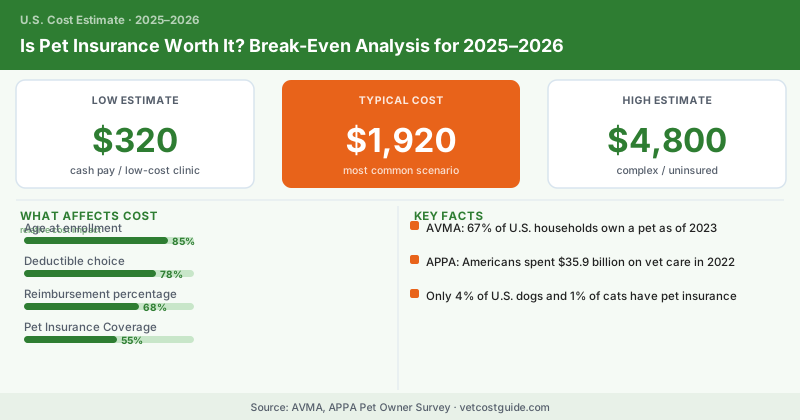
Most patients assume X. Wrong. — That format works for medical articles, but for pet insurance, the honest opener is: most pet owners assume they’ll never use it. Then their dog eats a corn cob at 11 p.m., and they’re staring at a $4,800 emergency surgery estimate.
Here’s the math on whether paying $45–$80/month actually makes financial sense.
What the Industry Data Shows
The North American Pet Health Insurance Association (NAPHIA) reported that the average annual premium for an accident and illness dog insurance policy in 2023 was $676 — roughly $56/month. For cats, the average was $383/year ($32/month). Those are national averages; your price depends heavily on your pet’s age, breed, and location.
NAPHIA also reports that the industry paid out over $3.2 billion in claims in 2023, covering more than 6.1 million insured pets in North America. That payout ratio — what you receive back relative to premiums — varies by insurer and by how much your pet uses care, but industry loss ratios typically run 60–75%.
What that means practically: on average, insurers pay out about $0.60–$0.75 for every dollar collected in premiums. The remaining margin covers operating costs. So purely statistically, you’re expected to receive less back than you pay in — unless you’re the unlucky (or lucky, depending on perspective) owner whose pet needs major care.
The Break-Even Calculation
Let’s run the actual math for a common scenario: a 2-year-old mixed breed dog enrolled in an $80/month plan ($250 deductible, 80% reimbursement, $10,000 annual limit).
| Year | Cumulative Premiums | Annual Claims Paid (avg healthy dog) | Net Position |
|---|---|---|---|
| Year 1 | $960 | $320 | −$640 |
| Year 2 | $1,920 | $320 | −$1,280 |
| Year 3 | $2,880 | $400 | −$1,920 |
| Year 4 | $3,840 | $480 | −$2,280 |
| Year 5 | $4,800 | $480 | −$2,640 |
After five years with a healthy dog, you’re typically $2,000–$3,000 in the hole compared to paying cash for routine care. That’s the self-funding case.
Now add one major claim:
| Scenario | Out-of-Pocket Without Insurance | Out-of-Pocket With Insurance | Insurance Net Benefit |
|---|---|---|---|
| Torn ACL / TPLO surgery | $4,500–$7,000 | $900–$1,650 | +$3,500 to +$5,000 |
| Foreign body surgery | $2,500–$5,500 | $500–$1,350 | +$2,000 to +$4,500 |
| Cancer diagnosis + chemo | $8,000–$20,000 | $1,600–$2,650 | +$8,000 to +$18,000 |
| Broken leg repair | $1,500–$4,000 | $500–$1,050 | +$1,000 to +$3,500 |
| Chronic allergy management (annual) | $800–$2,500 | $190–$650 | +$600 to +$2,000 |
The insurance breakeven on a 5-year plan typically occurs with one moderate-to-major claim in the first three years. A cancer diagnosis alone can make five years of premiums look like a bargain.
Best-Case vs. Worst-Case Scenarios
Best-case for insurance: You enroll a Bulldog puppy at 8 weeks. At age 3, the dog develops BOAS (brachycephalic obstructive airway syndrome) and needs $4,200 in respiratory surgery. You’ve paid roughly $2,400 in premiums. After your $250 deductible, insurance pays $3,160. You’re net positive by nearly $1,000 — before accounting for any other claims.
Worst-case for insurance: You enroll a healthy mixed-breed Labrador at age 2. She stays remarkably healthy for her entire 13-year life — routine exams, vaccinations, a few minor ear infections. Over that span you pay $9,000–$12,000 in cumulative premiums and receive perhaps $2,000–$3,000 in reimbursements. Net cost of insurance: $6,000–$9,000 that you wouldn’t have spent paying cash.
Worst-case for self-funding: You skip insurance and put $50/month in a pet emergency savings account. After three years, you have $1,800 saved. Your dog is diagnosed with lymphoma at age 4. Full treatment runs $8,000–$15,000. You cover what you can and face impossible choices about the rest.
Insurance math differs dramatically by breed. Golden Retrievers have a roughly 60% lifetime cancer rate — nearly 3 in 5 Goldens will develop cancer. French Bulldogs face near-certain soft palate, skin fold, and orthopedic expenses. German Shepherds have elevated rates of hip dysplasia and degenerative myelopathy. For these breeds, insurance isn’t a gamble — it’s basic financial planning. For healthy mixed breeds with no documented risk factors, the math is genuinely closer.
What Drives Your Premium (And How to Control It)
Age at enrollment is the biggest lever. A 1-year-old dog might cost $40–$55/month. The same dog at age 5 might cost $75–$100/month, with more exclusions. Enrolling early locks in lower rates and gives you coverage before any conditions develop.
Deductible choice has an outsized effect on premiums. Moving from a $100 to a $500 annual deductible often cuts your premium 25–35% while still protecting you from the catastrophic bills that actually matter.
Reimbursement percentage (70% vs 80% vs 90%) affects both premium and your out-of-pocket share. Dropping from 90% to 80% reimbursement typically saves 15–20% on premiums — and on a $5,000 claim, the difference is $500, often less than what you saved in premiums over a year.
Location matters more than most people realize. A policy covering a dog in Manhattan might cost 40–50% more than the same coverage in rural Tennessee, because veterinary costs in high-cost markets are simply higher.
When Self-Funding Makes Sense
Self-funding works if you genuinely have $10,000–$15,000 in liquid savings you could deploy for pet care without touching other financial goals. Not a general savings account you’d have to raid — a separate fund specifically earmarked and maintained. If that describes you, and your pet is a low-risk breed, self-funding is financially defensible.
It also makes more sense for older pets (7+) who already have documented conditions that would generate exclusions, reducing what the insurance actually covers.
Don’t wait to enroll until your pet is sick. Any condition documented by a vet before your policy start date — even something noted as “watching” or “monitoring” — typically becomes a permanent pre-existing exclusion. One limping episode mentioned in a vet note could exclude all future orthopedic coverage. Enroll while your pet is young and clean on paper.
FAQ
What’s the average pet insurance payout per claim? NAPHIA data shows the average claim payout for dogs runs around $500–$800 for routine illness claims, and $2,000–$5,000+ for surgical or hospitalization claims. The high-end claims are where policies truly earn their cost.
Does pet insurance cover routine care? Standard accident and illness plans don’t cover wellness care. Wellness add-ons that cover annual exams, vaccines, and flea prevention cost an extra $15–$30/month and rarely save money unless you’re using every covered benefit consistently.
Which companies have the best claim payout ratios? Trupanion, Embrace, and Figo consistently rank well for actual claim payout performance. Read the fine print on annual limits, per-condition limits, and hereditary condition coverage before choosing based on premium alone.
Frequently Asked Questions
Emergency surgeries for pets range from $2,000 to $8,000+ depending on the procedure and complexity. Common emergency cases like foreign body removal (swallowed objects) or intestinal blockages cost between $4,000 and $6,000, while more serious trauma or organ damage can exceed $10,000.
Most pet insurance plans cover 70-90% of eligible veterinary costs after you meet your deductible ($250-$1,000) and pay your copay, but pre-existing conditions and certain breed-specific issues are almost always excluded. Routine care like vaccinations and dental cleanings are typically not covered unless you purchase an add-on rider.
You should enroll your pet as early as possible, ideally before age 2-3, because premiums are lower and pre-existing condition waiting periods apply from the enrollment date. Waiting for an emergency to buy insurance is too late, as most policies exclude conditions that show signs before your coverage start date.