52.2% of microchipped dogs that entered shelters were returned to their owners. For unchipped dogs, that number was 21.9%. For cats, it’s even more dramatic — 38.5% of microchipped cats were reunited with their families, versus just 1.8% of unchipped cats. (Lord et al., Journal of the American Veterinary Medical Association, 2009.) One percentage point versus thirty-eight.
A microchip costs $25–$75 and lasts the lifetime of your animal. That’s the case for it in three numbers.
But there’s a critical catch that voids most of this benefit, and a lot of pet owners don’t find out about it until it’s too late. More on that in a moment.
What a Microchip Actually Is
A veterinary microchip is a passive radio frequency identification (RFID) transponder encased in biocompatible glass, roughly the size of a grain of rice — about 12mm long. It contains exactly one piece of information: a unique 15-digit identification number conforming to the ISO 11784/11785 standard.
Passive means no battery, no power source, no ongoing transmission. The chip does nothing on its own. It only activates when a scanner emits a radio frequency that energizes the chip’s antenna coil — generating just enough current to transmit the ID number back to the scanner. That’s it. No GPS. No real-time location. No alerts when your dog jumps the fence.
The chip contains no medical records, no address, no name. Just the number. And that number means nothing without a registry entry connecting it to you — which is where most people fall down.
The Implant Procedure
The chip comes pre-loaded in a sterile syringe with a 12-gauge needle — yes, larger than a typical vaccine needle. Most pets show no more than a brief reaction to the injection. No sedation required. The entire procedure takes about 30 seconds.
The chip is placed subcutaneously (under the skin) between the shoulder blades — a standard site recommended by AVMA guidelines that allows consistent scanning. Over time, fibrous tissue grows around the chip and anchors it in place. Migration (the chip moving from the implant site) is rare but does occur occasionally, which is why scanners should pass over the entire animal, not just the shoulder blades.
Cost: $25–$75 at a private veterinary practice. Often $10–$20 at community microchip clinics, shelter events, or low-cost vet clinics.
| Location | Typical Cost | Notes |
|---|---|---|
| Private veterinary practice | $45–$75 | Often done during another visit (wellness exam, spay/neuter) |
| Low-cost/community clinic | $20–$40 | Periodic events at pet stores, shelters |
| Humane society or shelter | $10–$25 | Some offer free microchipping events |
| Combined with spay/neuter | $25–$50 add-on | Discounted when bundled |
| Annual registration renewal | $0–$25/year | Depends on registry |
Registration — The Critical Step Most People Skip
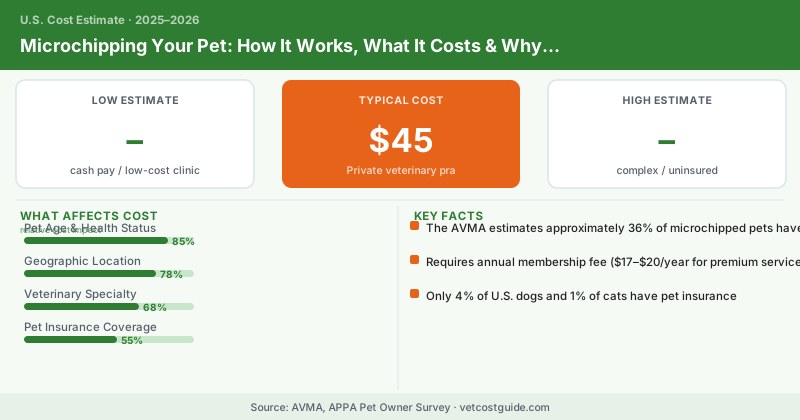
Here’s the failure point in the entire system. The AVMA estimates approximately 36% of microchipped pets have chips that are either unregistered or have out-of-date contact information in the registry. A chip with no registration is essentially useless — the number exists, but there’s no database entry connecting it to an owner.
When a shelter or vet clinic scans a found pet and retrieves a chip number, they look that number up in a database. If it’s not registered — or if you’ve moved since you registered and haven’t updated your address — the chip accomplishes nothing. Your pet is in the system but invisible.
How to register your chip:
Major registries in the US:
- HomeAgain (homeagain.com) — One of the largest. Requires annual membership fee ($17–$20/year for premium services; basic registration is free)
- AKC Reunite (akcreunite.org) — One-time fee of about $19.50 for lifetime registration
- Found Animals Registry (foundanimals.org) — Free registration, no annual fee
- PetLink (petlink.net) — Free basic registration
Key insight: there’s no single universal registry in the US. Different manufacturers and different vets use different databases. This is why the AAHA Universal Pet Microchip Lookup Tool (lookup.aaha.org) exists — it searches across multiple participating registries simultaneously. When your pet is found, this is the tool someone will use.
Best strategy: register in multiple registries. Found Animals is free, so there’s no reason not to register there alongside your primary registry.
Getting your pet microchipped without registering the chip is like putting a lock on a door and leaving the key on the mat. The chip number identifies your pet; the registry is what connects that number to you. If you’ve moved, changed your phone number, or had any contact information change since registering, update your registry entry today. Shelters report that out-of-date registration is nearly as common as no registration at all.
What Happens When Your Pet Is Found
Someone finds your dog. They bring her to a vet clinic or animal shelter. The scanner passes over her body — the entire body, since chips occasionally migrate from the shoulder blades. The scanner reads the 15-digit number. Staff looks it up using the AAHA tool or their preferred registry.
If your registration is current, they find your name, phone number, and address within seconds. They call you. Your dog comes home.
That’s the whole system. Simple when it works, useless when the registration step was skipped.
Microchips vs. GPS Trackers: Two Different Tools
GPS pet trackers — Whistle, Fi collar, Apple AirTag with a custom mount — have become popular. They do something a microchip doesn’t: provide real-time location tracking. Genuinely useful for dogs who are escape artists or work off-leash.
But GPS trackers require:
- Battery charging (typically every few days to once a week)
- A subscription service ($7–$25/month)
- The tracker to still be attached when the pet is found
- Cellular or GPS coverage in the area
A microchip has none of these dependencies. No charging, no subscription, no maintenance, and it can’t be removed by the pet or detached when a collar is lost. For most pets, both tools serve complementary purposes — the chip is the permanent failsafe, the tracker is the real-time convenience option.
Do this today: look up your pet’s microchip number on the AAHA Universal Pet Microchip Lookup Tool (lookup.aaha.org). If no registration appears, register immediately at Found Animals (free) and one paid registry. If you see your old address, update it. If you’ve never been able to find the chip number, your vet can scan for it at the next visit. This 10-minute task is the single most effective thing you can do to make sure your microchip actually works when it’s needed.
At Every Life Transition: Scan and Verify
Microchip registration should be checked whenever your contact information changes. Move? Update. New phone number? Update. Transfer ownership? The chip should be re-registered to the new owner — most registries have a transfer process.
It’s also worth asking your vet to scan for the chip at annual wellness visits, just to confirm it’s still readable and hasn’t migrated. Adds no cost, takes 30 seconds. Over a 15-year lifespan, that’s 15 confirmations that your permanent ID is intact.
For $25–$75 and 10 minutes of registration, a microchip is genuinely the best single investment in your pet’s safety. The only thing that undermines it is skipping the registration step — so don’t skip the registration step.
Frequently Asked Questions
Microchipping typically costs between $25 and $75 at veterinary clinics, with most practices charging around $40–$50 for the procedure. This one-time fee covers the implant and initial registration, and the microchip lasts for your pet's entire lifetime without replacement or renewal costs.
Most standard pet health insurance plans do not cover microchipping as it is considered a preventive or elective procedure rather than treatment for illness or injury. However, some pet wellness plans or add-on coverage options may reimburse $25–$50 of the microchip cost, so check your specific policy details with your provider.
The microchip is implanted with a needle similar to a vaccine injection and causes minimal discomfort; no anesthesia or surgery is required, and the procedure takes less than a minute. Your pet can resume normal activity immediately with no recovery period needed, though some vets recommend monitoring the implant site for a day to ensure no irritation occurs.