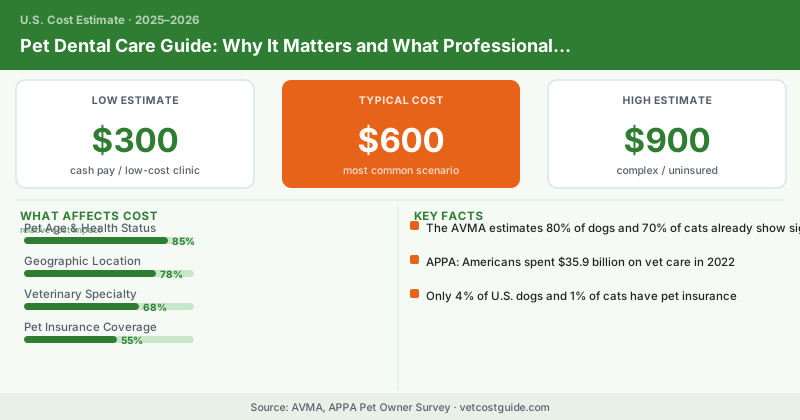
Age 3. Not age 10, not age 12 — age 3. The AVMA estimates 80% of dogs and 70% of cats already show signs of dental disease by the time they’re three years old. These are young animals walking around with infected gums, painful teeth, and bacteria entering their bloodstreams with every meal.
Let’s also clear up one persistent myth before we get into specifics: dry kibble does not clean your pet’s teeth. The idea makes sense intuitively — crunchy food must scrub the teeth, right? The American Veterinary Dental College reviewed the evidence and concluded that “the dental benefits of dry food have been greatly exaggerated.” Kibble crumbles when bitten. It doesn’t scrape the gumline where periodontal disease actually begins.
Here’s what actually happens when dental disease progresses, what a real cleaning involves, and what you can expect to pay.
What Happens Without Treatment
Dental disease doesn’t stay in the mouth. That’s the part most owners miss.
Stage 1 is gingivitis — redness and inflammation of the gums, caused by plaque bacteria. Fully reversible with a cleaning at this stage. Stage 2 and 3 bring early to moderate periodontal attachment loss. Stage 4 is advanced periodontal disease: bone loss around tooth roots, deep pockets full of bacteria, teeth literally loose in the socket.
At stages 3 and 4, bacteria from infected gums enter the bloodstream repeatedly with every bite of food. The AVMA has documented associations between severe dental disease and heart valve disease (especially in small dogs), kidney disease, and liver disease. The research is still developing on whether dental disease directly causes these systemic problems — but no credible veterinary authority argues that ignoring it is harmless.
Beyond systemic effects: dental disease hurts. Dogs and cats rarely stop eating even with severe oral pain — survival instinct. So owners conclude the pet is fine. They’re not. Pets with untreated dental disease often show dramatic behavioral improvements after treatment. More playful, more energetic, better appetite. Many owners describe their senior pet as “becoming a different dog” after long-overdue dental work.
The Anesthesia-Free Cleaning Debate
You’ve probably seen anesthesia-free dental cleanings marketed at groomers, pet stores, or even some vet practices. They’re cheaper — typically $100–$300 — and skip anesthesia entirely.
The AVMA’s position, shared by the American Veterinary Dental College and AAFP: anesthesia-free cleanings are cosmetic procedures that do not treat dental disease.
Here’s why that distinction matters. Periodontal disease begins below the gumline, where the tooth root meets the socket. Removing subgingival tartar and evaluating pocket depth requires instruments under the gum tissue — which requires the pet to be completely still and cooperative. Dental X-rays are also impossible without anesthesia. An anesthesia-free cleaning scrapes visible tartar from the tooth crown, making teeth look cleaner while leaving the disease-causing bacteria underneath untouched. In some cases, it can worsen outcomes by creating rough surfaces that harbor more bacteria.
Anesthesia-free cleanings aren’t a cheaper version of the same service. They’re a different service — one that addresses cosmetics but not the actual disease. The AVMA explicitly opposes them when used as a substitute for professional veterinary dental care. A pet with clean-looking teeth and active subgingival infection is more dangerous than a pet with visibly dirty teeth, because the warning signal has been removed.
What a Professional Cleaning Actually Involves
A proper veterinary dental cleaning is a full medical procedure, not a tooth polish.
Pre-anesthetic bloodwork ($80–$150): Before anesthesia, your vet typically recommends bloodwork to confirm the kidneys and liver can process anesthetic drugs safely. Not upselling — legitimate safety medicine, especially for pets over 7.
Anesthesia and monitoring: Your pet is placed under general anesthesia with IV catheter access, continuous monitoring of heart rate, blood pressure, oxygen levels, and body temperature, plus a trained technician dedicated to anesthesia monitoring throughout the procedure.
Full-mouth dental X-rays: Most pet owners don’t know this happens. A study in the Journal of Veterinary Dentistry found that 28% of dental lesions in dogs and 42% in cats were invisible without X-rays — meaning a “clean”-looking tooth could hide an abscess or root resorption underneath. Full-mouth X-rays are the standard of care.
Supragingival and subgingival scaling: Ultrasonic scalers and hand instruments remove calculus from above and below the gumline.
Periodontal probing: Each tooth socket is probed for pocket depth — pockets over 3mm in cats or 5mm in dogs indicate attachment loss.
Polishing: Smooths the tooth surface to slow future tartar accumulation.
Extractions if needed: Performed during the same anesthesia event. This is where costs vary most — zero extractions versus multiple molar extractions is the difference between a $400 bill and a $1,500 bill.
| Service | Small Dog or Cat | Medium Dog | Large Dog |
|---|---|---|---|
| Cleaning, no extractions | $300–$550 | $350–$650 | $400–$750 |
| Pre-anesthetic bloodwork | $80–$150 | $80–$150 | $80–$150 |
| Full-mouth dental X-rays | $75–$150 | $75–$150 | $100–$200 |
| Single tooth extraction (simple) | $50–$150 | $75–$175 | $100–$200 |
| Multiple extractions (severe disease) | $400–$800 | $500–$1,000 | $600–$1,200 |
| Total (cleaning + bloodwork + X-rays) | $455–$850 | $505–$950 | $580–$1,100 |
| Total (with significant extractions) | $855–$1,650 | $1,005–$1,950 | $1,180–$2,300 |
Home Dental Care: What Actually Works
Ranked from most to least effective:
Daily toothbrushing: The gold standard. Soft-bristled toothbrush or finger brush with pet-safe enzymatic toothpaste. Human toothpaste contains fluoride and xylitol — both toxic to pets. Ideally start young. For adults not used to it, there’s a gradual introduction protocol: start with just a finger on the gums, add flavor, add the brush over several weeks.
VOHC-approved dental chews: The Veterinary Oral Health Council awards its seal to products that have demonstrated plaque or tartar reduction in controlled studies. Look for the VOHC seal. Products like Greenies (dogs), Virbac CET chews, and OraVet have earned it.
Water additives: Dental rinses added to the water bowl. Less effective than brushing but useful for pets who won’t tolerate a toothbrush.
Dental diets: Prescription dental diets like Royal Canin Dental and Hills t/d have VOHC approval. Their fiber matrix doesn’t crumble immediately on biting, allowing the kibble to wipe the tooth surface. Not a replacement for cleaning, but a meaningful supplement.
The most common reason owners decline professional dental cleanings is fear of anesthesia in older pets. This fear is understandable but often misplaced. Modern veterinary anesthesia with proper pre-screening, IV catheter access, and dedicated monitoring has a low complication rate in healthy-to-moderate-risk patients. Stage 3 periodontal infection with ongoing systemic bacterial exposure is a considerably higher long-term health risk than a properly monitored anesthetic procedure. Ask your vet to walk you through the pre-anesthetic screening process — most owners feel much better once they understand how closely their pet is monitored.
How Often Does Your Pet Need a Cleaning?
There’s no universal answer — genetics, home care, diet, and individual plaque accumulation rates all factor in. Small dogs and cats (especially Persians, Siamese, and other breeds with crowded mouths) tend to need more frequent cleanings. Some small dogs need annual cleanings starting at age 2–3. Many large dogs can go 2–3 years between cleanings with consistent home care.
Your vet will stage the dental disease at each exam and recommend a timeline. Following that recommendation is significantly cheaper than treating the consequences of deferral — a full-mouth extraction in a small dog can approach $2,000–$3,000 and is entirely preventable with earlier intervention.
Frequently Asked Questions
Professional dental cleanings under anesthesia typically cost $300–$900, depending on your pet's age, size, and the severity of dental disease. Additional costs apply if extractions are needed, ranging from $500–$3,000 per tooth, which is why preventive cleaning is significantly more affordable than treating advanced disease.
Most standard pet insurance plans exclude routine dental cleanings as a pre-existing condition or wellness service, leaving you responsible for the full cost out-of-pocket. Some premium or specialized dental-focused plans may cover 70–90% of cleaning costs after a deductible, so check your specific policy before assuming coverage.
Since 80% of dogs and 70% of cats show signs of dental disease by age 3, veterinarians recommend starting cleanings by age 1–2 as a preventive measure, with follow-ups every 1–2 years depending on your pet's individual risk. Your vet will examine your pet during routine checkups and recommend cleaning if tartar buildup or gum inflammation is present.