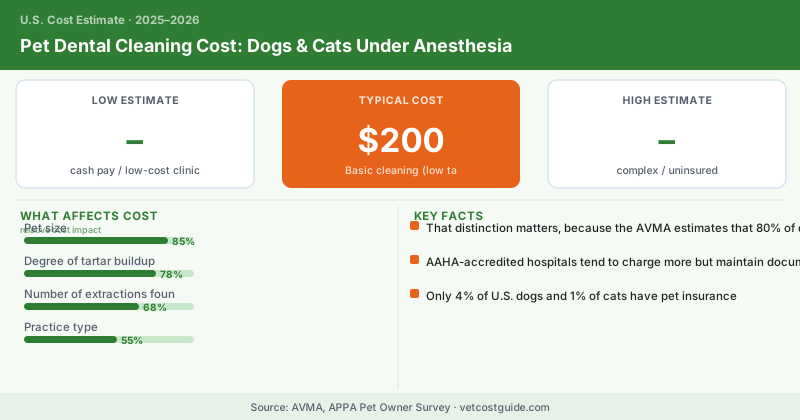
Anesthesia-free dental cleanings remove visible tartar — but they don’t treat the disease below the gumline, which is where periodontal disease actually lives. That distinction matters, because the AVMA estimates that 80% of dogs and 70% of cats show signs of dental disease by age 3. Most of that disease is invisible on the surface. A professional veterinary cleaning — the kind that requires general anesthesia — is the only procedure that actually addresses it.
What a Professional Dental Cleaning Involves
This isn’t a tooth brushing. A veterinary dental cleaning under anesthesia includes:
Pre-anesthetic bloodwork: Screens for organ function issues that could affect anesthesia safety. Especially important for dogs and cats over 7 years old. Cost: $80–$200.
General anesthesia: Required to position the mouth properly, eliminate pain from probing and subgingival scaling, and keep the pet still for accurate dental radiographs. Inhalant anesthesia with IV catheter and fluids is standard.
Full-mouth dental radiographs: The most important upgrade from a “basic” cleaning. X-rays reveal tooth root abscesses, bone loss below the gumline, retained roots from previous extractions, and resorptive lesions in cats — none of which are visible on exam. Cost when added: $150–$300.
Ultrasonic scaling above and below the gumline: The ultrasonic scaler removes calculus (hardened tartar) from the crown and subgingival pockets where bacteria accumulate. This is the step that can’t be done safely in an awake animal.
Probing all teeth: A periodontal probe measures pocket depth around every tooth. Pockets deeper than 3mm in dogs or 1mm in cats indicate attachment loss and active disease.
Polishing: Smooths the enamel surface after scaling to slow future tartar accumulation.
Extractions if needed: If disease is too advanced to save a tooth, extraction follows the cleaning. Expect $100–$300 per tooth for simple extractions; surgical extractions of multi-rooted teeth run higher.
| Service Tier | What's Included | Typical Cost |
|---|---|---|
| Basic cleaning (low tartar) | Anesthesia + scaling + polish | $200–$400 |
| Standard cleaning | Bloodwork + anesthesia + scaling + polish | $300–$600 |
| Full dental with radiographs | Bloodwork + anesthesia + X-rays + scaling + polish | $450–$800 |
| With 1–2 simple extractions | Full dental + extractions | $550–$1,000 |
| With multiple or surgical extractions | Full dental + complex extractions | $800–$1,500+ |
Why Anesthesia Is Non-Negotiable
The AVMA and the American Animal Hospital Association (AAHA) both publish formal position statements opposing anesthesia-free dentistry as a substitute for professional veterinary care. It’s not a position based on convenience — it’s based on anatomy and physics.
Subgingival scaling (below the gumline) requires sharp instruments in tight tissue pockets. In a conscious, moving animal, this causes pain and creates a genuine laceration risk. Dental radiographs require specific head positioning held absolutely still. Probing pocket depth requires inserting an instrument 1–5mm below the gumline around all 42 (dog) or 30 (cat) teeth. None of these steps can be performed safely without anesthesia.
An anesthesia-free “dental” that removes visible tartar costs $100–$200 and leaves the subgingival disease untreated. It may actually be harmful — because a clean-looking mouth can delay the owner from pursuing real dental care while disease progresses below the surface.
- Is full-mouth dental radiography included? If not, ask to add it — this is the single upgrade with the most diagnostic value.
- What pre-anesthetic monitoring is used? At minimum: IV catheter, IV fluids, pulse oximetry, ECG, temperature monitoring.
- Will I get a call before any extractions? Most practices call owners during the procedure if extractions are found to be needed, since this adds cost.
- Who is monitoring anesthesia? A dedicated anesthesia monitor (licensed technician) separate from the doctor performing dentistry is the standard at AAHA-accredited hospitals.
- What’s included in the quoted price? Clarify whether the estimate includes bloodwork, radiographs, anesthesia monitoring, and what the per-tooth extraction fee is if extractions are needed.
Cost Factors That Move the Number
Pet size: Larger dogs require more anesthesia, more dental radiographs, and the procedure takes longer. A 90-lb dog’s dental typically costs more than a 10-lb cat’s for these reasons.
Degree of tartar buildup: Heavy calculus takes longer to remove. Pets with 3+ years of tartar accumulation often have longer, more expensive cleanings — and more extractions.
Number of extractions found: This is the biggest cost variable and the hardest to predict in advance. A pet with severe periodontal disease might need 6–10 extractions, adding $600–$2,000 to the total. Dental radiographs help predict this before the procedure starts.
Practice type: Corporate veterinary chains (Banfield, VCA) often offer wellness plan pricing that includes annual dentals at a bundled rate. AAHA-accredited hospitals tend to charge more but maintain documented equipment and staffing standards. Veterinary school dental clinics offer the lowest cost — typically 30–50% below private practice — but wait times can be long.
Geographic location: A dental cleaning in Manhattan runs 40–60% more than the same procedure in rural Arkansas.
Breed-Specific Risk
Some breeds are at much higher risk for early, severe dental disease:
- Brachycephalic breeds (Bulldogs, Pugs, Shih Tzus, Persians, Scottish Folds): Compressed jaw with normal tooth count means severe crowding, deep pockets, and accelerated periodontal disease. Annual cleanings starting at age 2–3 are often recommended.
- Small dogs under 15 lbs (Chihuahuas, Yorkshire Terriers, Dachshunds): Genetically prone to heavy tartar and early tooth loss. May need cleanings every 6 months.
- Greyhounds and Whippets: Thin enamel makes them disproportionately prone to severe dental disease relative to their size.
For cats, Persians and Siamese are higher risk, and all cats are prone to tooth resorption (feline odontoclastic resorptive lesions) — a painful condition only diagnosable with dental radiographs.
Home Care Between Cleanings
Professional cleanings aren’t a once-and-done solution — the same tartar-forming bacteria are in your pet’s mouth the day after the cleaning. Home care slows the progression:
Daily brushing is the gold standard. Use pet-specific toothpaste (never human toothpaste — the fluoride and xylitol are toxic to pets). A $5–$20 pet toothbrush kit is all you need. Even brushing 3x/week has measurable impact on tartar accumulation rates.
Dental chews and water additives: VOHC (Veterinary Oral Health Council) approval is the benchmark — products with the VOHC seal have passed controlled efficacy trials. Look for it on packaging.
Water additives: Tasteless antibacterial additives ($10–$20/month) reduce plaque bacteria in pets that won’t tolerate brushing.
“Anesthesia-free dental cleaning” is not a substitute for professional veterinary dentistry. The AVMA and AAHA both oppose it explicitly. It removes visible surface tartar while leaving subgingival disease — the actual source of tooth loss, pain, and systemic bacterial seeding — completely untreated. A mouth that looks clean after an anesthesia-free polish may have active periodontal disease in every tooth pocket. If your vet offers anesthesia-free dentistry as the standard of care rather than as an explained limitation, that’s worth a second opinion.
Is a Dental Cleaning Worth the Cost?
Untreated dental disease doesn’t just cause bad breath and tooth loss. Chronic oral bacterial infection has been linked in veterinary literature to increased risk of kidney disease, heart valve disease, and systemic inflammatory conditions. A $500 dental cleaning every 12–18 months is considerably less expensive than managing chronic kidney disease or endocarditis over a pet’s remaining lifespan.
The cleanings are also the time your vet gets to look inside the mouth with good light, a probe, and radiographic confirmation. Oral tumors, retained deciduous teeth, and palate abnormalities are often caught during dentals — and early is always better.
Frequently Asked Questions
Anesthesia-free 'cleanings' only remove visible tartar above the gumline. They can't clean the subgingival (below-gumline) pockets where periodontal disease actually lives and progresses. Both the AVMA and AAHA have published position statements opposing anesthesia-free dentistry as a substitute for professional dental care — it can create a false sense of oral health while disease advances unseen.
Most dogs and cats benefit from annual professional cleanings. Small breeds, brachycephalic breeds, and pets with a history of rapid tartar buildup may need cleanings every 6 months. Your vet can recommend a schedule based on your pet's mouth at each annual exam.
The vet probes around each tooth to assess periodontal attachment. Teeth with more than 50% bone loss, root exposure, or significant mobility are candidates for extraction. Each extraction costs $100–$300 depending on tooth size, root number, and whether a surgical extraction (cutting gum tissue) is needed. Full-mouth dental radiographs catch problems invisible to the naked eye.