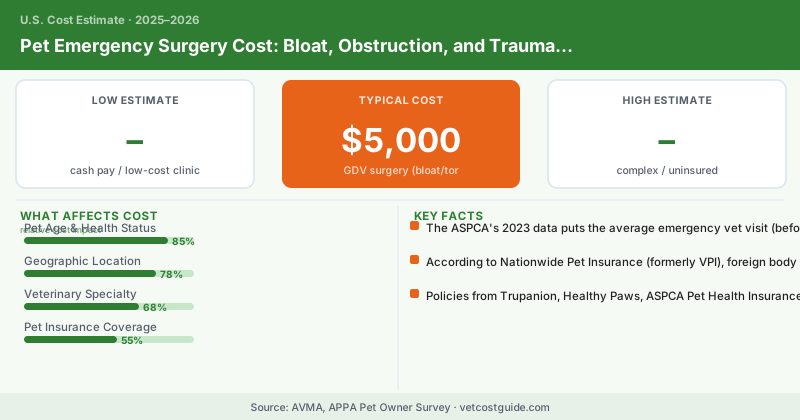
It’s 11 p.m. Your dog is pacing, bloated, trying to vomit and failing. Or your cat stopped eating three days ago and is now hunched in the corner. Or your dog got hit by a car. In each of these cases, you’re about to face an emergency surgery bill — and the number will be in the thousands. The ASPCA’s 2023 data puts the average emergency vet visit (before surgery) at $800–$1,500. Add a major surgical procedure and you’re looking at $3,000–$10,000 or more.
This guide breaks down what specific emergency surgeries actually cost, what to expect from the billing process, and how to handle it when you’re facing five figures at midnight.
- GDV (bloat/stomach torsion) surgery runs $3,000–$7,500 and is almost always fatal without it.
- Foreign body removal (obstruction) costs $1,500–$5,000 depending on whether it requires intestinal resection.
- Trauma surgery (internal bleeding, fractures, organ repair) ranges $2,000–$8,000+.
- Emergency facilities charge a $100–$250 emergency exam/triage fee before any treatment begins.
- Pet insurance reimburses 70–90% of eligible emergency surgery costs after deductible — enrolling before an emergency changes everything.
Emergency Surgery Cost Overview
| Emergency Procedure | Low Cost | Typical | High Cost |
|---|---|---|---|
| GDV surgery (bloat/torsion) | $3,000 | $5,000 | $7,500 |
| Foreign body removal (no resection) | $1,500 | $2,800 | $4,500 |
| Foreign body + intestinal resection | $3,000 | $4,500 | $7,000 |
| Splenic mass/rupture removal | $2,500 | $4,000 | $6,500 |
| Traumatic internal bleeding repair | $2,500 | $4,500 | $8,000 |
| Diaphragmatic hernia repair | $2,500 | $4,000 | $7,000 |
| C-section (emergency/dystocia) | $1,500 | $2,800 | $5,000 |
| Urinary obstruction (cat — medical/surgical) | $1,500 | $2,500 | $5,000 |
| Emergency triage exam fee | $100 | $175 | $250 |
GDV: The Most Time-Critical Emergency
Gastric Dilatation-Volvulus — commonly called bloat — is the one emergency where minutes genuinely matter. The stomach fills with gas, flips on itself, cutting off blood supply. Without surgery, the dog will die, typically within 6–12 hours of onset.
Large and giant breed dogs with deep chests are most at risk: Great Danes, German Shepherds, Standard Poodles, Boxers, Weimaraners, Saint Bernards. Trupanion’s 2023 claims data shows GDV as one of the five most expensive single-incident claims they process, with average payouts of $4,200–$5,800 after deductible.
What the surgery involves: Decompression of the stomach, un-rotating it back to position, assessing the stomach wall and spleen for tissue death (necrotic tissue requires resection), and performing a gastropexy — permanently tacking the stomach to the body wall so it can’t rotate again. The gastropexy is why the surgery is worth it even if done once: the recurrence rate for GDV in dogs that have had gastropexy is less than 5%.
What drives cost up: Time delay (the longer since onset, the more tissue damage), need to remove part of the stomach or spleen (splenectomy adds $500–$1,500), and overnight ICU monitoring post-surgery. Expect 1–3 nights of hospitalization at $200–$600/night.
Total realistic cost range: $3,500–$7,500 all-in, including the ER exam, pre-surgical bloodwork, IV fluids, surgery, hospitalization, and discharge medications.
If your large-breed dog is showing non-productive retching, a distended abdomen, restlessness, or excessive drooling — go to an emergency vet immediately. Do not wait to see if it passes. GDV is fatal without surgery and the window is narrow.
Foreign Body Obstruction: When They Eat What They Shouldn’t
Dogs eat things. Corn cobs, socks, toys, rocks, peach pits — the list of objects surgically removed from dogs every year is both alarming and occasionally impressive. Foreign body obstruction is one of the most common emergency surgeries in dogs, and it’s a top claim category for pet insurance. According to Nationwide Pet Insurance (formerly VPI), foreign body ingestion claims average $2,700–$3,800 for surgeries.
Not every ingested object requires surgery. Some can be induced to vomit within 2–4 hours of ingestion; others can be retrieved endoscopically ($1,000–$2,500) without opening the abdomen. The decision tree:
- Endoscopic retrieval — possible if the object is still in the stomach and accessible. Costs $1,000–$2,500.
- Gastrotomy (opening the stomach) — if the object is lodged there. Costs $1,500–$3,500.
- Enterotomy (opening the small intestine) — if the object has moved into the intestine. Costs $2,500–$5,000.
- Intestinal resection and anastomosis — if a section of intestine has lost blood supply and needs removal. This is the most serious scenario, involving removing dead intestine and reconnecting healthy ends. Costs $3,000–$7,000. Recovery is more complicated and ICU time increases.
Cats and strings: A special hazard for cats. Linear foreign bodies — string, ribbon, hair ties, tinsel — wrap around the base of the tongue or get caught in the pylorus while the intestine contracts around the rest of the string, causing it to “saw” through the intestinal wall. Perforation and septic peritonitis are the dangerous outcomes. Linear foreign body removal in cats frequently requires intestinal resection and runs $3,000–$6,500.
Trauma: Cars, Falls, and Animal Attacks
Trauma is uniquely unpredictable in cost because severity ranges from a simple laceration repair ($300–$800) to complex multi-system injury repair ($5,000–$12,000+).
Common traumatic emergencies and costs:
| Traumatic Injury | Typical Surgical Cost | Notes |
|---|---|---|
| Internal hemorrhage (spleen/liver) | $3,000–$6,500 | Splenectomy or hepatic repair |
| Fractured pelvis (surgical repair) | $2,500–$5,500 | Some managed medically |
| Fractured femur (TPLO/plating) | $2,500–$4,500 | Orthopedic specialist preferred |
| Diaphragmatic hernia | $3,000–$6,000 | Repair + respiratory stabilization |
| Penetrating chest wound | $2,000–$5,000 | Chest tube, thoracotomy if needed |
| Bite wound debridement + repair | $800–$3,500 | Extensive wounds may need staged closure |
Post-trauma workup before surgery — chest X-rays, abdominal ultrasound (FAST scan), IV fluid stabilization, blood pressure monitoring — adds $300–$800 before the surgical quote is even finalized.
The Billing Process at Emergency Clinics
Emergency and specialty veterinary hospitals almost universally require payment upfront or a deposit before surgery begins. This isn’t a judgment about you — it’s standard practice in emergency medicine because treatment must happen immediately and can’t wait for insurance reimbursement.
What to expect:
- Estimate sheet: The clinic will give you a written estimate range (low/high) before surgery. The actual bill is usually within this range but can exceed the high end if complications arise.
- Deposit required: Typically 50–100% of the estimated total is collected before the procedure. For a $5,000 surgery, expect to put down $2,500–$5,000.
- Final bill at discharge: Any remaining balance is due when you pick up your pet.
Financing options available at most emergency clinics:
- CareCredit — 0% APR promotional periods of 6–24 months depending on transaction amount
- Scratch Pay — Instant veterinary financing decisions; 0–26.99% APR depending on credit
- The clinic’s own payment plan — Many clinics have internal plans, but these are inconsistent; ask directly
See how vet payment plans work for more on financing options, and emergency vet costs for the full picture on ER visit costs before surgery is even on the table.
What Pet Insurance Covers
Emergency surgery is exactly what comprehensive pet insurance is designed for. Policies from Trupanion, Healthy Paws, ASPCA Pet Health Insurance, and others reimburse 70–90% of eligible emergency surgery costs after your annual deductible — often turning a $5,000 bill into a $500–$1,500 out-of-pocket expense.
Critical caveats:
- Pre-existing conditions are excluded. If your dog has a known GDV risk factor or prior GI obstruction history, some insurers may exclude those conditions.
- Waiting periods apply. Most policies have 14-day waiting periods for illness and 48-hour to 14-day periods for accidents. A pet enrolled yesterday can’t file a claim for a GDV today.
- Bilateral and breed conditions vary by insurer — some exclude breed-specific conditions like GDV predisposition in deep-chested breeds.
The time to enroll is before the emergency — not after. Learn more about whether pet insurance is worth it and what surgery coverage actually looks like.
How to Prepare Before an Emergency Happens
The single best financial preparation for pet emergencies: an emergency fund or an active pet insurance policy. The AVMA recommends that pet owners have $1,000–$2,000 available for unexpected veterinary costs; for large-breed dogs with GDV risk, orthopedic risks, or known health predispositions, that number should be $3,000–$5,000.
Practical steps right now:
- Identify your nearest 24-hour emergency veterinary hospital and save the number in your phone.
- Know your financing options — a pre-approved CareCredit card in your wallet before an emergency removes one decision in a high-stress moment.
- If you have a high-risk breed (Great Dane, German Shepherd, Standard Poodle, or any large deep-chested dog), ask your vet about prophylactic gastropexy during spay/neuter surgery. It costs $200–$400 extra and eliminates GDV risk permanently.
Emergency surgery is terrifying — financially and emotionally. But veterinary medicine’s capacity to save animals from what would have been certain death just 20 years ago is remarkable. Most dogs and cats that reach an emergency clinic alive survive their surgery. That’s worth knowing when you’re staring at a five-figure estimate at midnight.
Frequently Asked Questions
Emergency bloat surgery typically costs $1,500–$3,000 for the procedure itself, but total bills including diagnostics, hospitalization, and aftercare often reach $3,000–$5,000 or higher. Costs vary by region, clinic, and whether the stomach has ruptured; rupture cases can exceed $5,000 due to extended monitoring and complications.
Most pet insurance plans cover emergency surgery after you meet your deductible and co-insurance (typically 10–20% out-of-pocket), though reimbursement is often 70–90% of eligible costs. However, some policies exclude pre-existing conditions or have surgery caps; review your policy details before an emergency, as coverage varies significantly by provider and plan tier.
Most cats recover within 2–4 weeks after foreign body removal surgery, with activity restrictions for the first 10–14 days and suture removal at 10–14 days post-op. Pain medication is typically prescribed for 5–7 days, and your vet will schedule a follow-up exam within 7–10 days to monitor healing.