What happens when your $5,000 policy meets a $15,000 cancer bill? You eat the other $10,000. That’s the annual limit at work, and it’s the clause most owners skim right past when they’re chasing the cheapest monthly premium.
An annual limit is the maximum dollar amount your insurer will reimburse in a single policy year. Hit it, and coverage stops cold until the year resets—no matter how many claims you’ve still got coming. It’s the single most important number in your policy after the premium itself.
- An annual limit caps total reimbursement per policy year, separate from your deductible and reimbursement rate.
- Common tiers are $5,000, $10,000, $15,000, and unlimited.
- A low limit can be exhausted by one major event—cancer or orthopedic surgery routinely tops $10,000.
- Unlimited plans cost more monthly but remove the worst-case ceiling. For chronic or expensive breeds, that’s often the smarter buy.
How the Limit Actually Resets
The limit is annual, tied to your policy year—not the calendar year necessarily. It resets to full on your renewal date. So a $10,000 cap means your insurer pays up to $10,000 in reimbursements between renewals; whatever you spend past that is on you until the clock turns over.
It works alongside your deductible and reimbursement percentage, not instead of them. First you meet the deductible, then reimbursement applies, then the total of those payouts counts against your annual limit. Our reimbursement guide walks through how those pieces stack.
What Different Limits Cost
| Annual Limit | Dog Monthly | Cat Monthly | Best For |
|---|---|---|---|
| $5,000 | $30-$45 | $15-$25 | Tight budgets young pets |
| $10,000 | $40-$60 | $22-$35 | Most owners mid-range |
| $15,000 | $50-$75 | $28-$42 | Large breeds chronic risk |
| Unlimited | $60-$95 | $35-$55 | Worst-case protection |
Notice the jump from $5,000 to unlimited often adds only $25 to $40 a month for a dog. When you weigh that against a single $15,000 bill, the unlimited tier frequently wins the math. Our worth-it analysis digs into exactly when that premium bump pays off.
Why Low Limits Burn People
The trap is that $5,000 sounds like a lot. It isn’t, once a real emergency starts.
A cancer treatment course with chemotherapy and surgery commonly runs $6,000 to $15,000 over a year. A torn cruciate ligament repaired surgically on both knees can hit $9,000 to $11,000. An emergency bloat surgery (GDV) in a large dog often lands at $5,000 to $8,000 in a single night. Any one of those blows through a $5,000 cap, and the rest of the year you’re uninsured in practice.
NAPHIA reported that the average accident-and-illness claim payout has climbed steadily, and that total US pet insurance premiums written reached roughly $4.27 billion in 2024. Vet costs are rising faster than general inflation, which means a limit that felt generous five years ago covers a lot less treatment today.
A “per-incident” limit is different from an “annual” limit, and some budget plans use the harsher per-incident or per-condition version. Per-incident caps reset for each new problem but can leave a chronic condition like diabetes underfunded year after year. Always confirm which type you’re buying.
How to Choose Your Limit
Match the limit to your worst realistic scenario, not your average vet visit.
- Young, low-risk cat indoors? $5,000 to $10,000 is often plenty.
- Large or deep-chested dog (Great Dane, Lab, Boxer)? Lean toward $15,000 or unlimited—bloat and orthopedic risk are real.
- Breed prone to cancer or chronic disease? Unlimited removes the ceiling on exactly the bills that would crush you.
- Cost-conscious but cautious? A $10,000 limit is the sweet spot most owners land on.
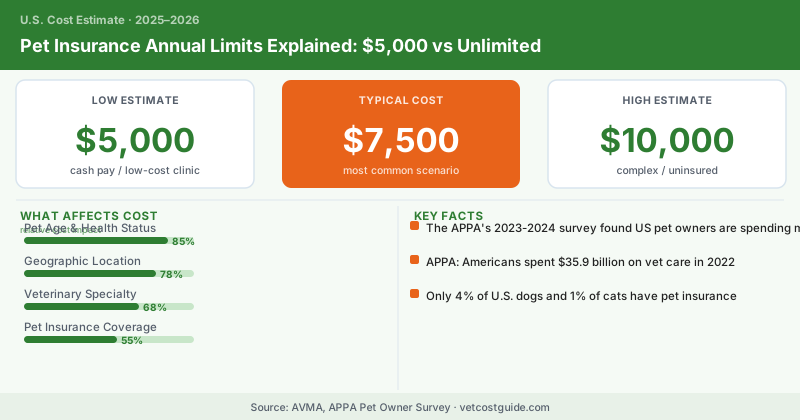
The APPA’s 2023-2024 survey found US pet owners are spending more on veterinary care every year, and the average vet visit cost for routine care is small compared to the catastrophic events insurance exists to cover. The whole reason you buy a policy is the rare $12,000 disaster—so don’t pick a limit that can’t actually absorb one.
One last tip: revisit your limit at every renewal, not just at signup. As your pet ages into higher-risk years, a limit that fit a healthy 2-year-old may be too low for an 8-year-old facing cancer or joint disease. Bumping up the limit is usually easy at renewal and doesn’t trigger a fresh pre-existing review the way switching insurers would.
Run your own numbers before you commit, and compare the monthly premium differences between limit tiers. Spending $30 more a month to lift your ceiling from $5,000 to unlimited is cheap insurance against the night everything goes wrong.
Frequently Asked Questions
Cancer treatment for pets ranges from $10,000 to $25,000+ depending on the type and stage, with chemotherapy alone costing $3,000–$8,000 and surgery running $5,000–$15,000. A $5,000 annual limit leaves you responsible for the remaining $5,000–$20,000 out-of-pocket, which is why unlimited policies cost more but protect against catastrophic bills.
Most pet insurance plans do cover cancer treatment, but once you reach your annual limit—whether it's $5,000 or unlimited—the insurer stops paying for any additional claims that year. With a $5,000 cap and a $15,000 cancer diagnosis, you'd receive $5,000 in reimbursement and owe the remaining $10,000 yourself until your policy year resets.
Consider upgrading to unlimited coverage immediately if your pet is over age 5, has any pre-existing conditions, or if you cannot afford a $10,000+ out-of-pocket bill for emergencies like cancer or major surgery. The monthly premium difference is typically $15–$40 more, but it eliminates the risk of losing coverage mid-treatment.