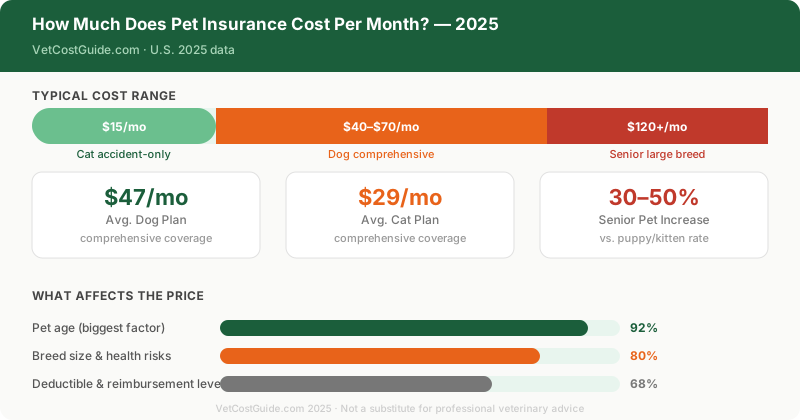
Here’s what nobody tells you upfront: the advertised starting prices for pet insurance are almost always for the cheapest possible configuration—young kitten, lowest deductible, accident-only. Real comprehensive coverage for a real dog in a real city costs substantially more. And it changes every year as your pet ages.
The range is wider than most people expect. A young mixed-breed cat in a mid-sized city: $15/month. A senior French Bulldog in San Francisco: $200+. Same insurance category, wildly different premiums—because five variables are all moving at once.
- Dog insurance averages $35–$75/month for a mid-tier accident and illness plan; cats average $15–$35/month.
- Age is the fastest-rising cost factor—premiums roughly double between age 3 and age 8 for most dogs.
- Breed can increase premiums by 50–100% over a mixed-breed baseline; French Bulldogs and Bulldogs are the most expensive to insure.
- Deductible and reimbursement choices give you 30–45% control over your monthly premium without changing your underlying coverage.
2025 Monthly Premium Data by Species, Breed, and Age
Pricing reflects accident and illness coverage with a $250 annual deductible and 80% reimbursement. Quotes pulled from Embrace, Lemonade, ASPCA, and Spot in October 2025 for Columbus, Ohio (near-average US market).
| Pet Type | Age 1–2 | Age 3–5 | Age 6–8 | Age 9+ |
|---|---|---|---|---|
| Mixed breed dog (medium) | $32–$41 | $44–$58 | $68–$89 | $105–$145 |
| Labrador Retriever | $38–$50 | $52–$68 | $78–$102 | $120–$165 |
| German Shepherd | $41–$54 | $56–$74 | $83–$110 | $128–$175 |
| French Bulldog | $65–$88 | $88–$118 | $128–$168 | $175–$220 |
| Golden Retriever | $44–$58 | $60–$79 | $90–$118 | $138–$185 |
| Domestic shorthair cat | $16–$22 | $20–$28 | $26–$36 | $38–$55 |
| Maine Coon cat | $22–$30 | $28–$38 | $36–$52 | $52–$75 |
Why Premiums Work the Way They Do
Insurers build their pricing on actuarial models drawn from years of veterinary claims data. They know exactly how often a 6-year-old Labrador in Ohio files a claim, what conditions it tends to involve, and what those procedures cost at local clinics. Every breed has a documented claims profile, and that profile is the foundation of your quote.
Age accelerates premiums faster than most owners budget for. Unlike human health insurance, there’s no regulatory cap on how much a pet insurer can raise your rate at renewal. Annual increases of 8–15% are common in middle age. After age 7, increases of 15–25% per year are not unusual. A dog you insure at $45/month at age 2 may cost $90/month by age 7—plan accordingly.
Geographic location is a proxy for local veterinary costs. A TPLO surgery costs $4,500 in Columbus and $7,200 in San Francisco—and your insurer knows both numbers. High-cost metros carry premiums 25–50% above national averages. This is why the same dog, same coverage, can differ by $25–$30/month just based on zip code.
Coverage level is the most controllable piece of your premium. Here’s what adjustments actually do:
| Coverage Choice | Premium Impact | Trade-off |
|---|---|---|
| $100 annual deductible | +25–35% vs $250 | Lower out-of-pocket per claim |
| $500 annual deductible | -25–30% vs $250 | More out-of-pocket before coverage kicks in |
| 70% reimbursement | -15–20% vs 80% | Pay 30% of eligible costs vs 20% |
| 90% reimbursement | +15–20% vs 80% | Only pay 10% of eligible costs |
| $5,000 annual limit | -20–30% vs unlimited | Exposed to catastrophic costs above cap |
| Unlimited annual limit | +15–25% vs $10K | Full protection regardless of claim size |
Geographic Cost Variation
Location effects are real and worth modeling before you choose a plan. We pulled quotes for the same dog (3-year-old male Labrador, $250 deductible, 80% reimbursement, $10K limit) across US cities.
| City | Embrace | Lemonade | ASPCA | Spot |
|---|---|---|---|---|
| Columbus, OH (baseline) | $52 | $41 | $48 | $44 |
| Denver, CO | $56 | $44 | $51 | $47 |
| Dallas, TX | $54 | $43 | $50 | $46 |
| Chicago, IL | $61 | $48 | $56 | $52 |
| Los Angeles, CA | $71 | $57 | $65 | $60 |
| New York, NY | $78 | $63 | $71 | $66 |
| San Francisco, CA | $81 | $65 | $74 | $69 |
What Doesn’t Move Your Premium
Your claims history. Filing pet insurance claims doesn’t directly increase your rate the way an auto claim would. Age-related increases happen at renewal regardless—but your individual claims don’t trigger rate hikes. Insurers may non-renew extreme outlier policies, but routine claim filing is not a premium trigger.
Indoor vs. outdoor status for cats. Some insurers ask, and the premium impact is tiny: typically $2–$5/month. Outdoor cats file accident claims more often, but that’s priced into breed-level actuarials rather than individual cat data.
Spay/neuter status. A small number of insurers offer 5–10% discounts for spayed or neutered pets, but it’s not universal and the savings are modest.
- Comparing plans at different deductible levels and thinking you’re seeing equivalent prices. A plan that looks $20/month cheaper may simply have a $500 deductible instead of $100. Always compare quotes using the exact same deductible, reimbursement percentage, and annual limit.
- Not accounting for annual premium increases when budgeting. If you enroll your 2-year-old dog at $45/month, budget for that to reach $70–$90/month by the time your dog is 6. Multi-year financial planning for pet insurance requires factoring in age-related premium growth.
- Overlooking multi-pet discounts. Embrace, Lemonade, Spot, and ASPCA all offer 5–10% discounts for insuring multiple pets. If you have two dogs or a dog and a cat, always ask about multi-pet pricing.
Getting the Best Monthly Rate
The single most effective way to minimize your monthly premium is to enroll young. Every year of delay is a year of lower premiums you’ll never get back—plus another year during which a health finding could create a permanent exclusion. NAPHIA’s 2024 industry report found that the average age at enrollment has been rising, which means more owners are paying higher rates than they need to.
Beyond timing, these moves have the most leverage:
- Raise your deductible. Moving from $100 to $500 cuts premiums 25–35% while still protecting against bills that actually hurt. Minor claims you’d pay either way aren’t worth carrying a low deductible for.
- Drop reimbursement slightly. Going from 90% to 80% reimbursement saves 15–20% monthly. You’re still covering 80 cents of every eligible dollar.
- Shop competing quotes at every renewal. Insurers don’t always lead with their best pricing for existing customers. A competitive quote from Lemonade or Spot often motivates a retention offer from your current provider.
Getting Started
- Pull quotes from at least three providers on the same day, using identical coverage parameters, so you’re comparing current prices accurately.
- Use a mid-range deductible ($250–$500) as your starting benchmark, then model how premium changes with $100 and $500 options.
- Multiply your quoted monthly premium by 60 to see your 5-year committed cost before a single claim—this frames the purchase decision clearly.
- Check for employer pet insurance benefits or veterinary school affiliation discounts before finalizing a provider.
- Enroll the same week you decide—every week of delay risks a new vet visit that could create a pre-existing exclusion.
Frequently Asked Questions
Why is pet insurance more expensive for French Bulldogs? French Bulldogs carry significantly elevated risk for several expensive conditions: brachycephalic obstructive airway syndrome (BOAS surgery averages $3,500–$6,500), intervertebral disc disease, skin fold dermatitis, and eye conditions. Their average veterinary claims costs are 60–90% higher than mixed breeds, which is directly reflected in premiums.
Does pet insurance get more expensive every year? Yes. Premiums increase at renewal as your pet ages, reflecting higher actuarial risk. Annual increases of 8–15% are common in middle age; increases of 15–25% are not unusual after age 7. Some insurers (Trupanion, notably) claim to use breed-level rather than individual-pet age adjustments, which can smooth out increase trajectories.
Is there a way to lock in a premium rate? No pet insurer in the US currently offers locked-in lifetime premiums. Some (like Trupanion) adjust rates based on aggregate breed data rather than your individual pet’s age, which can produce more predictable pricing. Enrolling early remains the best strategy for managing long-term costs.
Are there any pet insurance plans under $20/month? Yes, for cats—several plans offer comprehensive accident and illness coverage for young cats under $20/month. For dogs, most accident-and-illness plans start above $25/month, though accident-only plans (no illness coverage) can run as low as $10–$15/month. Accident-only plans provide very limited value and aren’t recommended as a primary strategy.
Frequently Asked Questions
Monthly pet insurance for dogs typically ranges from $25 to $65 for accident-only plans and $40 to $120+ for comprehensive coverage that includes illness and wellness. Costs vary significantly based on your dog's age, breed, location, and the deductible you choose—a young mixed-breed dog in a mid-sized city costs less than an older purebred in a major metropolitan area.
Most comprehensive pet insurance plans cover veterinary treatments for accidents and illnesses after you meet your deductible, typically reimbursing 70–90% of eligible claims. You pay the vet upfront, then submit claims for reimbursement; routine preventive care, pre-existing conditions, and certain hereditary issues are usually excluded from coverage.
Pet insurance is most affordable when your pet is young—premiums increase as your animal ages and can jump 10–15% annually after age 5. Enrolling before any health issues develop is critical, since pre-existing conditions are permanently excluded, so waiting until your pet shows symptoms will cost you significantly more or leave gaps in coverage.