Most people assume pet insurance works like the card you hand the receptionist at a human doctor’s office. Wrong. You pay the full vet bill yourself, then your insurer pays you back later. That single difference surprises almost every new policyholder—and it changes how you should budget.
So when your dog needs a $3,000 emergency surgery, you front the entire $3,000. The reimbursement check shows up days or weeks later, and it’s never the full $3,000. Let’s walk through exactly why, with real numbers.
- Reimbursement is retroactive: you pay the vet in full, then the insurer pays you back.
- The payout is your reimbursement percentage (usually 70%, 80%, or 90%) applied after your deductible is met.
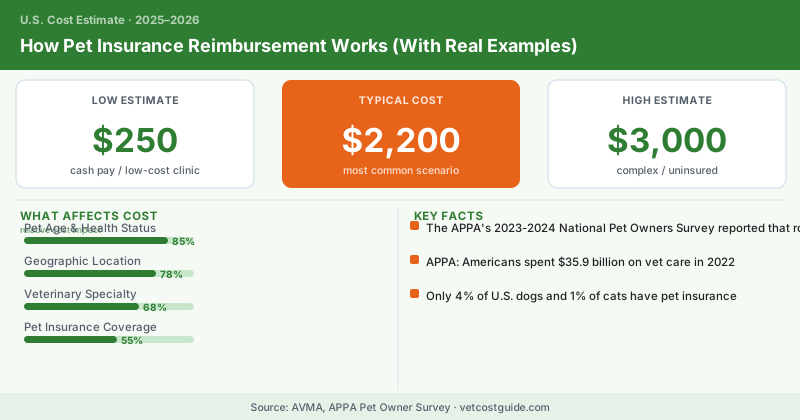
- A $3,000 claim with a $250 deductible at 80% reimbursement pays you $2,200—not $2,400.
- Direct-pay options exist at some clinics but are still rare in the US.
The Three-Step Process
Reimbursement follows the same flow at nearly every provider:
- You pay the vet. The full invoice, out of your own pocket, the day of treatment.
- You file a claim. Upload the itemized invoice through an app or website, usually within 90 to 180 days.
- You get paid back. After the insurer subtracts your deductible and applies your reimbursement rate, the balance lands in your bank account—often within 5 to 15 days.
That gap between paying and getting paid back is exactly why a CareCredit card for vet bills or a vet payment plan matters. You still need the cash up front.
The Math Nobody Explains Clearly
Here’s where owners get the numbers wrong. Your deductible comes out first, then your reimbursement percentage applies to what’s left. The order matters.
| Claim Scenario | Bill | Deductible | Reimburses | You Get Back |
|---|---|---|---|---|
| 80% plan, $250 deductible | $3,000 | $250 | 80% | $2,200 |
| 90% plan, $250 deductible | $3,000 | $250 | 90% | $2,475 |
| 70% plan, $500 deductible | $3,000 | $500 | 70% | $1,750 |
| 80% plan, deductible met | $3,000 | $0 | 80% | $2,400 |
The formula is: (Bill − Deductible) × Reimbursement % = Your Payout. On that first row, it’s ($3,000 − $250) × 0.80 = $2,200. Once your annual deductible is satisfied, it drops out entirely, which is why claims later in the policy year pay better. For a deeper look at how the deductible piece works, see our deductible guide.
Reimbursement Percentage vs. Premium
You usually pick your reimbursement rate when you sign up, and it’s a direct tradeoff. A 90% plan pays you more per claim but costs more every month. A 70% plan is cheaper monthly but leaves you covering nearly a third of every bill.
NAPHIA’s 2024 State of the Industry report found the average annual premium for an accident-and-illness dog policy was about $676 a year, or roughly $56 a month. Bumping from 70% to 90% reimbursement can add 20% to 40% to that figure. Whether that’s worth it depends on how often you expect to file—and how big the claims might be. Our is pet insurance worth it breakdown runs the cost-benefit math.
What Reimbursement Does NOT Cover
Even at 90%, several things never make it into the payout:
- Your exam fee, on some plans, is excluded—check the fine print.
- Anything over your annual limit is yours to cover.
- Pre-existing conditions are off the table entirely.
- Taxes and certain pickup fees may not count toward reimbursement.
Submit your claim with an itemized invoice, not just a receipt total. Insurers reject claims that don’t break down each line item, and a vague “balance paid $3,000” receipt is the single most common reason a clean claim gets bounced back for more paperwork.
How to Make Reimbursement Faster
Speed comes down to documentation. File through the mobile app the same day, attach a clear photo of the full itemized invoice, and include your pet’s prior records if it’s a new condition. Clinics can also email records directly to your insurer to settle questions about whether something is pre-existing.
The APPA’s 2023-2024 National Pet Owners Survey reported that roughly 66% of US households own a pet—and a growing share of those owners now file at least one claim a year. The ones who get paid back fastest are the ones who treat the itemized invoice like the receipt it is.
Bottom line: reimbursement isn’t instant, and it isn’t 100%. But on a major claim—a cancer treatment plan can run $6,000 to $15,000—getting 80% of that back is the difference between a manageable expense and a financial crisis. Just remember you’re fronting the cash first, every time.
Frequently Asked Questions
If your plan covers 80% with a $500 deductible, you'd pay the $500 deductible plus 20% of the remaining $2,500 ($500), leaving you responsible for $1,000 total—meaning you get $2,000 reimbursed, not the $2,400 many owners expect. The final reimbursement also depends on whether your vet's charge falls within your plan's benefit limit; if your plan caps orthopedic surgery at $2,500, you won't recover costs beyond that cap.
With pet insurance, you pay 100% of the vet bill upfront—there's no insurance card to hand the receptionist—and then submit a claim for reimbursement days or weeks later. Most plans reimburse 70-90% after your deductible (typically $250-$1,000), meaning you're always out of pocket initially and waiting for the insurer to send you a check.
Most insurers process claims within 5-10 business days, though some take up to 2-3 weeks depending on documentation completeness and claim complexity. To speed up reimbursement, submit your itemized vet invoice and completed claim form immediately after your pet's visit, as delays often result from missing paperwork rather than insurer backlog.