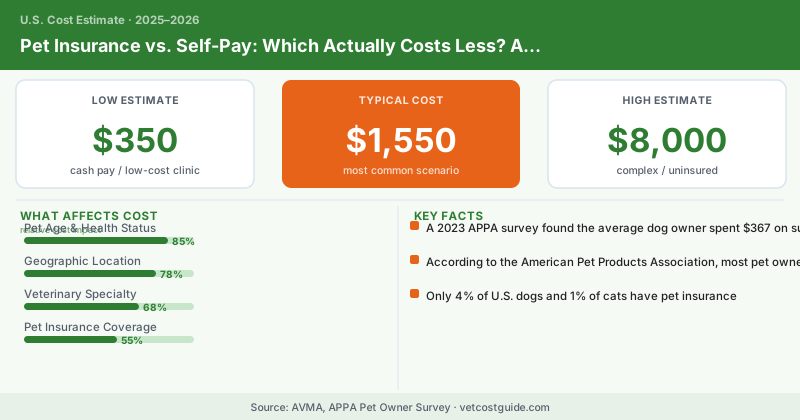
“Just put the monthly premium in a savings account.” You’ve heard that advice. It’s not wrong in theory — but it assumes your pet’s first major illness doesn’t arrive in year one, before you’ve saved enough. A 2023 APPA survey found the average dog owner spent $367 on surgical vet visits in the past year, and that’s an average across all dogs, not just sick ones. The real question isn’t “does insurance pay off mathematically?” — it’s “when does it pay off, and for which pet?” Here’s an honest comparison.
- Average accident-and-illness insurance for a dog: $40–$80/month ($480–$960/year)
- Average accident-and-illness insurance for a cat: $20–$50/month ($240–$600/year)
- Break-even point: typically 1 major illness or accident per 4–6 years
- Self-pay “savings account” works if: your pet is healthy for 5+ years AND you actually save the money
- Insurance wins when: a major claim happens in years 1–3, or the pet has a chronic condition
Head-to-Head: Insurance vs. Self-Pay for Common Scenarios
| Scenario | Vet Bill | With Insurance (80%/250 ded) | Self-Pay |
|---|---|---|---|
| ACL/TPLO surgery | $5,000 | $1,550 | $5,000 |
| Dog foreign body surgery | $3,500 | $1,050 | $3,500 |
| Cat urinary blockage | $2,500 | $750 | $2,500 |
| Dog cancer chemo (1 year) | $8,000 | $2,750 | $8,000 |
| Dog diabetes (annual ongoing) | $1,800 | $610 per year | $1,800/year |
| Cat kidney disease (annual) | $1,500 | $550 per year | $1,500/year |
| Annual wellness (vaccines, exam) | $350 | Not covered (wellness add-on) | $350 |
| Routine years (no major issues) | $350 | $350 + $720 premium = $1,070 | $350 |
The Break-Even Math (Honestly Calculated)
A $60/month premium costs $720/year. Add a $250 deductible and 80% reimbursement, and here’s the math for a $3,000 vet bill: you pay $250 deductible + 20% of $2,750 = $250 + $550 = $800. You saved $2,200 on that incident.
But in years where nothing major happens, you paid $720 for no benefit. The break-even is when your cumulative insurance savings across good and bad years equals zero. For a dog with one significant illness in year 3, that break-even typically hits in years 4–5 — and every year after year 5, the lifetime value is positive.
This math breaks down if:
- Your pet has zero major health events in 10 years (more likely in small, mixed-breed pets)
- You actually did put $720/year into a dedicated savings account earning interest
- The insurance company denies your claim (this happens; read exclusions carefully)
The math strongly favors insurance if:
- Your pet is a breed with known expensive health conditions (Labs and TPLO surgery, Persians and kidney disease, Bulldogs and respiratory issues)
- You adopt from a rescue and don’t know the health history
- You’d struggle to pay a $4,000 vet bill out of pocket without going into credit card debt
The Self-Pay Savings Account: Does It Actually Work?
In theory, if you save $60/month starting when your puppy is 8 weeks old, by year 5 you have $3,600 set aside — enough for most single incidents. The problem is behavioral, not mathematical. According to the American Pet Products Association, most pet owners don’t maintain separate pet emergency funds. When the bill arrives, it goes on a credit card at 20–25% interest, making the self-pay option far more expensive than insurance would have been.
The savings account strategy genuinely works if you’re disciplined, start early, and your pet doesn’t have a major incident in the first 2–3 years. It’s also a reasonable approach for:
- Cats with no known genetic risks in their breed background
- Small dogs (lower risk for joint and orthopedic issues)
- People with existing emergency funds of $5,000+ who can genuinely absorb a bad vet bill
Chronic Conditions: Where Insurance Wins Decisively
Here’s where the comparison isn’t even close. A dog diagnosed with diabetes requires insulin, syringes, monitoring strips, and regular vet visits — running $1,500–$2,500/year indefinitely. Dog diabetes treatment costs alone can drain a savings account in 2–3 years.
The same applies to cat kidney disease treatment, dog epilepsy treatment, and dog Addison’s disease. These conditions require lifelong management. Insurance with a chronic illness benefit — where the deductible resets annually rather than per-condition — pays off year over year. The key is enrolling before the diagnosis, since pre-existing conditions are excluded.
Never enroll in pet insurance after symptoms have appeared or after a diagnosis. Most policies define a “pre-existing condition” as any condition showing signs before the policy effective date — even if it’s not yet formally diagnosed. If your dog has been limping for two weeks and you then buy insurance and have the ACL diagnosed, the claim will be denied. Insurance works as a risk tool, not a bill-payment tool after the fact.
What Type of Policy Actually Makes Sense
Accident-only policies ($15–$30/month) cover trauma, ingestion of foreign bodies, broken bones — nothing else. They make sense for owners who want catastrophic protection but have healthy pets with no breed-specific disease risk.
Accident-and-illness policies ($40–$80/month for dogs, $20–$50 for cats) cover the full range: illness, cancer, hereditary conditions (if not pre-existing), surgeries, emergency care, chronic disease management. This is the product most people mean when they say “pet insurance.”
Wellness add-ons ($15–$30/month) cover routine care — vaccinations, annual exams, flea/tick prevention. These typically don’t “save” you money since they reimburse exactly what you paid — but they remove the budget variability of routine care.
Reimbursement structures to compare:
- Higher deductible ($500) + higher reimbursement (90%) = better for catastrophic events
- Lower deductible ($100) + lower reimbursement (70%) = better for frequent mid-size claims
- Annual deductible (resets each year) = better than per-condition deductible for single-incident pets
- Per-condition deductible = sometimes better for pets with multiple ongoing chronic conditions
The Real Answer: It Depends on These Three Things
1. Breed. Best pet insurance for dogs comparisons almost always favor insurance for purebreds with known health conditions. French Bulldogs average $9,000–$14,000 in lifetime orthopedic and respiratory vet bills. Golden Retrievers have a 60% lifetime cancer rate. These breed risks change the calculation decisively.
2. Financial cushion. If a $5,000 vet bill would put you in serious financial hardship, insurance is risk management you need. If you have $15,000 in liquid savings and zero debt, the self-pay math is more reasonable.
3. Peace of mind value. Some owners place real value on being able to say “yes” to every treatment recommendation without a financial conversation happening simultaneously. Insurance doesn’t just pay bills — it removes the worst medical decision many pet owners face: choosing between debt and a pet’s life.
Frequently Asked Questions
Does pet insurance cover pre-existing conditions? No standard policy covers pre-existing conditions. However, “curable” pre-existing conditions (like a single ear infection 3 years ago) are treated differently by different insurers — some consider them resolved and coverable after 12 months symptom-free. “Incurable” conditions (diabetes, kidney disease) are typically permanently excluded.
Is a lower monthly premium always better? Not necessarily. Very low premiums often come with annual benefit caps ($5,000–$10,000) that are exhausted quickly in serious illness scenarios. An uncapped annual benefit is significantly more valuable than a lower monthly premium when a $20,000 cancer treatment is on the table.
When is the best time to buy pet insurance? The younger the pet, the better. Lower premiums, fewer exclusions, and protection against conditions that haven’t developed yet. For a puppy or kitten, the first week of ownership is the ideal time to enroll.
Frequently Asked Questions
Emergency surgical procedures for dogs range from $1,500 to $5,000+, depending on the complexity and your location. The 2023 APPA survey found the average dog owner spent $367 on surgical vet visits annually, but this average masks the reality that a single emergency surgery can easily exceed $3,000 in urban markets.
Most pet insurance plans cover 70–90% of eligible veterinary costs after you meet your annual deductible (usually $250–$500). However, pre-existing conditions, breed-specific issues, and certain treatments are commonly excluded, meaning your actual out-of-pocket costs depend heavily on your pet's health history and your plan's fine print.
Pet insurance typically breaks even after 2–3 years if your pet requires one moderate illness or injury costing $2,000+; however, if your pet stays healthy, self-paying into a savings account saves money. The real value of insurance is protection against catastrophic costs (surgical emergencies, cancer treatment, chronic illness) that could exceed $10,000, which most pet owners cannot absorb without financial hardship.