Here’s a question that exposes how wellness add-ons really work: if a plan costs $25 a month and pays out a maximum of $300 a year in benefits, are you insuring anything—or just prepaying your vet on a payment plan? For most wellness add-ons, it’s closer to the second. That’s not necessarily bad. It’s just not insurance in the usual sense.
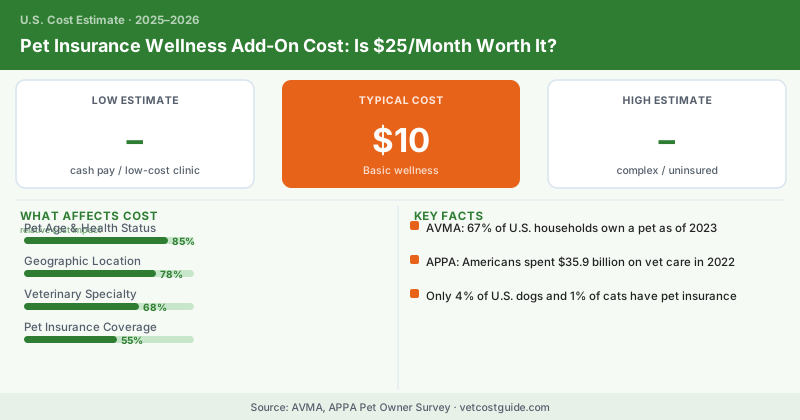
A wellness add-on (sometimes called a preventive or routine-care rider) layers onto your accident-and-illness policy and reimburses predictable costs: vaccines, annual exams, dental cleanings, flea and tick prevention, bloodwork. It runs $10 to $30 a month. The catch is that these costs aren’t surprises—so the math is different from real insurance.
- Wellness add-ons cost $10-$30/month and cover routine, predictable care—not emergencies.
- They reimburse against a fixed annual benefit schedule, often $250-$700 total per year.
- You typically get back roughly what you pay in—it’s forced budgeting, not risk transfer.
- They make sense if you struggle to save for routine care or want predictable monthly costs; less so if you’d just bank the money.
What a Wellness Add-On Actually Costs
| Tier | Monthly Cost | Annual Cost | Max Annual Benefit |
|---|---|---|---|
| Basic wellness | $10-$15 | $120-$180 | $200-$300 |
| Mid wellness | $18-$25 | $216-$300 | $350-$500 |
| Premium wellness | $26-$30 | $312-$360 | $500-$700 |
| Dental add-on (some plans) | $5-$12 | $60-$144 | $100-$300 |
Look at the right two columns together. A mid-tier plan costs you $216-$300 a year and caps out at $350-$500 in benefits. To come out ahead, you have to actually use most of those benefits—every vaccine, exam, and cleaning the schedule allows. Miss a few and you’ve overpaid. This is the opposite of catastrophic accident-and-illness coverage, where you hope to never collect.
Why It’s Budgeting, Not Insurance
Real insurance transfers risk: you pay a small premium to protect against a rare, huge loss. Routine care isn’t rare or huge—it’s scheduled and predictable. So a wellness add-on can’t transfer risk that isn’t there. What it does is spread a known annual cost across 12 monthly payments, with the insurer taking a cut for the convenience.
That cut is the key number. If you’d pay $400 a year for routine care and the add-on costs $300 but reimburses $400, you’re modestly ahead. If it costs $300 and you only use $250 of benefits, you’ve lost money. The APPA’s 2023-2024 survey shows US owners spend significant predictable sums on routine care annually, so the potential benefit is real—but only if you fully use it.
Who Should Buy the Wellness Add-On
Wellness benefits usually expire annually and don’t roll over—use them or lose them. They also often require you to pay the vet first and submit for reimbursement, just like a regular claim. If you won’t reliably file for every $30 vaccine, the add-on quietly loses money for you.
The add-on genuinely helps if:
- You struggle to save and would otherwise skip preventive care to save cash.
- You want a single predictable monthly pet bill instead of lumpy annual vet charges.
- You have a puppy or kitten with a packed first-year schedule of vaccines and visits—that’s the year the benefit is most likely to pay out fully.
It’s a weaker buy if you’re disciplined enough to set aside $30 a month yourself, since you’d keep the insurer’s margin and the flexibility.
The Smarter Money Move for Most Owners
For a lot of owners, the better play is to skip the wellness rider and self-fund routine care from a small dedicated account—then put the dollars you’d save toward a higher annual limit on the part that actually matters, the accident-and-illness coverage. That’s where the genuinely scary bills live: a dog emergency vet visit at $1,500-$6,000 or a cancer treatment course at $6,000-$15,000.
NAPHIA’s 2024 report shows accident-and-illness plans dominate the US market precisely because that’s where insurance does its real work—covering the unpredictable. Routine care is predictable by definition, so it rarely needs insuring.
That said, if the add-on is the nudge that gets your pet its dental cleaning and annual exam—care that prevents bigger problems down the road—the modest cost can be worth it for the behavior change alone. Just go in knowing what it is: a convenient way to prepay routine vet visit costs, not a shield against catastrophe. Decide which problem you’re actually solving, and buy accordingly.
Frequently Asked Questions
Pet wellness add-ons typically range from $10 to $30 per month, depending on your pet's age, species, and the insurance provider. Most plans cap annual wellness benefits between $200 and $500, which means you'll likely receive back roughly what you pay in premiums over a year.
Wellness add-ons cover preventive care including annual exams, vaccinations, dental cleanings, and sometimes flea/tick prevention or microchipping. These riders are not traditional insurance—they function more like a prepayment plan since payouts are capped and typically match or slightly exceed what you pay monthly.
If your pet needs regular preventive services (annual exams costing $50–$100, vaccines at $15–$50 each, and dental cleanings at $150–$300), a $25/month add-on may break even or save you modestly. However, if your pet is young and healthy with minimal preventive needs, paying out of pocket is often cheaper than paying $300 annually for capped benefits.